
Most advice about the best guest posting sites starts with domain authority and ends with a submission link. That's an incomplete way to choose where to spend your writing time. A respected publication can still be the wrong destination if its editors reject commercial angles, restrict company links to an author bio, or require human-written submissions.
The bigger problem is confusing access with quality. An analysis summarized by Market Intelligence Tools examined approximately 257,267 sites listed in guest-posting marketplaces and classified 96.2% as low quality. That finding applies to the marketplace sites examined, not every publication accepting contributors, but it's a good reason to scrutinize individual destinations.
Written guidelines matter more than an authority score when deciding whether to pitch. They tell you what editors want, what they refuse, and whether your intended outcome is compatible with their rules.
The selections below include a publisher marketplace and ten editorial publications. They serve different purposes: some help you find placements, while others offer selective access to business, developer, or startup audiences.
A publication that permits a company link isn't promising a followed backlink, permanent placement, or acceptance of your preferred anchor text.
Use the distinctions to choose a relevant outlet before drafting. Where payment terms, AI rules, or response deadlines aren't established, treat them as questions to resolve, not permission to assume.
Table of Contents
- 1. Outrank
- 2. HubSpot Blog
- 3. Zapier Blog
- 4. MarketingProfs
- 5. VentureBeat / DataDecisionMakers
- 6. SitePoint
- 7. SaaS Mag
- 8. Startup Stash
- 9. 1stepGrow
- 10. Startup Boston
- 11. Fast Company Work Life
- How the 10 Guest Posting Sites Compare on Niche, Submission, Links, and Pay
- Pitch the Fit, Not the Link Count
1. Outrank
Outrank is the operational choice, not a single editorial destination. Its publisher marketplace belongs on this list because finding potential publishers and managing content production are different problems from pitching an individual magazine.
The broader platform combines AI-assisted keyword research, article creation, branded images, content customization, and publishing integrations. For a founder managing a company blog alongside outside contributions, that combination can reduce the handoffs between planning, drafting, and publishing.
Its publishing connections include WordPress, Webflow, and Notion. Collaboration, rewrites, and API integrations are also relevant when an agency or product team needs a coordinated production workflow rather than another spreadsheet of prospects.
Where the workflow needs editorial control
Outrank's AI capabilities create an important trade-off: a draft you can generate isn't necessarily a draft a publisher will accept. An outlet requiring human-written work may reject AI-generated copy regardless of how carefully you revise it.
Before choosing a placement, establish:
- Commercial terms: What are you paying for, and what happens if the publisher declines?
- Link treatment: Where can the link appear, who selects the anchor, and how will a paid placement be labeled?
- Content rules: Does the individual publisher permit AI assistance, require disclosure, or insist on an independently written submission?
- Timing: Is the stated schedule an editorial estimate or a contractual delivery commitment?
I'd consider Outrank when content operations are the bottleneck and the team can still review each publisher independently. It's less suitable if you expect marketplace access to substitute for editorial relationships or guarantee that generated articles satisfy another publication's standards.
2. HubSpot Blog
HubSpot suits contributors who can explain a business decision, experiment, or process in enough detail for another marketer to use it. Its subject areas include marketing, sales, service, and websites, so a founder's operational expertise can fit without turning the article into a launch announcement.
The HubSpot guest-blogging guidelines emphasize original contributions, practical insight, sourcing, and limits on self-promotion. They allow a restricted company-site mention subject to editorial review, not an open invitation to distribute commercial links.
The exclusivity trade-off
Accepted work must remain exclusive to HubSpot. That makes this a poor destination for an article you also intend to publish on your company blog or distribute through another contributor program.
Editors may adapt accepted material for accuracy, search relevance, and completeness. Submit only if you're comfortable with editorial changes, including changes that weaken your preferred promotional framing.
- Best fit: An original explanation of a marketing or customer-facing process, supported by firsthand evidence.
- Poor fit: Product-led copy with generic advice wrapped around a landing-page link.
- Resolve before drafting: Current AI-use requirements, contributor-payment terms, and submission availability.
I'd prioritize HubSpot when the lesson remains useful after removing your product name. If removing the company mention collapses the article's purpose, revise the concept before pitching.
3. Zapier Blog
A detailed explanation of how you automated customer onboarding is a better Zapier candidate than a roundup of automation products. The difference is central to its contributor program: practical experience fits; app-comparison and best-apps guest listicles don't.
The Zapier Blog guidelines cover workflows, productivity, business growth, automation, and related topics. Contributors submit through a pitch process, and accepted work can include an author profile and business blurb.
For founders, the strongest material explains decisions and exceptions. Describe what triggered the workflow, where information moved, which steps required human review, and what you'd change rather than naming the apps involved.
Submission filter: Zapier requires original, unpublished, human-written content. Don't treat an AI-generated draft as eligible merely because you've edited its wording.
The editorial process and submission volume also make Zapier unsuitable for a launch campaign that depends on a fixed publication date. Pitch the lesson independently of your launch calendar.
Payment and exact commercial-link treatment should be confirmed before committing substantial writing time. An author business blurb offers context, but it isn't the same as permission to place product links throughout the article.
Choose Zapier for workflow expertise, especially when your contribution helps readers reproduce a process without buying your product.
4. MarketingProfs
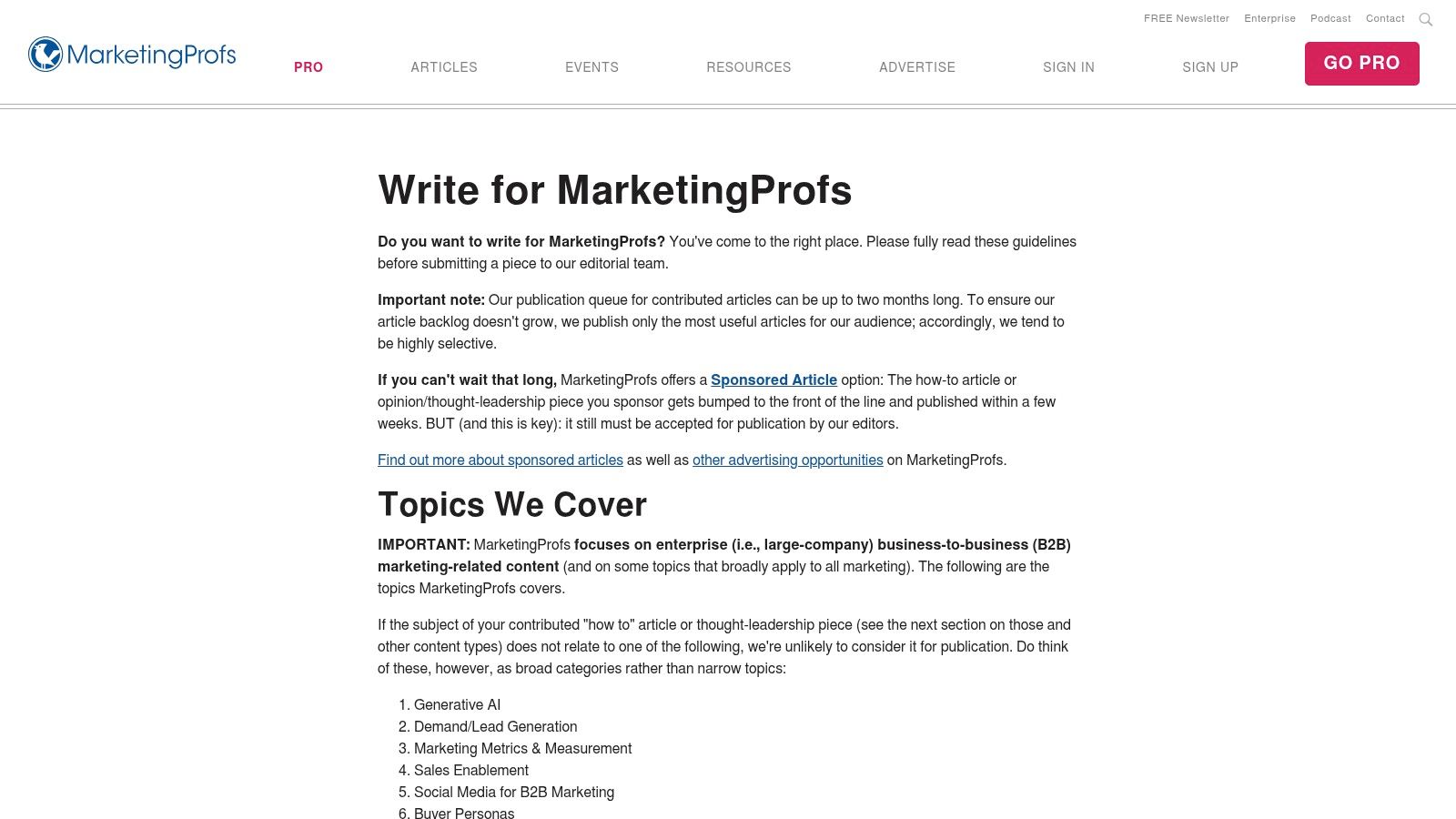
MarketingProfs is a strong fit for focused marketing instruction, but not for deadline-dependent launch publicity. Its contributor process favors substantive how-to articles rather than broad founder narratives.
The MarketingProfs submission guidelines call for original, unpublished material, an author bio, a headshot, and disclosure of relevant business interests. Contributions are unpaid, and editorial acceptance doesn't mean immediate publication.
Useful rights, uncertain scheduling
A meaningful advantage is that contributors retain copyright and may republish later under the publication's attribution requirements. That offers more reuse flexibility than an outlet requiring permanent exclusivity, although you should check the current terms before scheduling republication.
The editorial team may revise submissions for clarity and house style. Unsuccessful submissions may not receive a response, so don't make an unanswered article the dependency holding up your entire content calendar.
- Pitch: A specific method for improving segmentation, campaign measurement, customer research, or another marketing task.
- Avoid: A service description presented as educational advice.
- Confirm: Current AI-content rules and whether any proposed company resource qualifies as a useful citation.
I'd choose MarketingProfs for an evergreen contribution that can withstand a long editorial lead time. Keep the article's instructional value separate from any commercial benefit you hope to receive.
5. VentureBeat / DataDecisionMakers
An enterprise AI article needs more than an enthusiastic prediction. VentureBeat's DataDecisionMakers is better suited to technical judgment, including implementation constraints, infrastructure decisions, analytics, security, and machine-learning practice.
The VentureBeat guest-post guidelines favor complete, evidence-backed contributions submitted through the designated process with an editable document. They also address sourcing and image licensing, which matter when your argument depends on architecture diagrams, screenshots, or external findings.
Keep promotion in its proper place
The guidelines permit a company or website reference in the author bio while discouraging unnecessary company links in the article body. Product promotion and material flagged as AI-written may be rejected.
That's a direct conflict with a campaign whose main requirement is a contextual landing-page backlink. An excellent technical article can still be the wrong investment if your team won't accept bio-level attribution.
- Strong angle: Explain a technical trade-off and the conditions under which different approaches make sense.
- Weak angle: Announce your AI product and generalize its features into industry advice.
- Planning question: Confirm current response expectations and contributor terms before tying the submission to a launch.
For broader publicity planning, Aura++’s guide to getting startup press coverage without a PR agency can help distinguish an editorial contribution from a news pitch. Use VentureBeat for the former when you have genuine technical substance.
6. SitePoint
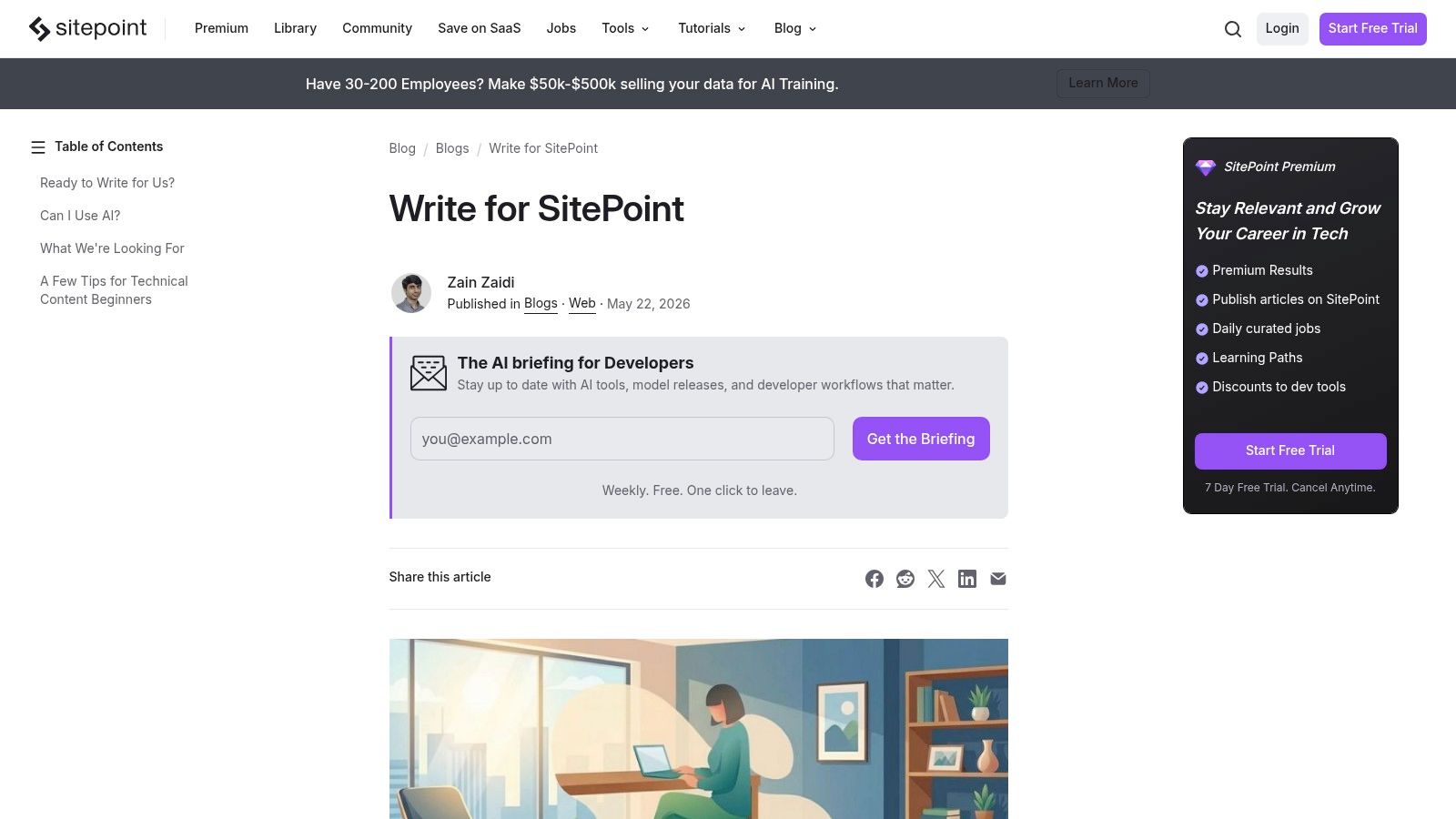
SitePoint is a developer publication, so your article should help someone build, debug, design, or evaluate something. A tested tutorial on a React implementation has a clearer audience fit than a general account of your startup launch.
The SitePoint write-for-us page describes educational tutorials, case studies, opinions, and best practices across programming, design, AI, developer tools, and no-code topics. Its guest-submission route requires paid Premium membership.
That distinction deserves attention. You're paying for access to a submission route, not purchasing unconditional editorial approval or a guaranteed SEO outcome.
Budget for technical review
SitePoint explains rejection reasons and allows revision and resubmission. Content that relies too heavily on generative AI may be rejected, so technical accuracy alone isn't the only consideration.
Before submitting:
- Test the example: Run the code in a clean environment and document dependencies.
- Show the limitations: Include failure cases, security considerations, or alternatives where relevant.
- Check commercial permissions: Confirm how product references and external links will be handled.
- Separate costs: Don't confuse membership fees with contributor compensation.
I'd recommend SitePoint to developer-founders who can teach beyond their own tool. If the tutorial only works as a sales demonstration, move the product-specific material to your documentation and pitch a more transferable lesson.
7. SaaS Mag
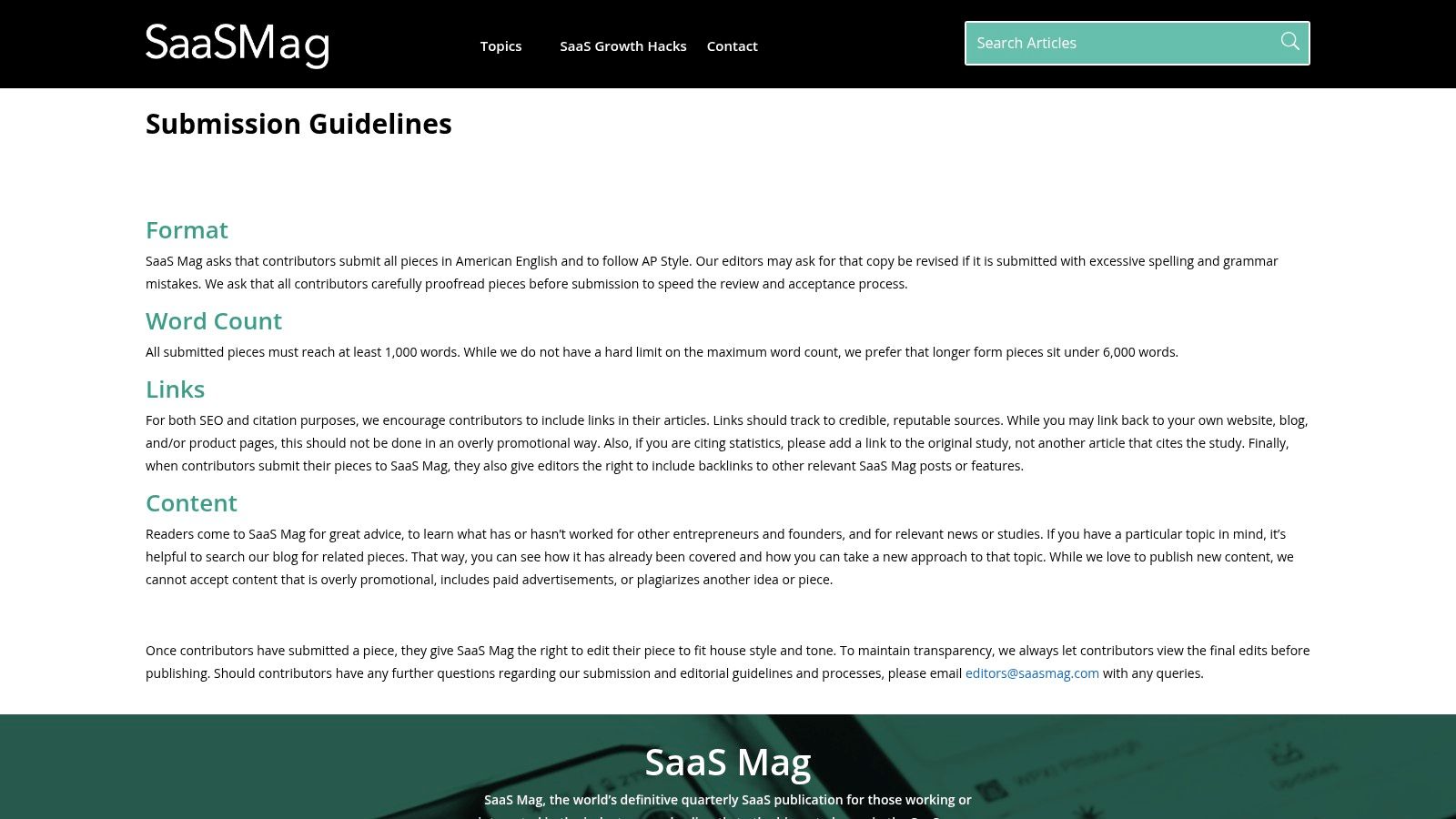
SaaS Mag offers a particularly relevant audience for SaaS business and technical expertise. Founder lessons, industry analysis, and original research fit better than a generic growth article with SaaS terminology added.
Its submission guidelines encourage substantive work and credible source links. They also allow a relevant author-site or product-page reference when it isn't overly promotional.
That flexibility makes SaaS Mag worth considering when your own resource helps explain the topic. It doesn't establish unrestricted anchor-text control or a promise that a commercial link will survive editing.
Editorial review is a practical advantage
Contributors can review the edited version before publication. For technical founders, that opportunity helps catch revisions that accidentally change the meaning of an implementation detail or business claim.
- Best fit: A researched explanation of a SaaS operating problem, technical decision, or founder lesson.
- Hard limit: Overly promotional articles and paid advertisements aren't accepted as editorial contributions.
- Unresolved terms: The guidelines described don't establish a response deadline, contributor fee, or explicit AI policy.
I'd pitch a topic with enough substance to justify the research effort, not expand a short announcement to meet the publication's long-form expectations. Disclose your commercial interests and make every product reference earn its place through reader usefulness.
8. Startup Stash
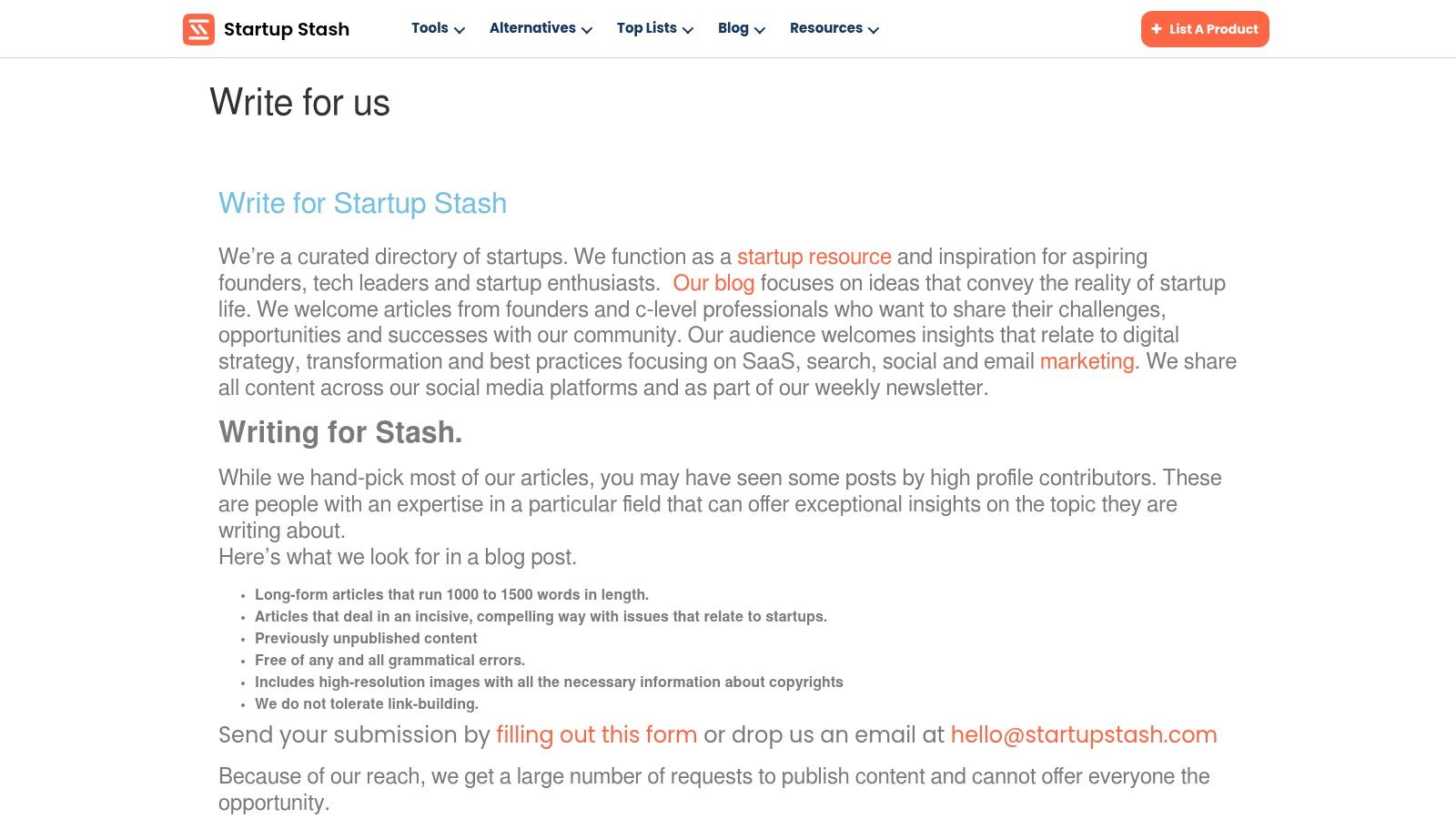
Startup Stash creates a clear stop sign for backlink-first outreach: it explicitly rejects link-building submissions. Founders can still contribute, but the article needs a purpose beyond placing a URL.
The Startup Stash contributor guidelines welcome original, actionable perspectives for founders, technology leaders, and startup readers. Topics include SaaS, digital strategy, search, social media, and email marketing.
Its stated distribution includes social channels and its newsletter. That makes audience relevance a more sensible reason to pitch than assumptions about ranking credit.
If your outreach email leads with link requirements, you're asking Startup Stash for something its rules explicitly discourage.
A suitable contribution might explain how to design a customer-feedback process or prioritize acquisition experiments. It should teach a founder something useful without requiring the reader to visit your website.
The publication doesn't establish a response window or contributor payment in the described rules. Confirm current AI expectations as well, rather than interpreting an unstated policy as approval.
If your immediate need is a place to list a new product, use a different channel. Aura++’s guide to startup directories to consider after launch addresses that task more directly than trying to turn an editorial pitch into a listing request.
9. 1stepGrow
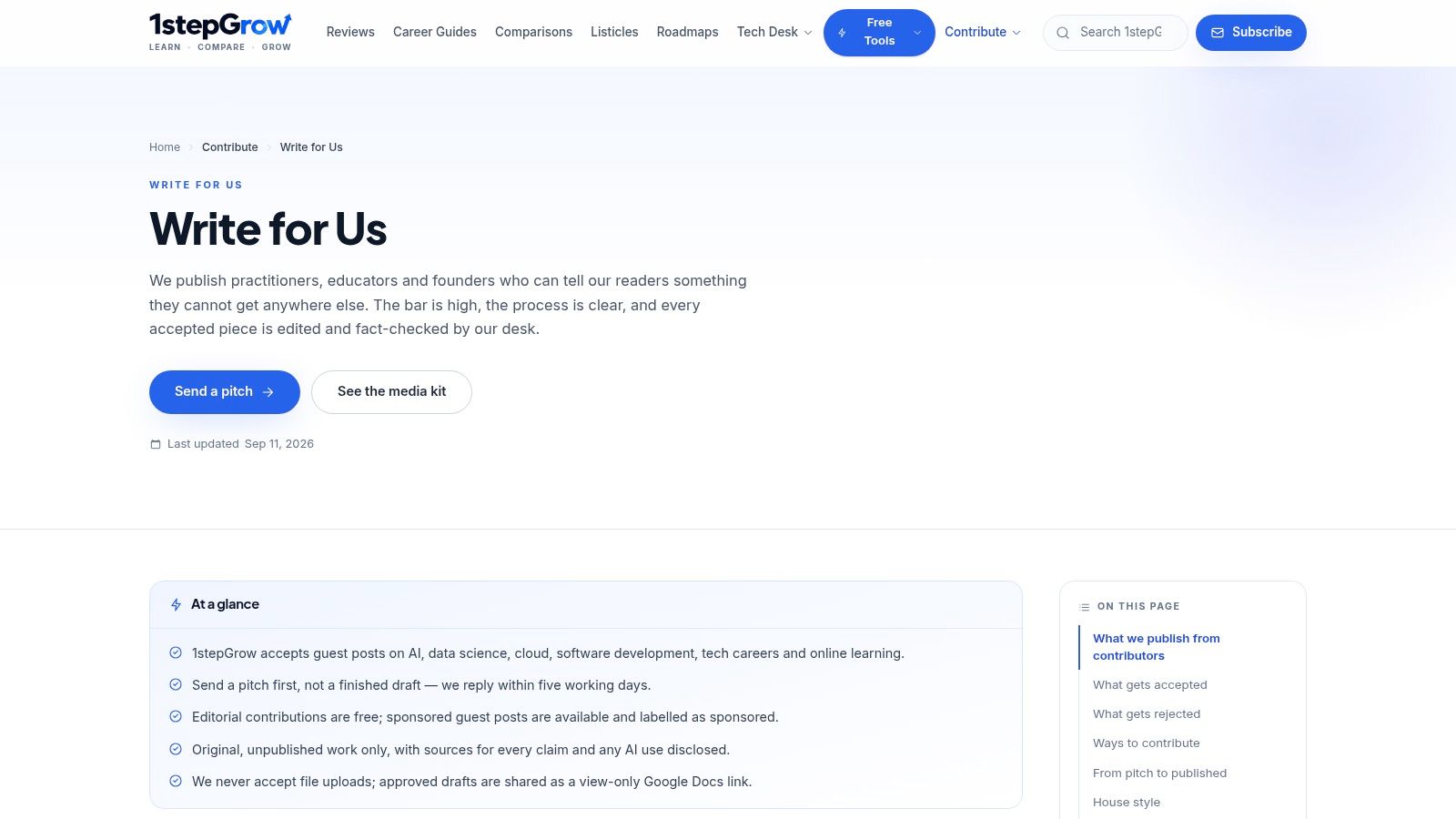
Pitch first at 1stepGrow. Its process asks contributors to establish the idea before delivering a full draft, which can save substantial writing effort when the subject or commercial angle doesn't fit.
The 1stepGrow contributor guidelines cover AI, data science, cloud, software development, technology careers, and online learning. They distinguish free editorial contributions from paid sponsored posts, with sponsored material labeled accordingly.
A clearer commercial distinction
Free editorial contributions can include author attribution and a relevant contextual reference, but a product or landing-page link isn't guaranteed. Editors still decide whether the destination helps readers.
The publication requires original work, evidence, and disclosure of AI use. That's different from an outright ban on every form of AI assistance, but disclosure doesn't remove your responsibility for accuracy or originality.
- Editorial route: Lead with a useful technical idea and explain your qualifications.
- Sponsored route: Establish pricing, labeling, deliverables, and link treatment before commissioning the draft.
- Workflow: Use the stated pitch-response and publication expectations for planning, not as unconditional guarantees.
I'd shortlist 1stepGrow when transparent process matters more than publication prestige. Its distinction between editorial and sponsored content is useful, provided you don't assume the free route entitles you to commercial placement or the paid route entitles you to ranking credit.
10. Startup Boston
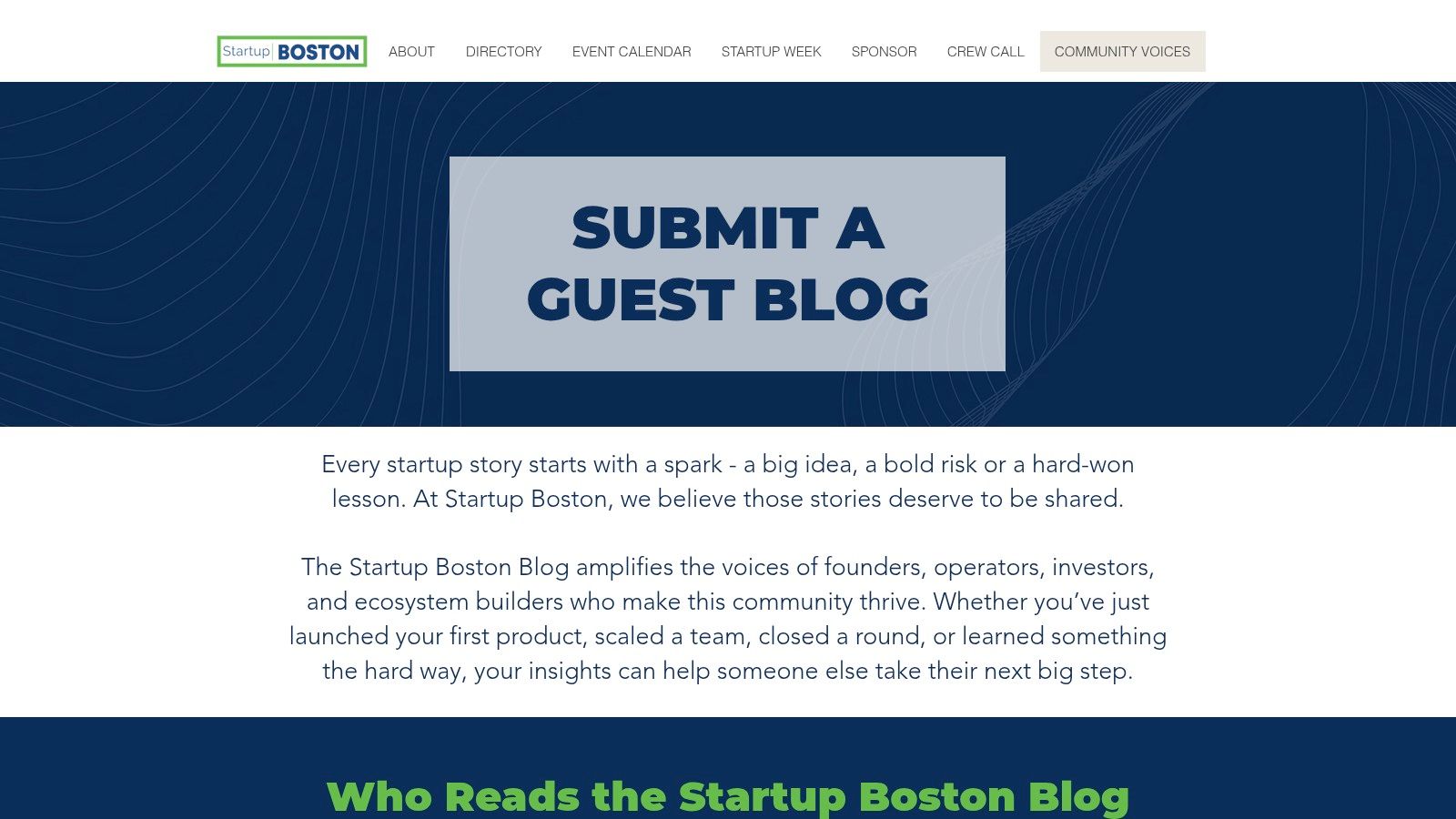
A founder's connection to the audience matters especially at Startup Boston. Its focus on the New England startup ecosystem makes regional relevance a meaningful selection criterion, not a detail to hide beneath an authority metric.
The Startup Boston guest-blog submission page welcomes original contributions from founders, operators, investors, and ecosystem builders. Topics include founder stories, product and growth, fundraising, team building, and technology.
A transferable lesson can fit, particularly when it helps local founders make a concrete decision. A generic product announcement without community relevance is a weaker proposition.
A limited business reference
The guidelines permit a restricted company or personal-website link and allow light editing for tone, clarity, and formatting. Treat that link as author context, not permission for repeated commercial references.
- Strong fit: A founder lesson with practical implications for the community.
- Limitation: Regional relevance may be weaker for teams without a meaningful ecosystem connection.
- Confirm first: Pricing, contributor compensation, AI rules, and response expectations aren't established in the described terms.
Submissions receive rolling review, and publication isn't guaranteed. I'd choose Startup Boston when reaching a relevant founder community is itself valuable, even without a predictable publication date or a particular backlink attribute.
11. Fast Company Work Life
Fast Company Work Life is an opinion opportunity, not a product-placement opportunity. Its interests include entrepreneurship, productivity, creativity, careers, hiring, work culture, and innovation.
The Fast Company contributed-article guidelines request complete, unpublished articles rather than pitches or outlines. The page is older, so verify that its submission route and terms remain current before preparing a draft.
That creates a different effort profile from a pitch-first outlet. You may need to develop the full argument without knowing whether an editor wants it.
The argument must stand independently
Contributions should have a clear point of view and shouldn't read like company PR or content marketing. Contributors are unpaid, accepted work is edited, and republication is subject to exclusivity terms.
A founder might argue for changing a hiring practice or challenge a productivity habit, using professional experience to explain the reasoning. A feature-by-feature description of the founder's software won't serve the same purpose.
- Choose it for: A distinctive, professionally relevant argument.
- Don't expect: A response to every submission or control over commercial references.
- Verify separately: Current AI-content policy, link permissions, and republication conditions.
I'd reserve this option for an argument worth writing even without acceptance. Don't spend the effort solely to pursue a company backlink.
How the 10 Guest Posting Sites Compare on Niche, Submission, Links, and Pay
| Item | Core Audience | Submission Route | Link Policy | Contributor Payment |
|---|---|---|---|---|
| Outrank | Businesses and professionals seeking SEO content tools | Publisher marketplace; specific submission process unspecified | Link terms unspecified | Not specified |
| HubSpot Blog | Business audiences across marketing, sales, service, and websites | Editorial review; exact route unspecified | One company-site link, subject to review | Not specified |
| Zapier Blog | Readers interested in apps, automation, business growth, and productivity | Pitch form and editorial review | Byline and business blurb; article link terms unspecified | Not specified |
| MarketingProfs | Marketing professionals | Submit an original, unpublished article with author materials | Republish later with attribution and a link to the original | Unpaid |
| VentureBeat / DataDecisionMakers | Enterprise technology, AI, data, analytics, and security readers | Online form and editable Google Doc | Company or website link allowed in author bio; body links discouraged | Not specified |
| SitePoint | Web developers and designers | Submit through paid Premium membership | Link terms unspecified | Not specified |
| SaaS Mag | SaaS founders, product teams, and technical readers | Submit an article of at least 1,000 words | Relevant author-site or product-page link allowed if not overly promotional | Not specified |
| Startup Stash | Startup founders, tech leaders, and startup enthusiasts | Form or email | Rejects link-building submissions; other link terms unspecified | Not specified |
| 1stepGrow | Readers interested in AI and technology | Pitch first, then submit a full draft if accepted | One relevant contextual link may be included; not guaranteed | Free editorial contributions; sponsored-post pricing unspecified |
| Startup Boston | Founders and startup community, especially in New England | Submit an original, unpublished article | One company or personal website link allowed | Not specified |
| Fast Company, Work Life | Professionals interested in entrepreneurship, work, and innovation | Submit a complete, unpublished article | Link terms unspecified | Unpaid |
Pitch the Fit, Not the Link Count
The best guest posting sites aren't interchangeable inventory. A developer tutorial, an enterprise AI analysis, and a founder opinion piece require different evidence, different writing, and different expectations about promotion.
The central distinction is editorial contribution versus purchased exposure. Google's spam policies identify paid guest posts that pass ranking credit and optimized anchor text in distributed guest posts as link-spam concerns; paid links should be qualified with rel="sponsored" or rel="nofollow".
That means a placement can offer legitimate advertising or referral value without being an appropriate way to purchase ranking credit. It also means that a relevant publication with strict editing can be a better choice than a higher-metric site offering unrestricted commercial anchors.
Check the rules before writing
Build a short opportunity record for each destination. Record the actual terms rather than relying on a directory's summary or an outreach seller's assurance.
- Audience and angle: Identify the reader's problem and the expertise you can contribute.
- Payment: Separate submission fees, membership costs, sponsored-placement charges, and contributor compensation.
- Links: Confirm permitted destinations, placement, editorial control, and sponsorship attributes.
- AI use: Distinguish human-written requirements from assistance policies and disclosure obligations.
- Rights and timing: Record exclusivity, republication terms, response expectations, and whether the outlet wants a pitch or complete draft.
When a policy is silent, ask a precise question. Don't assume that permission to include a website means permission to choose an exact-match anchor, and don't assume that paying for access guarantees publication.
Measure the outcome you actually wanted
For an expertise-led contribution, track qualified referral visits, relevant inquiries, newsletter subscriptions, and conversations with potential customers. Check that the published article preserves your argument and that its links still lead to useful destinations.
Keep launch distribution separate from editorial acceptance. A publication shouldn't need to accommodate your launch date, repeat your positioning, or preserve a sales link for the contribution to be worthwhile.
For product visibility, Aura++ offers scheduled launches, structured project pages, community voting, and launch assets designed to support discovery beyond launch day. Use that kind of product-focused destination alongside guest contributions, not as a reason to make those contributions more promotional.
Choose the publication whose readers you can help most, check its current rules, and prepare a focused submission around a specific lesson. If you're launching a product, create its Aura++ project page separately, then let the guest article demonstrate your expertise on its own terms.