Buying Twitter followers violates X rules, can trigger account action, and wrecks your metrics. The question isn't whether the shortcut is available, it's how to build reach without poisoning your data.
Most advice on this topic gets stuck on vanity. Bigger numbers look impressive for a day, but they don't create intent, trust, or distribution, and that's why follower-buying so often backfires for brands that need clean reporting and durable growth.
Table of Contents
- Why Buying Twitter Followers Rarely Pays Off
- How the Follower Market Actually Works
- The Three Faces of a Purchased Audience
- Platform Rules and Detection Signals You Should Know
- How TweetBoost Can Help
- The Hidden Cost of Inflated Metrics
- Red Flags When Evaluating Any Growth Offer
- Durable Alternatives That Compound Reach
- A 90-Day Plan for Real Audience Growth
Why Buying Twitter Followers Rarely Pays Off
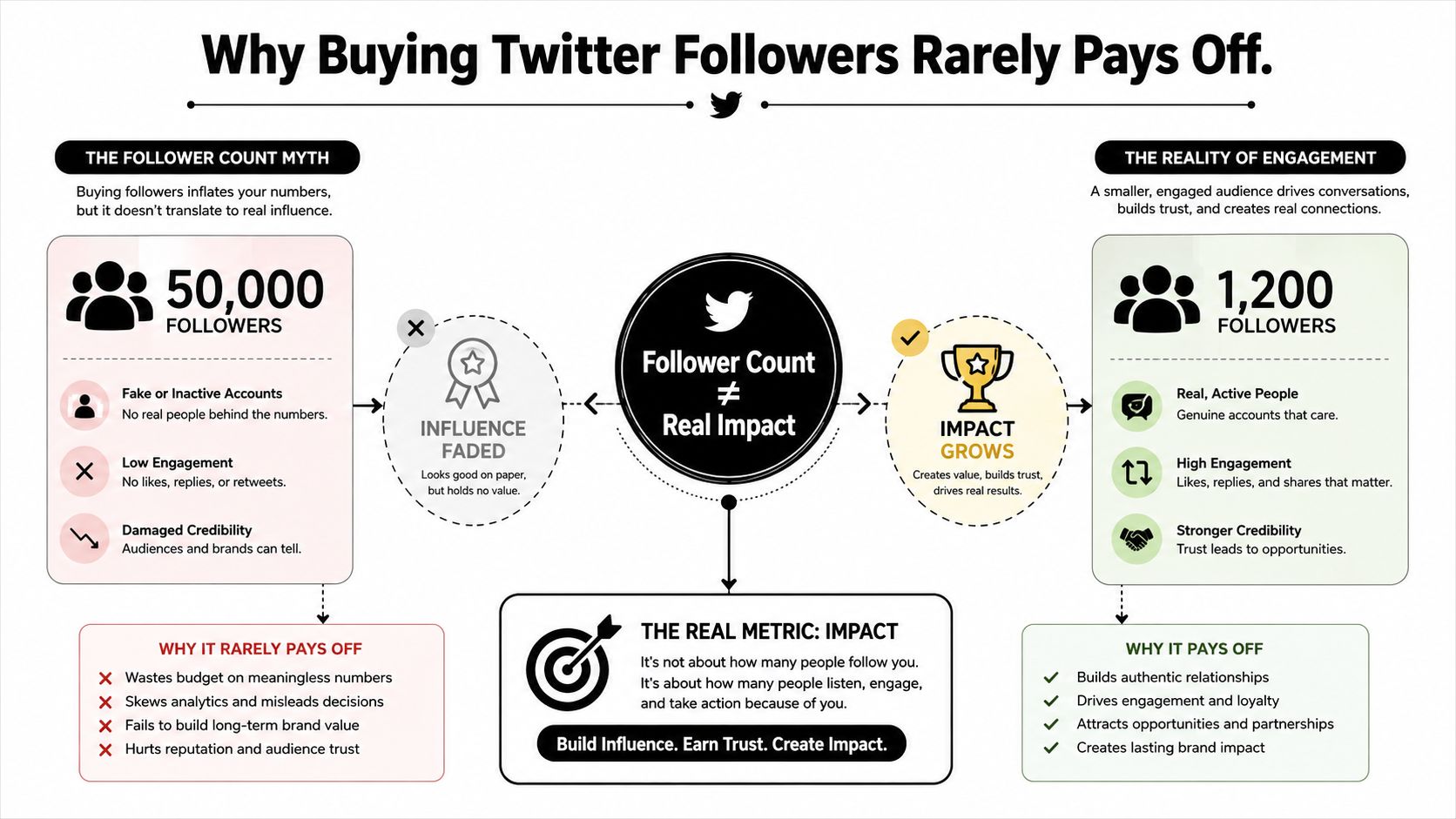
A large follower count doesn't equal influence. It only means you have a larger denominator, and if those followers don't care, don't click, and don't reply, every metric you use to judge performance starts lying to you.
That's the core problem with buy Twitter followers campaigns. They don't just add empty accounts, they corrupt the baseline your team uses to decide what's working. When follower authenticity becomes measurable through audit tools like TwitterAudit and SparkToro's Fake Followers Audit, the old excuse of “nobody will notice” stops holding up TwitterAudit.
The launch-day trap
A growth lead can see this fail in one clean scenario. A brand buys 10,000 followers before a product launch, posts a strong thread, and the engagement ratio falls flat because the denominator jumped overnight while the numerator barely moved.
That matters because teams use follower count to size audiences, set expectations, and compare campaigns. If the audience is inflated, a good post can look weak, and a weak post can look acceptable. Either way, the signal is gone.
Practical rule: If the audience didn't arrive with intent, it can't be treated like demand.
The historical reason this market matters is simple. The Devumi case showed that follower inflation could be bought cheaply and at scale, with reporting showing orders of up to 250,000 followers and prices starting at $12, which made manufactured social proof look less like a stunt and more like a commodity BBC.
That's why the safer framing is wrong. The key issue isn't just whether the platform might punish you, it's whether the purchase destroys the quality of the data you'll rely on for the next launch, the next campaign, and the next partnership pitch.
How the Follower Market Actually Works
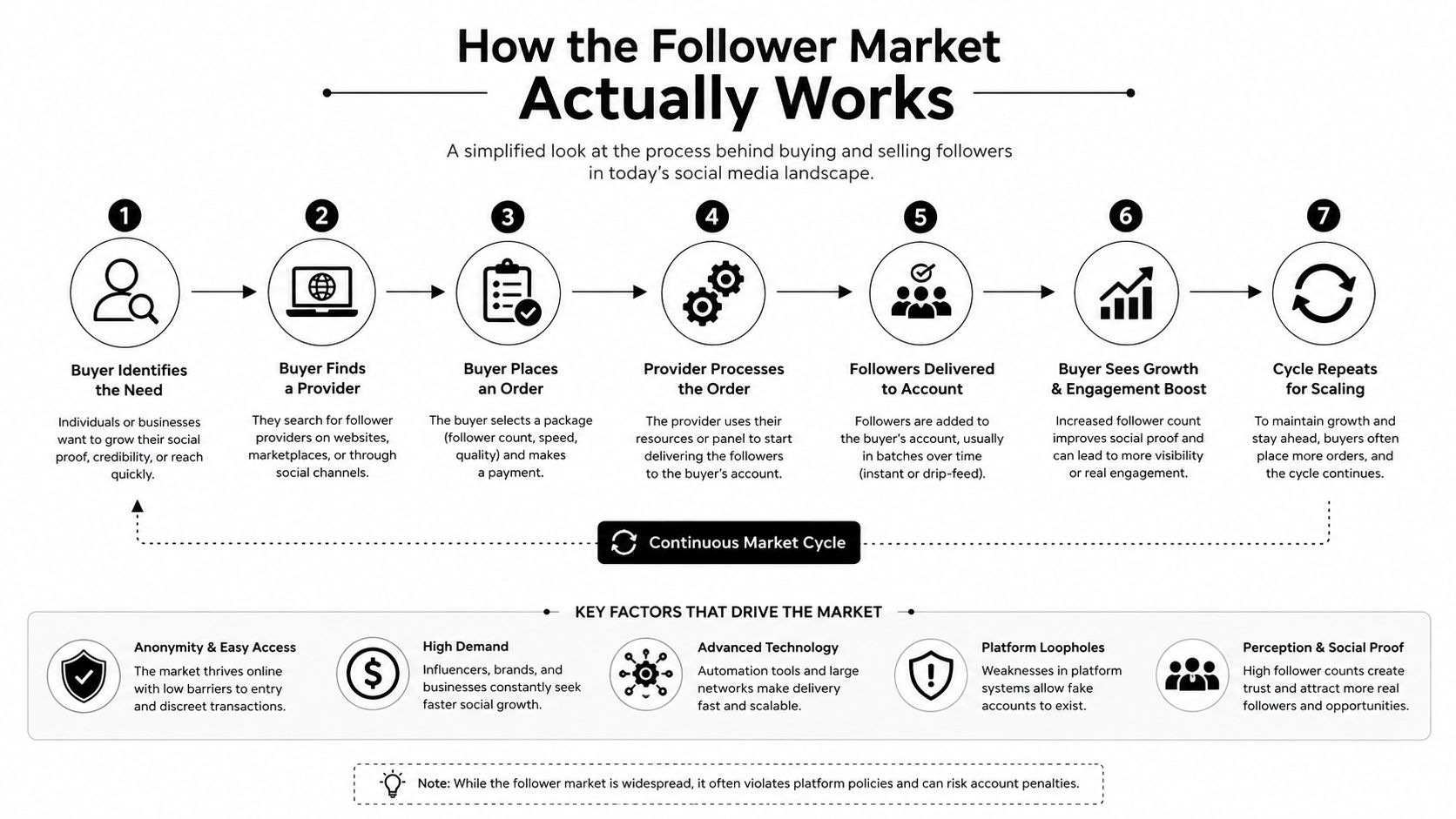
The follower market is built to feel ordinary. A buyer sees tidy packages, a checkout button, and delivery promises, but behind that polish is a resale chain that usually has little control over where the accounts came from or how long they'll last.
What the storefront layer sells
Most sellers package followers in obvious tiers, the same way a media buy is sold in slabs. You'll see low-friction offers for a few thousand accounts, bigger bundles for accounts trying to cross a milestone, and “premium” options that claim to look more real or more region-specific.
The product page is doing the persuasion, not the delivery system. It sells speed, volume, and reassurance, but those three things usually pull in different directions. Faster delivery tends to look more synthetic, and cheaper inventory usually means less reliable account quality.
How delivery is disguised
Vendors rarely dump everything at once if they want to stay alive long enough to collect more orders. They drip-feed followers over hours or days so the profile doesn't spike in a way that looks obviously manufactured.
Some services also customize profile details, like bios, avatars, or tweet history, to make the accounts look less disposable. Refill guarantees then act like a safety blanket, but they're really a sign that drops are expected and baked into the business model.
The packaging changes, but the core logic stays the same. The seller is trying to make an inauthentic inventory look like natural audience growth.
Where the inventory comes from
The supply side is the part buyers should care about most. Research cited in the verified data shows purchased-follower ecosystems can be measured and trained against, with one study manually verifying 13,000 purchased fake followers and 5,386 genuine followers for classifier training, another identifying anomalous follower groups, and a separate analysis tracking 63,358 fake accounts available for purchase Mendeley.
That means the market isn't just a random pile of isolated accounts. It often behaves like a coordinated network, which is exactly why it creates downstream risk for the buyer. If you understand the plumbing, the rest of the trade-offs become easier to evaluate.
The Three Faces of a Purchased Audience
Bought followers don't usually arrive as one uniform mass. They tend to fall into a few recognizable types, and each one leaves different traces behind.
Bots, dormant accounts, and fake real-looking profiles
The easiest accounts to spot are the obvious bots. They often have no avatar, no bio, no original posts, and weird follower-to-following patterns that make them easy to filter out in an audit. If a profile has a huge following ratio and nothing else to show for it, you're looking at a shell, not a person.
Recycled or dormant accounts are trickier because they can look old enough to pass a quick glance. They may have ancient signup dates, thin tweet history, and then a strange burst of activity or following behavior that doesn't match how a real person uses X. Those sudden shifts matter more than the age of the profile.
The hardest type is the fake account built to look alive. These often use polished profile photos, scraped bios, and templated tweet histories, which makes them feel legitimate until you inspect behavior. Real reach shows up in replies, link clicks, and consistent attention. Fake reach doesn't.
| Archetype | Profile Signals | Engagement Behavior | Easiest Detection Method |
|---|---|---|---|
| Bots | No avatar, no bio, little or no post history | No replies, no clicks, no meaningful activity | Audit the follower-to-tweet pattern and creation clustering |
| Dormant or recycled accounts | Old signup dates, thin tweet history, reactivated profiles | Uneven bursts of following, little original content | Check profile edits and sudden growth spikes |
| Fake real-looking accounts | AI-style photos, scraped bios, templated timelines | Surface-level presence, weak behavioral engagement | Compare reply patterns, click behavior, and timezone consistency |
What actually gives them away
The single biggest tell is inconsistency. An account can look normal in isolation, but it starts to break down when you compare it to the rest of the audience. A brand that bought followers usually gets a mix, not a clean one-size-fits-all audience.
That's why audit tools matter. They don't need perfection to be useful, they just need enough signal to show that the audience isn't what it claims to be.
Platform Rules and Detection Signals You Should Know
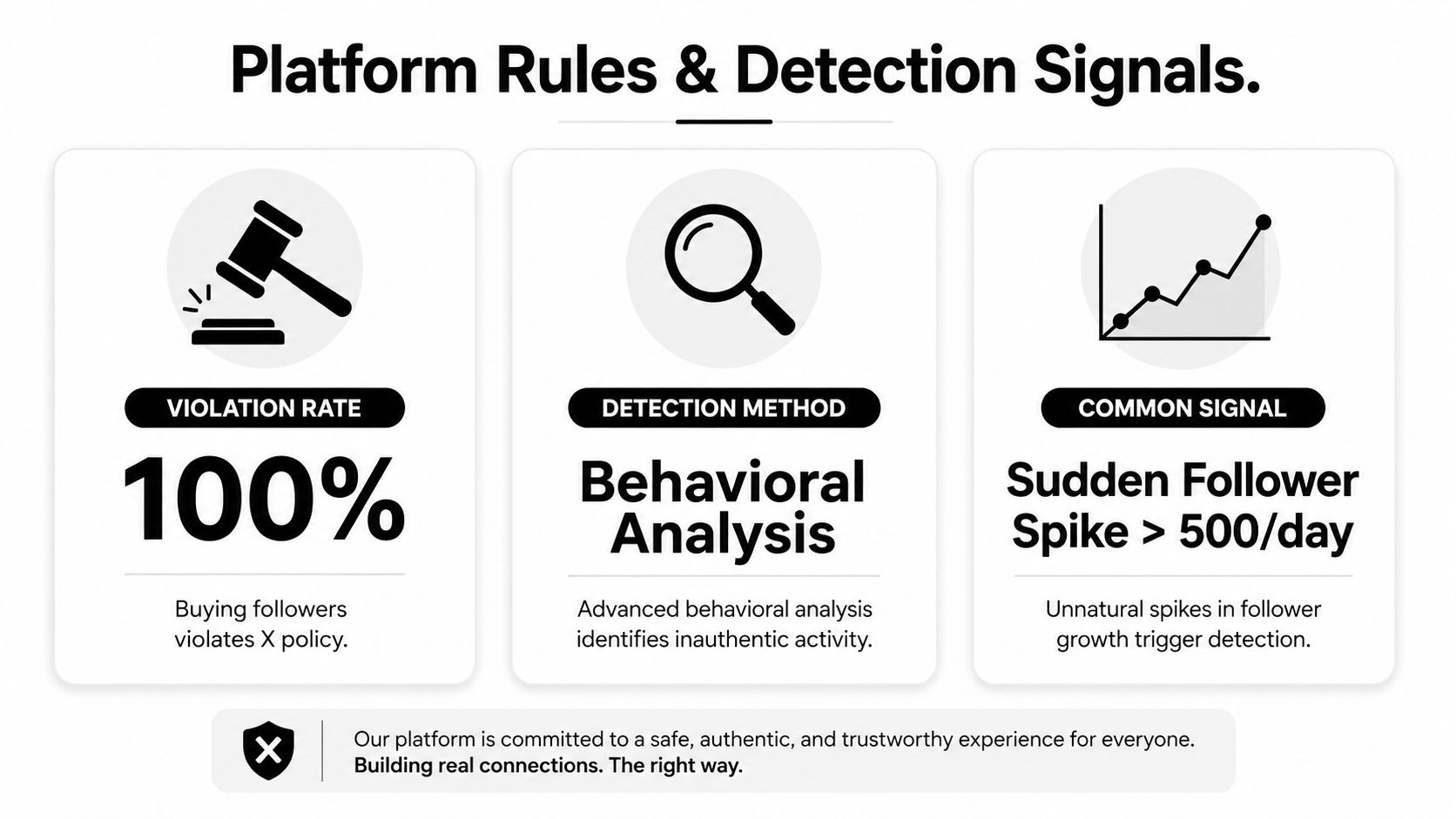
X's position is not ambiguous. Its authenticity rules prohibit buying, selling, or coordinating follows, along with follow-churn and indiscriminate following, and those violations can lead to account actions including removal or suspension X authenticity rules.
How detection usually starts
The first layer is automated pattern detection. Sudden follower spikes, clustered signup behavior, and weak engagement relative to audience size are the kinds of patterns that systems can flag without a human ever opening the account.
The second layer is review. If the pattern looks off enough, the account can get inspected more closely, especially if the growth curve doesn't line up with the content history. The third layer is cleanup, where purges sweep away accounts that look inactive or spammy.
That's why bought followers are risky even when they seem to “stick” at first. They're often sourced from the same recycled IP pools, reused fingerprints, and dormant inventories that get touched by anti-spam systems later. The profile may look fine for a week, then wake up inside a purge cycle.
What you'll notice after the fact
The buyer sees the damage in obvious ways. Followers jump, but likes and replies don't. New followers have zero tweets, default avatars, or profile details that don't match the account's claimed audience. Over time, the engagement rate sinks and the account starts looking artificially cold.
Practical rule: If the follower graph rises without a matching lift in conversation, the growth wasn't real enough to trust.
Independent 2026 coverage says roughly 5% to 10% of active X accounts are bots at any given time, and another 2026 analysis says platforms remove more than 500 million suspected spam and bot accounts per year fake follower statistics 2026. That makes any purchased audience a ticking clock, not a stable asset.
How TweetBoost Can Help
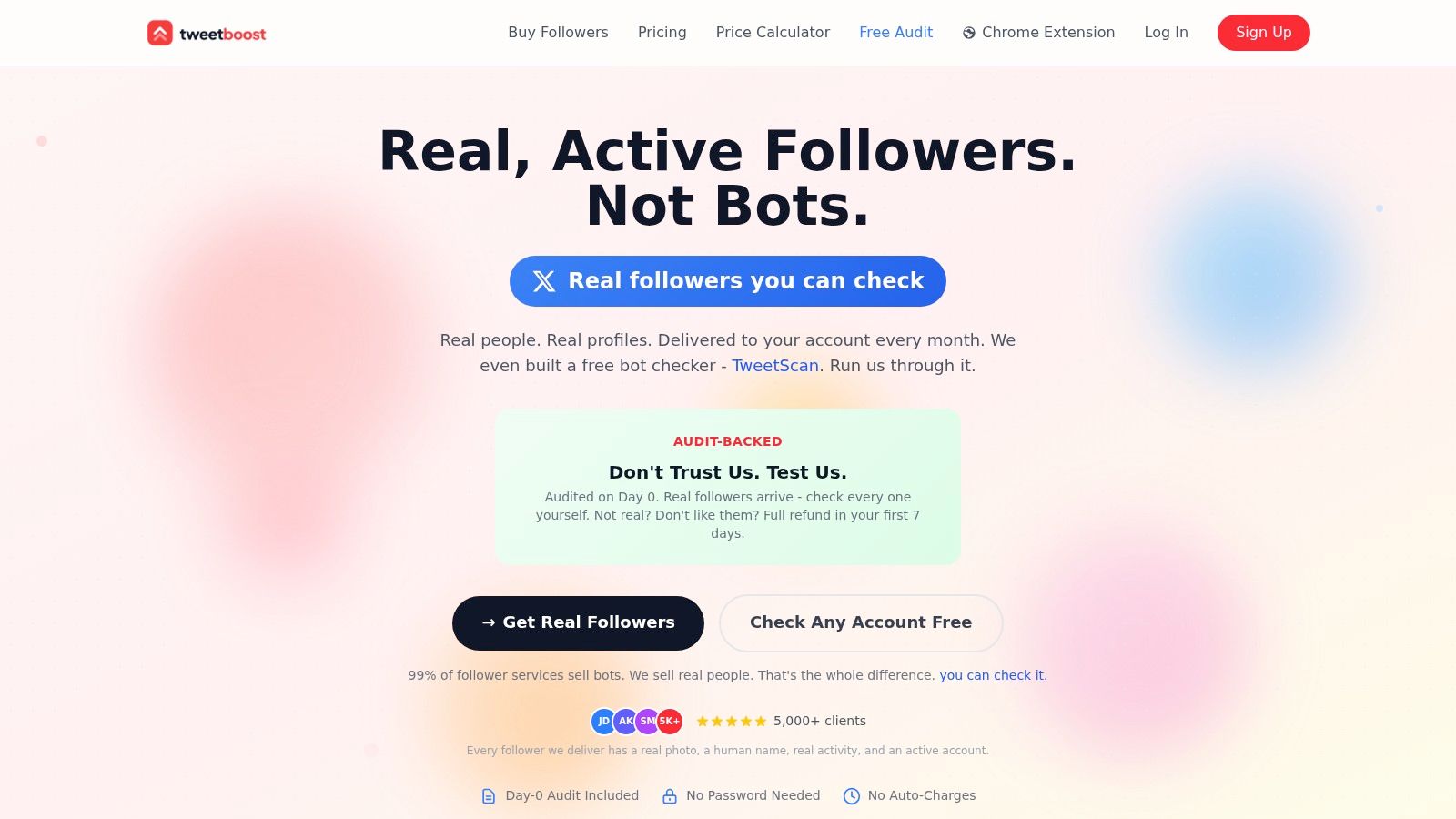
If your real problem is clean growth data, not empty vanity, you want a service that treats follower acquisition as a measurement exercise. TweetBoost positions itself around real, human followers delivered through organic promotion and AI-assisted targeting, with a Day-0 audit, periodic rescans, and a 30-day comparison dashboard so you can see what changed without handing over passwords. One useful reference if you're comparing options is buy real Twitter followers.
What it actually solves
The biggest problem with inflated metrics is uncertainty. If you can't tell whether your growth came from real audience interest or low-quality inventory, your reporting becomes unusable, and that hurts partnerships, content decisions, and channel planning.
TweetBoost's model tries to address that by tying growth to audits instead of assumptions. The service also avoids password access, doesn't use automatic renewals, and frames delivery around natural pacing and quality filters rather than a raw dump of accounts. For a team that cares about measurement first, that matters more than a flashy follower count.
Where it fits and where it doesn't
The plans include subscription tiers with estimated monthly delivery from Lite to Custom, plus engagement delivery on up to 50 tweets per month, weekly reporting on higher tiers, and support via email, live chat, and Telegram. The service also lists tools such as TweetScan, Shadowban Test, and a Follower Count Checker, which makes sense if you want a workflow that includes verification, not just acquisition.
A few cautions still apply. The service says it focuses on real-account delivery, but it doesn't guarantee niche, interest, or country-level precision, so it's better for general credibility building than hyper-specific audience segmentation. And because it works with gradual growth, it's most useful when you're already publishing and want the follower curve to look credible rather than explosive.
If you're choosing between a source that buys scale and a source that documents quality, choose quality. Inflated metrics break downstream decisions. Verified growth at least gives you something you can measure.
The Hidden Cost of Inflated Metrics
The damage from bought followers isn't just the purchase price. It's the fact that every downstream metric built on top of follower count becomes less useful, which means your team starts making decisions on bad data.
What gets distorted first
A fake-heavy audience doesn't click, reply, or convert, so your reach rate, engagement rate, and content benchmarks all drift away from reality. That creates a false picture of performance, especially when an account looks large enough to seem credible at a glance.
If you're judging creators or partners, the problem gets bigger. Recent 2026 commentary says fake or purchased followers are common enough to distort creator authenticity checks and due diligence, and one independent report estimates 31% to 38% fake-follower prevalence on X in some segments while another finds 37.2% of influencer followers are fake overall engagement benchmarks 2026. Those numbers are a warning that audience quality is now part of every serious review.
Brands don't just lose money on bad inventory, they lose the ability to compare campaigns honestly.
How the math breaks
A 10,000-follower account with a large ghost audience may look influential, but its real distribution power is much smaller than the profile suggests. That means media buyers can overprice sponsorships, founders can overestimate demand, and teams can misread which posts deserve amplification.
| Metric | With Real Audience | With 40-60% Purchased Followers |
|---|---|---|
| Reach rate | Reflects genuine interest | Looks lower because inactive accounts dilute the denominator |
| Engagement rate | Useful for content decisions | Artificially depressed and hard to benchmark |
| Partnership value | Easier to defend in audits | Vulnerable to credibility checks |
| Audience sizing | Reliable enough for planning | Unreliable for forecasting and targeting |
The hidden cost is opportunity. Every hour spent trying to manage a fake audience is an hour not spent on content, community, or product. The gap widens because real growth compounds, while fake growth keeps forcing you back to the starting line.
Red Flags When Evaluating Any Growth Offer
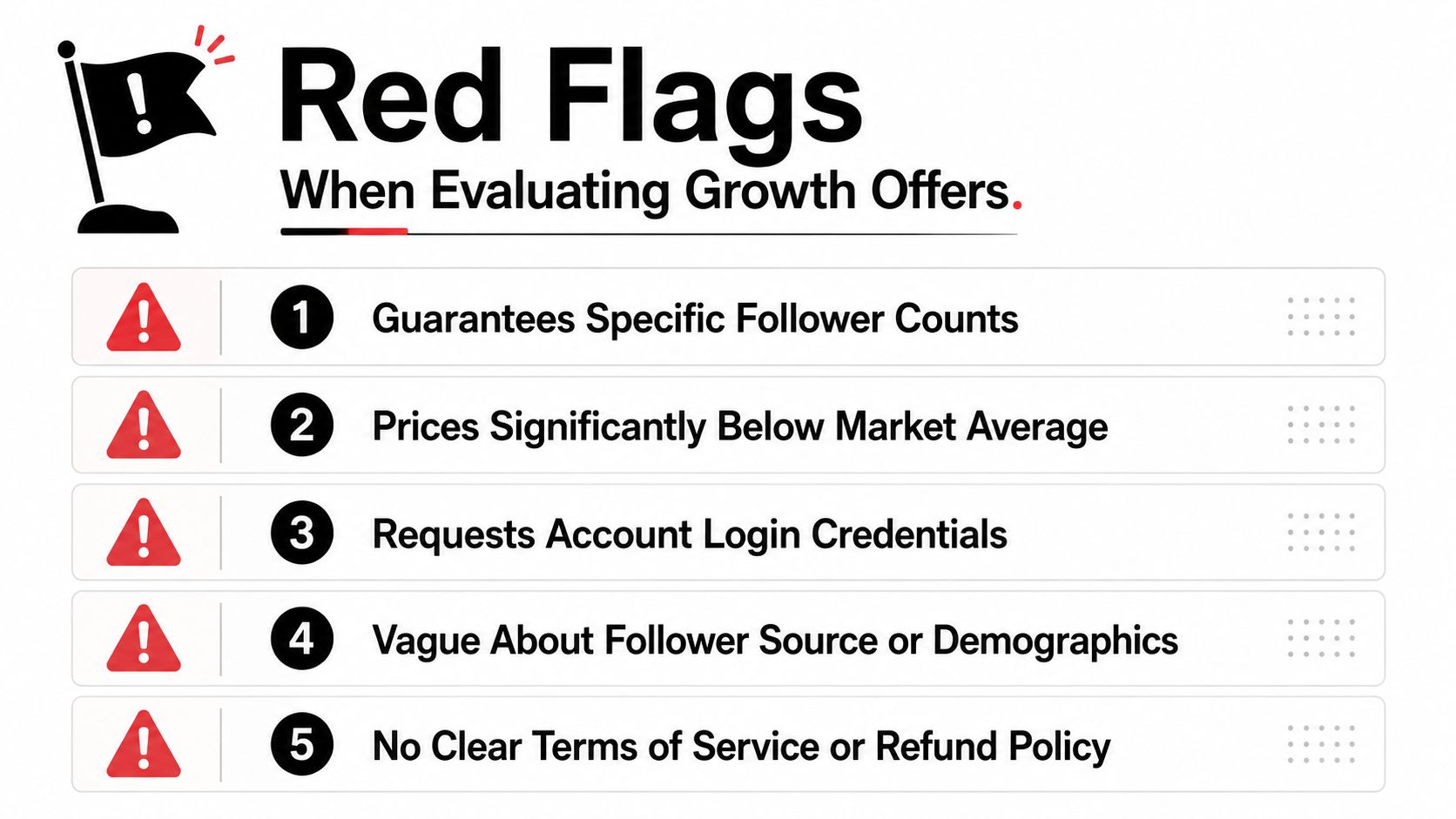
The easiest way to avoid bad outcomes is to treat the offer itself as the evidence. Legitimate growth providers sell process, timing, and verification. The bad ones sell a number and hope you don't ask follow-up questions.
Pricing and delivery should raise questions fast
If a seller promises a very low per-follower rate, bulk-only packages, or no tier transparency, that's usually a shortcut to low-quality inventory. If they promise delivery in 24 to 72 hours, they're often prioritizing speed over account safety.
You can test this by asking for a sample audience report before paying. If the seller can't explain the source, quality mix, or likely retention behavior, they're selling confidence, not followers.
Contract terms matter more than the pitch
No refund policy, no audience-quality guarantee, and payment methods that avoid normal consumer protections all point in the same direction. The seller wants the transaction done before questions start.
Ask for milestone-based payment and a written description of what qualifies as delivery. If they resist third-party audits or discourage any independent verification, assume they know the audience won't hold up well under inspection.
Post-sale behavior tells the truth
Bad vendors often upsell bot engagement to “balance” the follower drop, which is just another way to mask the same problem. A better provider, or a better approach entirely, should not need that kind of patchwork.
If you want a cleaner operating model for social media management, compare it against structured scheduling and campaign tools like SocialRails. The point isn't that software replaces strategy, it's that reliable systems are easier to trust than mystery inventory.
A legitimate growth offer should feel a bit boring. It should explain pacing, audience quality, and measurement. If the pitch is all urgency and no evidence, walk away.
Durable Alternatives That Compound Reach
Follower buying fails as a growth method because it distorts the audience signal. The better move is to build reach through channels that attract real attention, then keep compounding it with content, launches, and links.
Three paths, three different strengths
Organic tactics work when you can stay consistent. Reply-first engagement, native video, threads built on original data, and recurring series build loyalty because people see a point of view before they see a pitch.
Structured launch platforms create a different kind of spike. Product Hunt, BetaList, Hacker News, relevant subreddit drops, and X-native launch moments can send a concentrated wave of qualified traffic when the hook is tight and the timing is right. For influencer-focused campaigns, tools like Influencer Studio can help manage outreach. Tools like Aura++ fit here too, because it schedules product launches, publishes structured project pages, and adds SEO-focused assets that keep the launch discoverable after day one.
Practical rule: Use organic content to keep people. Use launches and backlinks to bring new people in.
Backlink-driven growth compounds in a way follower buying never can. Guest posts, podcast tours, and PR placements route search and referral audiences back to your profile, so each placement can keep working through discovery, indexing, and reuse.
| Path | Time to First Results | Effort | Durability | Follower Quality |
|---|---|---|---|---|
| Organic content | Slower | High | Strong | High |
| Structured launches | Fast | Medium | Medium to strong | High when the hook is good |
| Backlink-driven growth | Moderate | High | Very strong | High |
The mix depends on stage and capacity. The standard is simple, build signals that attract humans, not counts that only look good in a dashboard.
A 90-Day Plan for Real Audience Growth
Start with audit, not ambition. Days 1 to 7 should be about checking the current audience, removing obvious junk, and writing one clear niche angle that the account can own without wobbling.
Weeks 2 to 4 build the content engine
Use reply-first engagement every day and test one flagship thread format twice a week. Keep the format repeatable so you can see which hooks, structures, and examples pull attention instead of guessing.
A small check here matters more than a big promise there. If replies go up and the thread format starts earning saves or shares, you've found something worth doubling down on.
Weeks 5 to 8 add outside demand
Run one structured launch or feature announcement, then add one podcast or guest post each week to push search and referral traffic back to the profile. If you need a scheduling workflow to keep that cadence orderly, SonicPost is one example of a tool built around planning and publishing rather than vanity inflation.
Weeks 9 to 12 should tighten the loop. Publish a recurring series, put paid amplification behind the strongest organic post, and review unfollow velocity so you can see whether the audience is sticking.
A monthly ritual keeps this from drifting. Spend 30 minutes pruning weak follows, repurposing the best post, and mapping the next 90 days around reply rate, thread impressions, referral clicks, and qualified follower growth. That's the rhythm that compounds.
If you want durable reach, stop chasing follower counts and start fixing the inputs that create them. Audit your account, tighten your content, and build one launch or backlink channel this month that brings real people back to your profile.