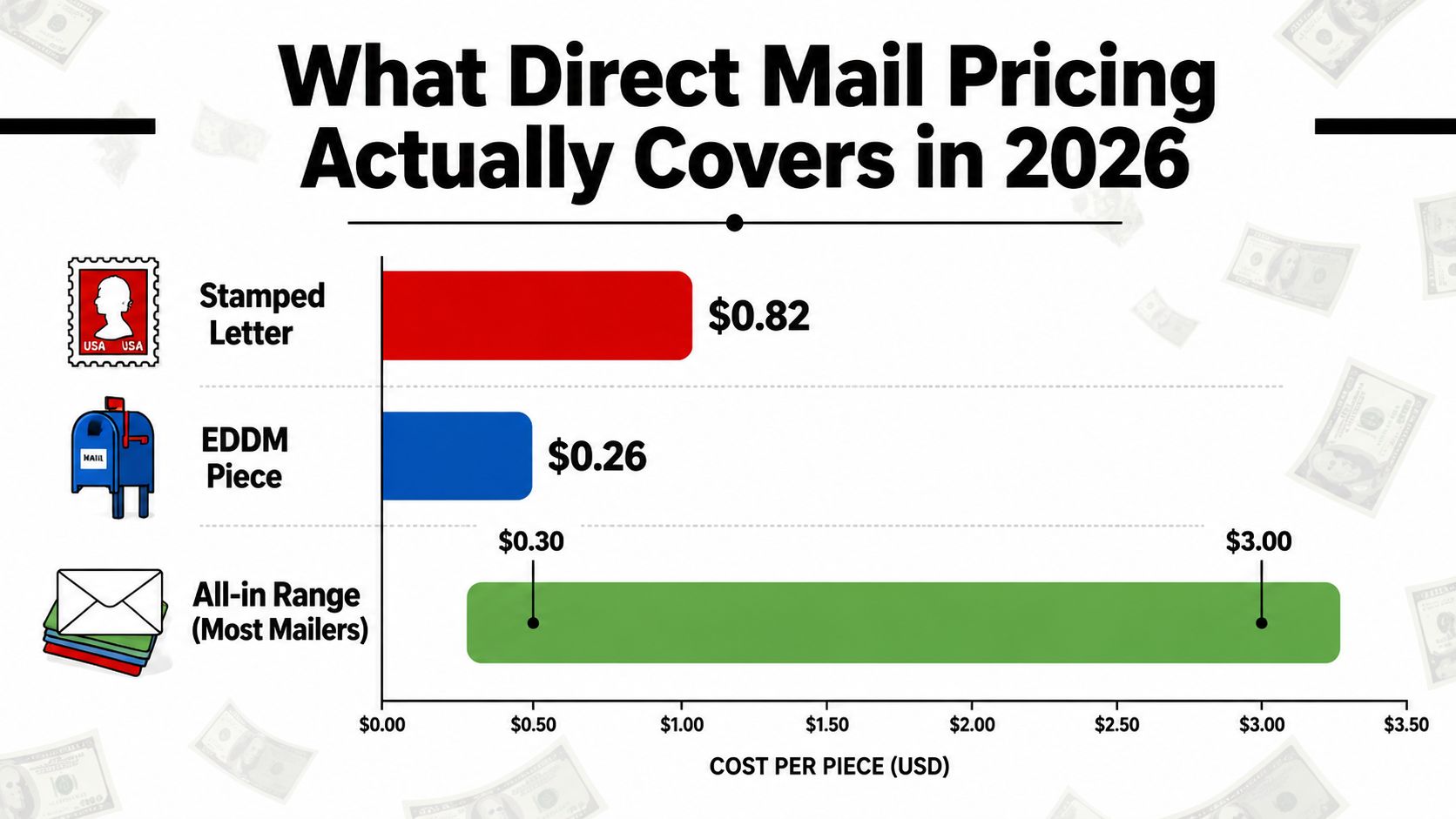
Direct mail pricing in 2026 usually lands around $0.30 to $3.00 per piece, depending on format and targeting. A stamped First-Class letter is $0.82, while an EDDM piece can be about $0.26, so the cheapest per-piece number is rarely the right budgeting answer.
That spread is why so many mail budgets go wrong. Buyers look at a postcard price, miss the list work, mail prep, and permit costs, then wonder why the invoice doesn't match the quote.
Table of Contents
- What Direct Mail Pricing Actually Covers in 2026
- The Line Items That Make Up a Direct Mail Invoice
- USPS Rate Classes and How They Shape Your Costs
- Pricing Models Compared Per Piece, Per Thousand, and All In
- How Sendvo Can Help
- Worked Cost Calculations for Real Campaigns
- Smart Ways to Cut Costs Without Killing ROI
- Sample Budgets and a Simple Pricing Calculator Template
- Direct Mail Pricing Questions Founders Ask Most
What Direct Mail Pricing Actually Covers in 2026
Direct mail pricing is not a single number, it's a stack of decisions. If you're comparing a stamped letter at $0.82 to an EDDM piece at about $0.26, you're already comparing two very different delivery models, and the all-in math can move fast when volume changes, targeting changes, or postage qualification changes. Independent 2026 pricing ranges still show most campaigns landing somewhere between $0.30 and $3.00 per piece, with wider spreads when format, stock, and postal optimization vary pricing range and budget spread.
The better way to think about it is cost per household reached, not cost per piece. A $0.40 postcard that hits a tight farm route can beat a cheaper saturation drop if the saturation version burns impressions on the wrong homes. If your mail lands in the wrong mailbox, the low unit price doesn't matter.
The four layers you should budget for
Most real campaigns break into four buckets. First is creative production, which includes strategy, design, copy, and proofing. Second is data and list work, which covers acquisition, cleaning, suppression, and deduping.
Third is printing and mail prep, meaning paper, finishing, addressing, folding, tabbing, sorting, and drop shipping. Fourth is postage and delivery tracking, where class selection and presort depth do the most damage or the most good. USPS commercial pricing can cut First-Class letter postage from $0.82 at the Post Office to $0.593 under commercial pricing, which shows how much mail preparation matters before the piece ever leaves the dock USPS commercial pricing.
Practical rule: never approve a quote until you know the share going to postage, the share going to print, and the share going to list work. If a vendor can't separate those cleanly, the quote isn't ready.
Direct mail pricing pages often stop at a base postcard or letter rate. That's the wrong question. The right question is what a campaign costs to reach the right households, with the right list quality, and with the right delivery class.
The Line Items That Make Up a Direct Mail Invoice
A direct mail invoice should read like a build sheet, not a mystery bill. If it doesn't, the vendor is hiding work you'll pay for somewhere else. I treat each line item the way a contractor treats a renovation estimate, because every piece of paper has labor, materials, and logistics behind it.
What usually shows up on the bill
Creative and design fees are the blueprint cost. You're paying someone to decide what the piece says, how it looks, and how it gets someone to respond. List acquisition or rental is like renting a curated address book, except the quality of that book decides whether your campaign reaches buyers or wasted names.
Data hygiene and suppression appends are the cleanup pass before a road trip. If you skip it, you keep mailing duplicates, stale addresses, and people who shouldn't receive the offer. That waste doesn't stay theoretical, it shows up in postage and bad delivery.
Printing and finish options are your material choice. Cheap stock can work for some offers, but the feel of the piece still affects how it's handled. Mail prep covers folding, inserting, tabbing, addressing, sorting, and palletizing, which is the shipping labor most buyers underestimate.
Permits and indicia prove postage is paid, and tracking or Informed Delivery upgrades help you measure what happened after the mail hit the network. The hidden line items that get skipped most often are list hygiene, permit work, and mail prep labor. Those are not optional extras, they're part of the job.
Sanity check: if a quote looks too clean, it usually means the messy but necessary work got pushed out of view.
| Line Item | What It Covers | Avg Share of Total Cost |
|---|---|---|
| Creative and design | Concept, copy, layout, proofing | Qualitatively meaningful, often fixed |
| List acquisition or rental | Buying access to a targeted audience | Varies by audience quality |
| Data hygiene and suppression | CASS, NCOA, dedupe, exclusions | Small line item that protects spend |
| Printing and finish | Paper, ink, trimming, coating | Often one of the largest variable lines |
| Mail prep | Folding, inserting, addressing, tabbing, sorting | Labor-heavy and frequently buried |
| Permit and indicia | Mailing permit, postage imprint setup | Usually overlooked until late |
| Postage | USPS class, presort, delivery route | Usually the largest or most sensitive line |
| Tracking and reporting | Informed Delivery, barcode tracking, logs | Optional in some quotes, essential in practice |
For a clean example of how a shop can present production and routing work in a structured way, look at this internal project page on straight mail execution.
USPS Rate Classes and How They Shape Your Costs
USPS class choice changes campaign economics more than creative does. First-Class Mail buys speed and simpler handling. Marketing Mail, formerly Standard Mail, usually costs less, but it demands more prep to earn the discount.
That tradeoff matters. A higher postage class can be the right call when the offer is time-sensitive or when you need faster delivery. A slower, cheaper drop that misses the buying window is not a savings.
How class choice changes the bill
The 2026 rate structure makes the gap clear. A stamped First-Class letter costs $0.82, and commercial First-Class pricing can drop to $0.593 with the right preparation USPS pricing. USPS marketing-mail automation rates sit well below retail postage, with one 2026 rate sheet showing $0.395 for 5-digit automation letters and EDDM retail around $0.259 per piece, compared with the $0.82 stamp 2026 USPS rate sheet.
That spread is why presort depth matters. Deeper mailing prep can cut postage without changing your offer, your copy, or your format. The postal system rewards mailers who do more of the sorting work before entry.
A simple way to choose the class
Use First-Class when speed, forwarding, or return handling matters more than postage savings. Use Marketing Mail when the audience is larger, the offer can wait, and your team can qualify for commercial rates. Use Periodicals only when you are mailing actual periodical content, not because you want a clever discount. Use USPS Marketing Mail Nonprofit only if you qualify.
Decision rule: choose the class that matches the campaign goal, not the lowest number on the page.
Rate changes also pushed Marketing Mail upward while First-Class moved more modestly, so route choice matters even more. The right question is not “What is the cheapest postage?” It is “Which class gets the right piece to the right home fast enough to matter?”
Pricing Models Compared Per Piece, Per Thousand, and All In
Vendors quote direct mail three ways because each model answers a different question. Per-piece pricing is the cleanest for small tests, especially under 5,000 pieces. Per-thousand pricing is useful when you care about scale and want to compare print and postage tiers. All-in pricing is the easiest way to launch fast, but it can hide weak targeting or inflated production choices.
When each model helps
Per-piece quotes are best when you're testing offers, formats, or audience segments. They make it easy to compare one postcard against another without rebuilding the whole budget model. Per-thousand quotes work better for larger programs because they expose where volume brings down paper, print, data, and postage.
All-in pricing is useful if your team wants one number and one owner. It's also the easiest model for non-specialists to approve. The tradeoff is obvious, if the vendor wraps creative, list, printing, and postage into a single figure, you may not notice whether the spend is going into audience quality or just a prettier envelope.
| Pricing Model | Best For | Watch For |
|---|---|---|
| Per piece | Small tests, format comparisons | Setup fees and exclusions |
| Per thousand | Scale planning and volume breaks | Hidden insertion or shipping charges |
| All in | Fast launches and lean teams | Weak targeting hidden by a neat total |
A $0.55 mailer delivered to 8,000 qualified households is cheaper in reality than a $0.42 postcard sent to 12,000 random names. That's the mistake buyers repeat over and over. The headline price is not the outcome.
Ask every vendor to separate postage, production, data, labor, and shipping, and to spell out quantity breaks, required formats, and overage charges. If they won't do that, you're not buying clarity, you're buying a surprise.
How Sendvo Can Help
Sendvo is useful when your direct mail pricing problem isn't just cost, it's coordination. It's a self-service platform for building audiences, creating postcards and letters, approving proofs, tracking delivery, and showing per-piece costs before you send. The product is in beta, so I'd treat it as a workflow tool with expanding access, not a magic fix for bad list strategy. For the current pricing structure, start with Sendvo pricing.
Where it actually solves a pricing problem
The strongest use case is a team that wants one system for audience selection, proofing, postage, and tracking. That matters because budget overruns often happen when list vendors, designers, mail houses, and analysts all work in separate tools. Sendvo's workflow, which includes audience building, browser-based design, address verification, and delivery tracking, reduces the number of places where cost can drift.
A small local postcard drop is the easy example. If you're mailing a few thousand names, the platform value is in exact audience counts, proof approval, and bundled per-piece cost visibility before release. That prevents the common mistake of paying for a broader drop than you intended.
A larger national prospect list is where the math gets more serious. When you're managing more names, the value comes from deduplication, suppression controls, and event tracking, because waste scales quickly when the list gets sloppy. Teams that need approvals, reusable templates, and webhook-triggered sends will care more about operational control than about saving a tiny amount on a single run.
When I'd consider it
I'd use a platform like this if you're running recurring campaigns, you need audience hygiene baked into the workflow, or you don't have an in-house mail ops person. I wouldn't use it to rescue a weak offer or a broad, untargeted list. Software can organize the spend, but it can't make bad targeting profitable.
The right choice is simple. If your problem is fragmented workflow and hidden execution costs, a platform can help. If your problem is that the campaign itself is unfocused, no pricing tool will save it.
Worked Cost Calculations for Real Campaigns
The fastest way to budget direct mail is to start with delivered household cost, not the sticker price on the envelope. You need to know what each reachable home costs, because undeliverable or poorly targeted names distort the number immediately. That's where many teams fool themselves.
Small local postcard drop
Use a 2,500-piece postcard run as the baseline. If printing is $0.12 per piece, addressing is $0.05, mail prep is $0.04, and postage is $0.26, the variable fulfillment cost is $0.47 per piece, or $1,175 total. Add $150 for creative and data work, plus $75 for drop shipping, and the all-in total becomes $1,400, or $0.56 per delivered household.
| Campaign | Line-Item Math | Total Cost | Effective Cost |
|---|---|---|---|
| 2,500-piece local postcard | 2,500 × ($0.12 + $0.05 + $0.04 + $0.26) + $150 + $75 | $1,400 | $0.56 per delivered household |
If 1,500 pieces are undeliverable or poorly targeted, the effective cost rises to about $0.93 per reachable household. That's why list quality is not a side issue, it's the budget.
National prospect letter campaign
Now take 20,000 prospect letters. If print is $0.10, list processing and hygiene are $0.07, personalization is $0.04, inserting is $0.05, and presorted automation postage is $0.40, the variable cost is $0.66 per piece, or $13,200. Add $1,200 for list rental, $1,500 for creative, $900 for data processing, and $600 for logistics, and the total becomes $17,400, or $0.87 per piece.
| Campaign | Line-Item Math | Total Cost | Effective Cost |
|---|---|---|---|
| 20,000-piece national prospect letter | 20,000 × ($0.10 + $0.07 + $0.04 + $0.05 + $0.40) + $1,200 + $1,500 + $900 + $600 | $17,400 | $0.87 per piece |
If that campaign generates $26,100 in attributed gross profit, the return is $8,700 before overhead, or 1.5x campaign cost. The only way this math matters is if you track delivered, contacted, converted, and attributed revenue separately. Otherwise you're just counting postage.
Smart Ways to Cut Costs Without Killing ROI
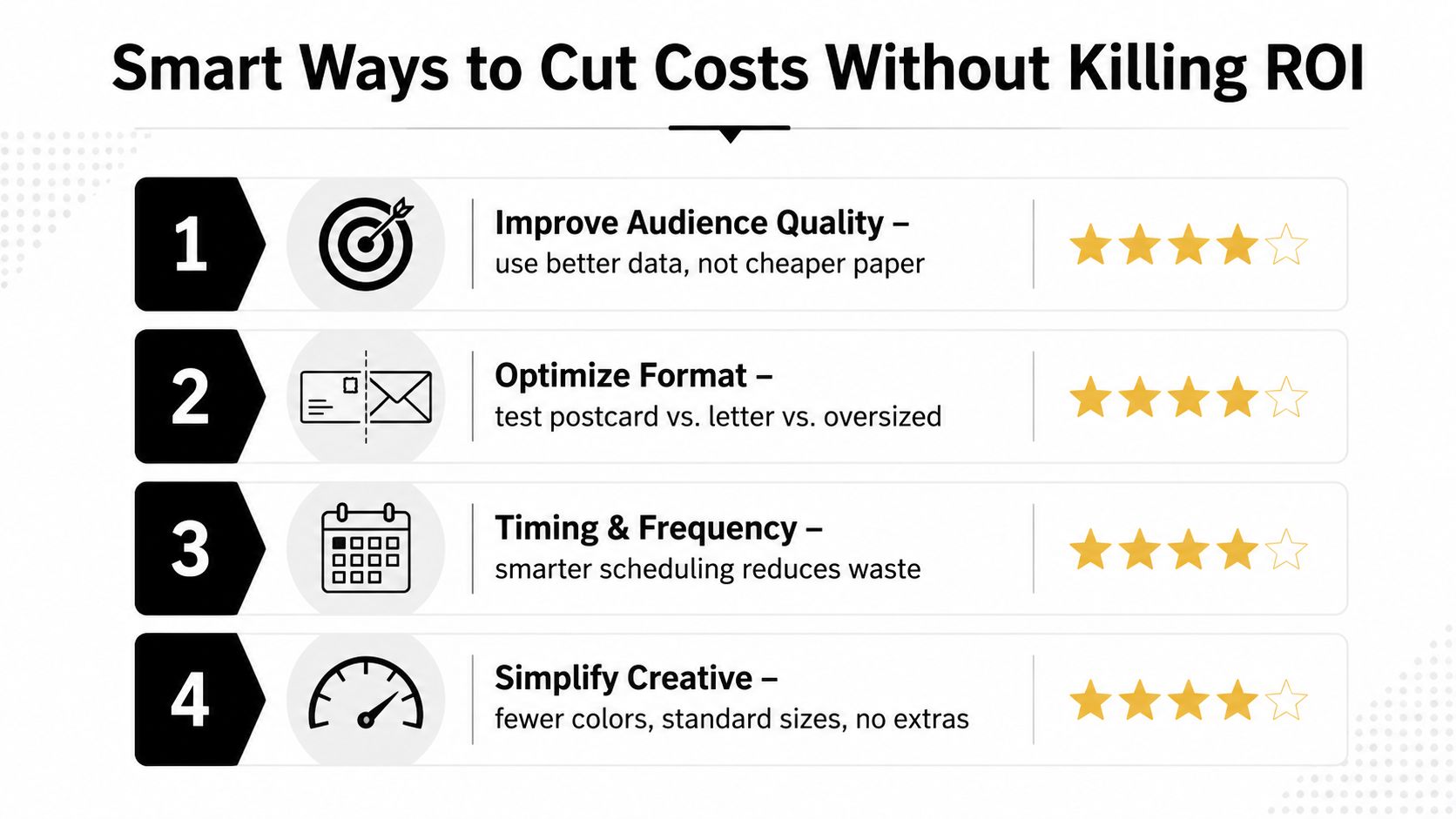
Cutting cost is easy. Cutting the wrong thing is what kills returns. The safest savings come from improving deliverability and targeting first, then tightening format and production choices.
Rank your savings moves by impact
Start with the list. Remove duplicates, suppress recent customers, and segment by purchase likelihood. A smaller list of qualified households is usually the smarter spend than a bigger list of broad names. If a piece never reaches the right person, every other line item was wasted.
Next, standardize size, weight, and folds so the job qualifies for better USPS treatment. The more predictable the format, the easier it is to lock in mail prep efficiency and postage savings. After that, look at recurring volume, because repeated mailings can lead to better production and postage economics.
Rule of thumb: never cut list hygiene to save a few cents if the result is a weaker audience.
Then decide whether the offer justifies self-mailers, EDDM-style distribution, or a more premium package. Cheap formats are fine when the message is simple. Dimensional or highly tactile mail is justified when the added response can pay for the extra cost.
A lower postage class can backfire if it delays a time-sensitive offer. Cheap stock can weaken trust. And a bad list can erase every other savings move, because you've just reduced the price of reaching the wrong people.
For teams cleaning prospect data before mailing, the internal email list cleaner workflow shows how hygiene fits into a broader acquisition stack.
A simple budget lens for three sizes
Use the same logic across campaign sizes, but expect fixed costs to spread differently as volume grows. Small mailings carry more pressure from design and setup. Larger ones absorb those costs better, which is why the cheapest-looking campaign on a quote sheet isn't always the best operating choice.
For teams that want a planning helper, this internal B2B pricing calculator is a useful way to model line items before you sign.
Sample Budgets and a Simple Pricing Calculator Template
A good quote should be easy to check against a formula. If you can't model it yourself, you're too dependent on the vendor's packaging. The simplest calculator is quantity multiplied by the sum of postage, print, data, and design or prep.
Three sample budgets
| Line Item | Local 2,500 pieces | Regional 25,000 pieces | National 100,000 pieces |
|---|---|---|---|
| Postage | Lower per-piece, higher retail pressure | Better qualification potential | Best volume leverage |
| Printing | Higher unit cost | Mid-range | Lower unit cost |
| List acquisition | Often minimal or local | Moderate | Largest audience planning variable |
| Design | Mostly fixed | Mostly fixed | Mostly fixed |
| Merge or personalization | Light | Moderate | Scales across the file |
| Mail prep | Meaningful at every size | More efficient with volume | Strongest operational efficiency |
| Total behavior | Fixed costs weigh heavily | Balanced mix | Fixed costs spread thinly |
A 10,000-piece EDDM drop uses the same math. Multiply 10,000 × (postage + print + data + design/prep), then add any fixed fees that sit outside the variable cost bucket. If the vendor quote can't be plugged into that formula, it's not ready for approval.
Check the quote against the template
Use this short checklist before you sign:
- Separate every line: postage, print, data, design, prep, shipping.
- Confirm the audience: exact quantity and whether any names are excluded.
- Check the class: First-Class, Marketing Mail, or EDDM.
- Ask about overages: what happens if count changes after proofing.
- Validate delivery timing: if the offer is time-sensitive, delays are a cost.
- Compare delivered household cost: not just quoted per-piece cost.
The point of the calculator is discipline. It keeps your vendor honest and forces the campaign owner to defend the audience, format, and timing, not just the price.
Direct Mail Pricing Questions Founders Ask Most
Founders usually ask the same questions once the budget gets real. Why does a 5,000-piece quote look so much higher per piece than a 50,000-piece quote? Because fixed setup, production, and prep are getting spread over fewer pieces. That doesn't mean the bigger run is automatically better, it means the smaller run has more overhead per household.
The next question is whether postage or printing is the bigger lever. In practice, postage and audience quality matter more than people want to admit. A cheap print job mailed to the wrong list is still a bad investment, and a slightly pricier class can still win if it gets the right piece delivered in time.
Another common question is what a list costs. There isn't one universal answer, because list rental depends on how well the audience is defined. The same is true for EDDM versus targeted lists, EDDM can be cheaper per piece, but it gives up precision, so the comparison is cost per household reached, not just raw postage.
The hidden fees show up in paper upgrades, address hygiene, NCOA processing, tabbing, and drop shipping. Those aren't edge cases, they're the normal places where the invoice gets built. If a buyer wants a reasonable benchmark, I'd rather they measure whether the campaign reaches the right households at a cost that fits the expected response value than obsess over a single benchmark number.
Direct mail stops making financial sense when the cost to reach a qualified household exceeds the value of the response you can reasonably expect. At that point, email, paid social, or programmatic display may be better for broad awareness. Mail still wins when you need attention, tactile presence, and a controlled audience, but it should earn that role with the numbers, not nostalgia.
If you're budgeting a campaign now, build the quote around delivered household cost, not headline postage. Pull apart every line item, compare classes, and reject any estimate that hides list work, prep labor, or permit charges.