You're probably in one of two situations.
Either your store is already spending enough on ads that the waste hurts, but nobody can clearly tell you where the waste is. Or you know Google should be a real growth channel, yet every agency call turns into the same recycled pitch about “full funnel,” “AI optimization,” and “creative testing” with very little accountability behind it.
That's why hiring an ecommerce PPC agency feels harder than it should. You're not buying design work. You're handing over a revenue lever that can slowly drain margin for months if the wrong team controls it.
I've hired agencies that looked polished on the sales call and fell apart in execution. I've also seen smaller specialist teams outperform bigger names because they understood feed issues, query control, promo timing, and contribution margin. The difference wasn't charisma. It was operating discipline.
Treat this like a hiring decision. You need a scorecard, interview questions, a structured trial period, and clear ownership. If you don't do that, you're not selecting a partner. You're gambling with ad spend.
Table of Contents
- Why Hiring an Ecommerce PPC Agency Feels So Hard Right Now
- Set Goals, Budget, and KPIs Before You Talk to Anyone
- The Vetting Checklist That Separates Real Operators From Pitch Decks
- How PPC Geeks Can Help
- RFP Questions That Reveal How an Agency Actually Works
- Pricing Models, Benchmarks, and How to Read a Proposal
- Contract Terms and the First 90 Days of Onboarding
- Red Flags, Comparison Template, and the Final Decision
Why Hiring an Ecommerce PPC Agency Feels So Hard Right Now
The problem isn't just too many agencies. The problem is that ecommerce paid acquisition got more technical while most agency pitches stayed shallow.
Paid search is now a huge market. One 2026 industry summary projects global PPC advertising spend at $306 billion, with ecommerce search-network CPC averaging $1.16 and Google ecommerce Search Ads converting at 2.81% according to Digital Applied's PPC statistics summary. That scale is exactly why mediocre management gets expensive fast.
Generic agencies sound fine until they touch your account
A generic paid media shop can usually launch campaigns. That isn't the hard part. The hard part is protecting margin when your product feed breaks, branded traffic muddies reporting, conversion tracking duplicates revenue, or Performance Max starts absorbing budget with weak visibility into what's driving sales.
Founders feel stuck because the options look bad in different ways:
- The cheap freelancer might be responsive, but often lacks the systems to manage feeds, Merchant Center issues, reporting, and creative coordination at the same time.
- The big agency usually has a polished sales process, but you still need to find out who will run the account after the deal closes.
- The “full-service growth partner” often bundles too many services and stays vague on the one question that matters: who owns profitable acquisition on Google every week?
Practical rule: If an agency can't explain how it handles feed health, search-term waste, and conversion accuracy in plain English, it isn't ready to manage ecommerce PPC at a serious level.
The surface area got larger
Retail search isn't just text ads anymore. A 2026 benchmark summary reports that Shopping ads account for 76% of retail search ad spend and about 85% of clicks in Google retail campaigns, with more than 1.2 billion product searches each month, as outlined in Yip SMS's ecommerce PPC benchmark roundup. That means a real ecommerce PPC agency needs product feed discipline, Merchant Center hygiene, and campaign structure that fits retail behavior.
At the same time, search pages got more crowded. AI-driven results now take up more space. Thrive's PPC trend summary says AI Overviews appeared on 14% of shopping queries in March 2026, up from 2.1% in November 2025, and paid click-through rates have been pressured on queries where those overviews appear. If an agency still evaluates success only through CPC and ROAS, it's missing what's happening on the page itself.
Why this feels like no clear owner
Most founders don't need more dashboards. They need one person who can defend the account with logic.
That person should be able to answer questions like:
- Why is Shopping underperforming by product category?
- Are we buying incremental demand or just harvesting branded intent?
- Is tracking clean enough to trust bid automation?
- What gets fixed first, the feed, the structure, or the landing page?
If nobody owns those answers, your account is unowned. That's what costs money every month.
Set Goals, Budget, and KPIs Before You Talk to Anyone
Most agency searches start too early. Founders book calls before they've decided what success looks like.
That guarantees weak conversations. Agencies fill the vacuum with their preferred pitch, and you end up comparing slide decks instead of operators.
Start with your survival math
Before outreach, write down the numbers your business can live with. You don't need fancy forecasting. You need contribution margin, average order value, repeat purchase behavior, and the customer acquisition cost ceiling your store can tolerate without choking cash flow.
Then convert that into channel-specific expectations.
Branded Search should not be judged the same way as non-brand Search. Shopping should not be judged the same way as remarketing. Performance Max should not be judged as a black box that gets infinite forgiveness because it “supports the funnel.”
Use this simple sequence:
- Define break-even ROAS by business model, not by agency opinion.
- Set a target ROAS that leaves room for profit, not just revenue.
- Choose a new-customer share goal if customer acquisition matters more than harvesting existing demand.
- Set a test budget for a full decision window, not a two-week panic sprint.
A lot of founders rush judgment. Don't. If the setup has tracking issues, feed issues, and structure issues, the first month is often cleanup before it's scale.
Build a one-page brief
Every finalist should receive the same one-page operating brief. That forces apples-to-apples thinking.
Include:
- Your margin structure: High-margin, mixed-margin, or low-margin SKU base.
- Your current channel mix: What's live now across Google Shopping, branded Search, non-brand Search, Performance Max, and remarketing.
- Your current reporting gaps: Attribution disputes, feed errors, poor query visibility, or inconsistent conversion definitions.
- Your promo reality: Seasonal spikes, discount cadence, inventory constraints, and product launch timing.
- Your decision metrics: The three numbers you'll judge the agency on at day 30, day 60, and day 90.
If you want planning templates and worksheets before outreach, this list of free ecommerce marketing tools is one practical place to pull from.
Keep the KPI list short
Founders often overcomplicate KPIs. Don't hand agencies a bloated measurement deck. Give them a tight operating scoreboard.
Use a shortlist like this:
- Target ROAS: The operating goal, not the vanity target.
- Break-even ROAS: The floor where growth stops being healthy.
- MER: Your blended reality check across paid media and revenue.
- New-customer share: Especially important if branded demand is already strong.
- CPC trend: Useful, but only in context with conversion quality.
- Quality score distribution: Not as a trophy metric, but as a signal of ad relevance and landing page fit.
If you can't explain your break-even economics in one minute, you're not ready to hire an agency. You're ready to pay someone else to guess.
Channel KPI Targets Before Agency Outreach
| Channel | Break-even ROAS | Target ROAS | New-Customer Share Goal | 90-Day Test Budget |
|---|---|---|---|---|
| Google Shopping | Fill in based on margin by product category | Fill in based on profit target | Fill in if acquisition is a goal | Set a budget you can sustain for a full test window |
| Branded Search | Usually lower urgency to scale if demand already exists | Protect efficiency and coverage | Usually lower than non-brand channels | Budget for defense, not vanity expansion |
| Non-brand Search | Set stricter break-even rules | Demand stronger intent and tighter control | Higher than branded Search | Budget only if landing pages and tracking are clean |
| Performance Max | Use blended economics and category logic | Judge by incrementality and product mix | Define carefully before launch | Test with controlled scope, not whole-catalog chaos |
| Remarketing | Often easier to clear break-even | Efficiency-focused target | Lower if returning-buyer capture is expected | Keep capped and measured against overlap |
The Vetting Checklist That Separates Real Operators From Pitch Decks
Most agency evaluations fail because founders ask broad questions and accept broad answers.
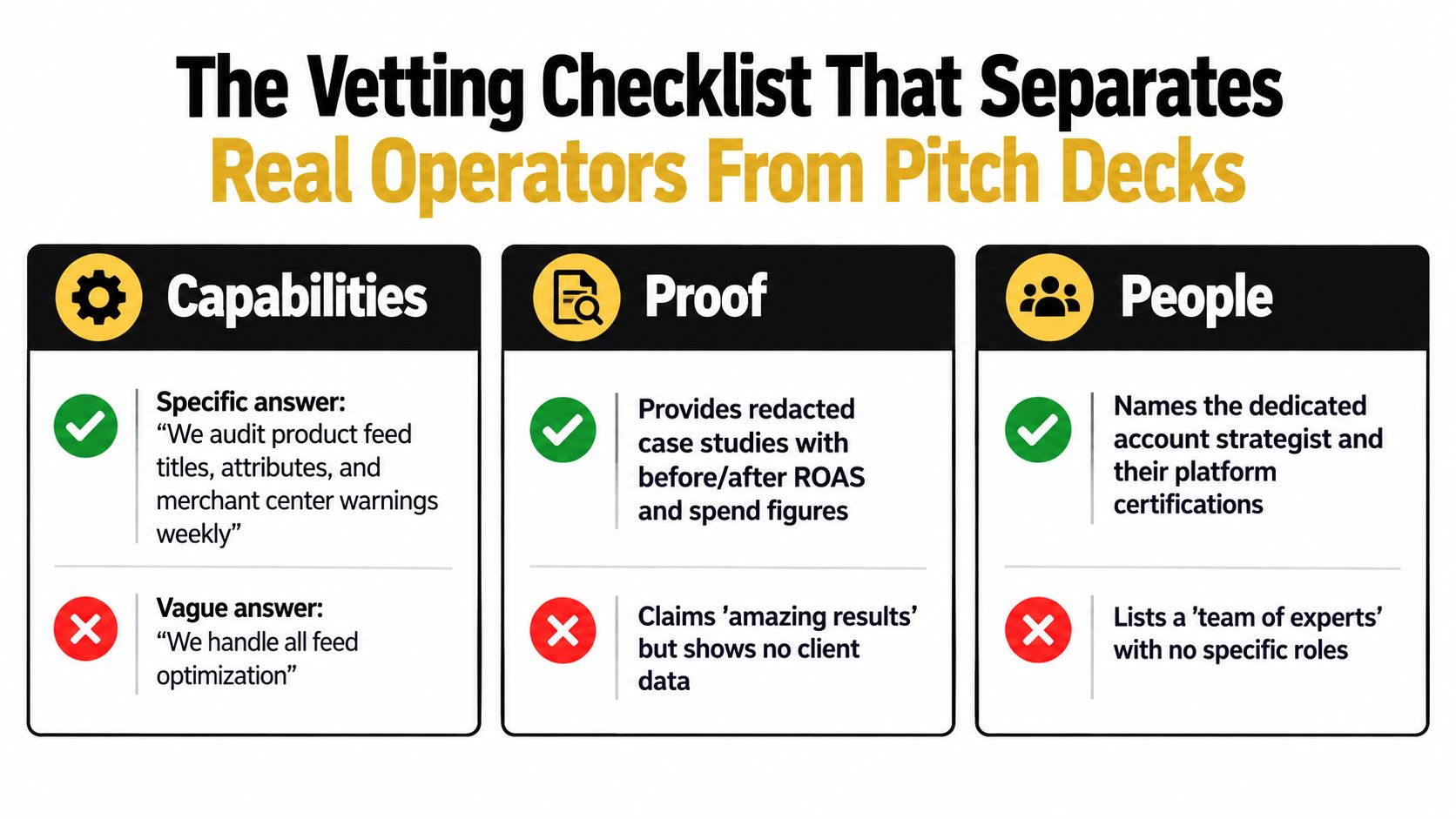
Don't ask, “How do you approach growth?” Ask what they do when Merchant Center warnings spike, when branded search inflates reported ROAS, or when Performance Max starts cannibalizing cleaner campaign types. Real operators get more specific as the questions get harder. Pretenders get vaguer.
A useful comparison point is how specialist service firms explain process on adjacent delivery models. Even outside PPC, this Webflow agency guide shows the kind of specificity you should expect when a team claims deep operational expertise.
Capabilities you should verify
Ask for exact workflows, not generic service lists.
A competent ecommerce PPC agency should be able to explain:
- Feed management practice: How often they review product titles, attributes, disapprovals, and category mapping.
- Merchant Center discipline: Who monitors warnings and suspensions, and what the escalation process looks like.
- Negative keyword architecture: How they separate research terms, irrelevant intent, and profitable search patterns.
- Performance Max structure: Whether they segment by product line, margin band, seasonality, or promotional intent.
- Creative iteration cadence: Who supplies image and video assets, who writes copy, and how often they refresh weak assets.
Weak agencies love phrases like “we handle everything” or “we optimize continuously.” That tells you almost nothing.
Proof that means something
Don't get hypnotized by polished case studies. Most of them are marketing assets, not evidence.
Ask for proof in three forms:
- Redacted account views that show trend lines over time, not one lucky month.
- Plain-English win stories where they explain what was broken, what they changed, and what happened next.
- Reference access to a current or recent client in a similar business model.
You're not looking for perfection. You're looking for reasoning quality.
One useful technical reality check comes from Core PPC's audit findings, which reported search-term waste in about 80% of accounts, duplicate or broken conversion tracking in roughly 40% to 65%, and at least three major issues in about 70% of audited accounts. The same analysis says stores may be overspending by 15% to 30% when negatives, tracking hygiene, and offline conversion handling are neglected. If an agency never talks about audits, waste, or tracking integrity, assume they either don't look or don't want you to ask.
People decide the outcome
Many hiring processes go soft. Founders evaluate the firm and ignore the operator.
Ask these questions directly:
- Who is the named strategist on the account?
- How long have they managed ecommerce-specific Google Ads programs?
- Who joins the weekly call after the sale closes?
- Who touches the feed?
- Who owns reporting?
- Who has final authority when performance drops?
What you're hiring is not the agency brand. You're hiring the account owner and the operating system around them.
If the senior salesperson disappears after close and the account gets passed to a vague “team,” assume you're buying inconsistency.
Red flags that should shorten the list
Some misses are annoying. Others are disqualifying.
Cut agencies quickly if they:
- Refuse role clarity: They won't name who will manage the account.
- Hide behind jargon: They substitute terms like “synergy” and “full funnel” for actual process.
- Skip feed detail: They talk Search and PMax but stay vague on product data.
- Avoid account access terms: They're fuzzy about ownership, permissions, or portability.
- Over-index on case studies: Lots of claims, very little operating detail.
A serious ecommerce PPC agency should leave you with a clearer picture of how the work gets done, not just a stronger impression of the sales team.
How PPC Geeks Can Help
One agency worth evaluating if you want a specialist rather than a broad digital shop is PPC Geeks. Their ecommerce PPC agency page is useful because it makes the offer legible for a buyer who needs hands-on paid search support, not abstract “growth.”
Where they fit best
PPC Geeks is positioned as a specialist PPC agency with Google Ads focus across ecommerce, lead generation, Shopping, remarketing, and reporting. The practical value is straightforward. If you're a UK brand or marketing manager who needs tighter control over wasted spend, cleaner tracking, and a team that works across platforms like Google Ads, Microsoft/Bing, Facebook, and Amazon, that's a coherent fit.
Their onboarding and audit-led approach is the part I'd pay attention to. That matters because many ecommerce accounts don't need “more strategy” first. They need cleanup, measurement discipline, and channel prioritization.
Problems they're built to solve
PPC Geeks makes the most sense when the issue looks like this:
- Spend is active, but confidence is low: The account runs, but reporting and decision logic feel weak.
- You need specialist help, not a media conglomerate: Smaller or mid-market brands often benefit from sharper PPC-specific ownership.
- Internal bandwidth is thin: Busy in-house teams need a partner who can manage feed optimization, reporting, and ongoing campaign reviews without constant chasing.
They also emphasize transparent reporting, a strategy aligned with your specific goals, and a UK-based team with deep combined experience. For a founder or marketing lead, that's useful when responsiveness and communication quality matter as much as platform skill.
When I'd shortlist them
I'd shortlist PPC Geeks if you want:
- A PPC-first operator rather than a generalist creative agency.
- An audit-led starting point that identifies tracking and waste before scaling.
- Cross-platform coverage with Google at the center but not in total isolation.
- A team that can own both setup and ongoing optimization instead of only advising.
I wouldn't treat any agency, including this one, as a default yes. I'd still run the same hiring process, ask for the named strategist, review reporting samples, and compare their operating detail against two or three other finalists. But as a candidate, they fit the profile of a specialist team for brands that need a clearer owner on paid search.
RFP Questions That Reveal How an Agency Actually Works
If you want good proposals, stop sending fluffy RFPs. Most founders ask for “approach,” “experience,” and “pricing,” then wonder why every response sounds the same.
You need questions that force operational detail.
If you want examples of how AI is changing campaign production and reporting expectations, this short piece on generative AI for advertising is a useful backdrop. It helps frame why generic promises around automation don't mean much unless the agency can explain control, measurement, and creative process.
Ask questions by operating category
Use categories so agencies can't hide weak areas inside broad strategic language.
Account setup
Ask:
- Which conversions would you verify first, and why?
- How do you separate branded and non-branded demand?
- What would you review inside Merchant Center in week one?
- What access do you require to run the account properly?
A strong answer mentions conversion definitions, tag validation, revenue reconciliation, branded query isolation, feed diagnostics, and admin-level transparency.
A weak answer sounds like “we'd review the account and then optimize from there.”
Strategy
Ask:
- When do you favor Shopping over Search for ecommerce acquisition?
- How do you decide the split between Performance Max and standard Search?
- How do you set budgets across high-margin and low-margin products?
- How do you handle promo cycles, stockouts, and seasonal category swings?
Category thinking matters. Koongo's 2026 Shopping benchmark summary reports a global average Shopping CPC of about USD 0.66, average CTR of 0.86%, and average conversion rate of 1.91%. It also notes that “good” Shopping performance often means CTR above 1.2% and CVR above 2% in competitive accounts. An agency that understands ecommerce should be able to explain how feed quality, product grouping, and margin thresholds affect those outcomes by category.
Creative and merchandising
Ask:
- Who owns ad copy and asset refreshes?
- How do you handle product launches and temporary promos?
- What do you change first when CTR is weak but conversion rate is acceptable?
- What do you change first when click quality is weak?
Strong answers distinguish between messaging problems, feed-title problems, image-asset problems, and landing-page friction. Weak answers dump everything into “creative testing.”
Use follow-up prompts to expose depth
The first answer is rarely enough. Ask the second question.
Examples:
- Which keywords or query themes would you pause in week one?
- What would make you reduce brand spend?
- When would you shrink a product set instead of expanding it?
- If Performance Max looks efficient, how do you test whether it's incremental?
Good agencies get sharper under pressure. Weak ones retreat into platform clichés.
Ask one uncomfortable follow-up on every major answer. That's where competence shows up.
RFP Question Scoring Rubric
| Question Area | Strong Answer Signals | Weak Answer Signals | Weight |
|---|---|---|---|
| Account Setup | Specific tracking checks, access requirements, branded vs non-brand structure | “We'll audit everything” with no sequence | High |
| Feed and Merchant Center | Mentions diagnostics, titles, attributes, disapprovals, warnings | Barely discusses feed work | High |
| Campaign Strategy | Explains Shopping, Search, and PMax roles by margin and intent | Defaults to one-size-fits-all automation | High |
| Creative Process | Clear ownership, refresh cadence, channel-specific asset logic | Says “creative is important” with no workflow | Medium |
| Reporting | Defines metrics, cadence, decision logic, and accountability | Offers generic dashboards only | High |
| Promo and Inventory Handling | Has a plan for sale periods, stockouts, and catalog shifts | No merchandising coordination | Medium |
| Accountability | Names owner, escalation path, and decision rights | Hides behind “the team” | High |
Score each response as strong, mixed, or weak before you even look at price. Cheap confusion is still expensive.
Pricing Models, Benchmarks, and How to Read a Proposal
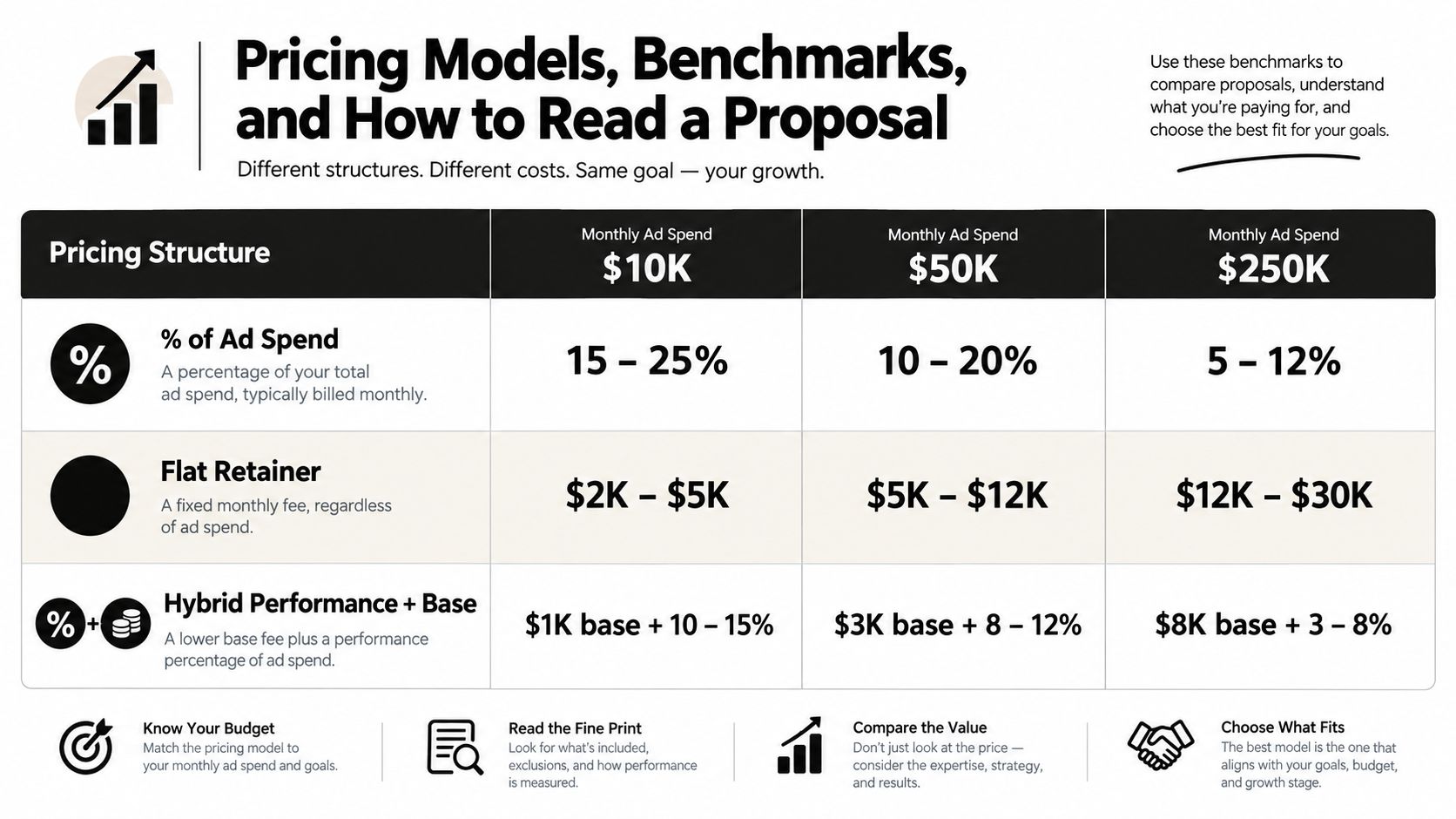
Pricing tells you what behavior the agency is rewarded for. Read proposals with that in mind.
A percentage-of-spend model rewards expansion. A flat retainer rewards efficiency, but can also lead to lower service intensity if the scope grows. A hybrid model tries to balance both, but only if the terms are clean.
What each model pushes agencies to do
Percentage of ad spend
This is common because it scales easily. The conflict is obvious. The agency gets paid more when spend goes up, even if profit quality doesn't improve.
Use this model only if the proposal includes strong controls around efficiency, channel mix, and spending authority.
Flat retainer
This can work well for stable accounts with disciplined scope. It usually aligns better if your main need is strategic control, account cleanup, feed governance, and reporting.
The risk is under-resourcing. If your catalog, channels, or creative needs expand, the agency may protect margin by reducing attention.
Hybrid performance plus base
This model can be sensible if the base fee covers real labor and the variable piece is tied to clearly defined outcomes. But read the fine print carefully. Many “performance” models still reward spend growth more than business health.
Proposal reading rules
Don't compare proposals by headline fee alone. Compare total operating drag.
Look at:
- Management fee structure: How the fee changes as spend rises.
- Included scope: Feed work, reporting, landing page input, creative iteration, promo support.
- Additional tools or service charges: Feed platforms, analytics work, design support, call tracking, or reporting setup.
- Who does the work: Senior strategist, junior coordinator, or a pooled team model.
One current trend matters here. Improvado's PPC trends analysis says that privacy-first targeting, modeled conversions, and first-party data readiness are now central, and that each additional channel can add 15 to 20 hours per month in management complexity. If a proposal promises broad multichannel management for a suspiciously low fee, assume something isn't staffed properly.
Don't let benchmarks replace business math
Agencies love “benchmark” language because it sounds objective. Benchmarks are useful. They are not your decision framework.
The practical way to read a proposal is:
- Check break-even first: Can your margin support the agency's implied efficiency assumptions?
- Review channel logic second: Are they pushing the right products and campaign types?
- Calculate agency drag third: Add management fees, tool costs, and any creative or landing page extras.
- Stress-test the model against weak months: Promo periods hide a lot of bad decisions.
A proposal is not a strategy. It's a pricing story wrapped around assumptions. Your job is to find the assumptions that break first.
Hidden costs that get ignored
Read line items slowly. Ask direct questions.
Watch for:
- Creative add-ons: New image sets, video edits, copywriting.
- Landing page fees: Build work, testing, or CMS support.
- Feed tooling: Third-party catalog software or management layers.
- Reporting extras: Custom dashboards, attribution cleanup, or analytics audits.
A good proposal should be boringly clear. If it takes three calls to understand billing, reporting, and scope, don't expect campaign management to be cleaner.
Contract Terms and the First 90 Days of Onboarding
Most founders spend too much time on pricing and too little time on contract terms. That's backwards.
The contract determines whether you can leave cleanly, keep your data, and hold the agency accountable when performance slips.
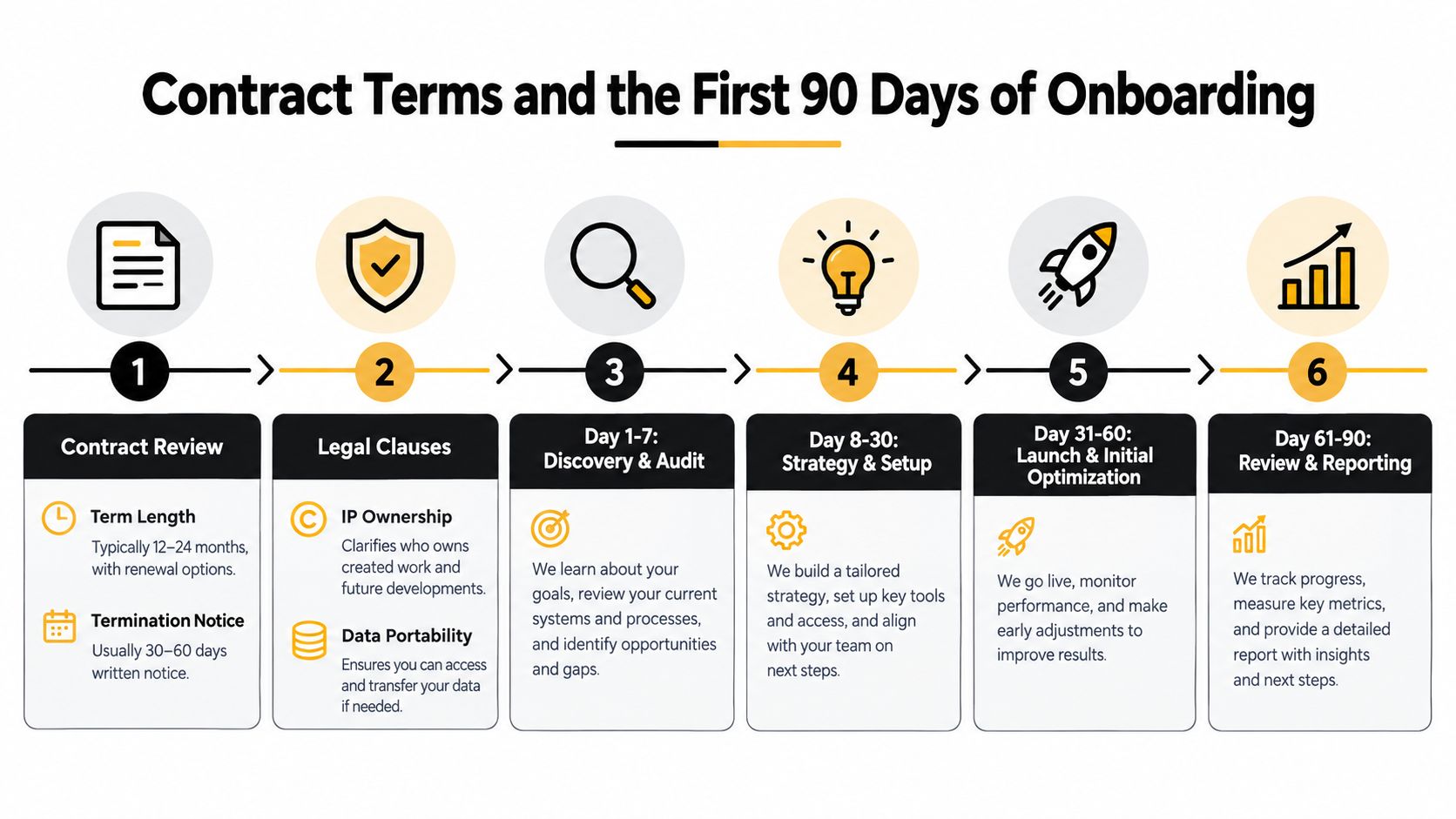
The clauses that actually matter
Ignore the legal padding and go straight to the operating terms.
Check these first:
- Term length: Shorter is better until the agency earns trust.
- Termination notice: You want a clean exit path without drawn-out lock-in.
- Account ownership: You should own the ad account, audiences, data, and creative assets created for your business unless something very specific is negotiated otherwise.
- Data portability: Reporting setups, naming conventions, and exported history should not be trapped inside agency systems.
- Exclusivity language: Be careful if the contract limits your ability to use specialists elsewhere.
- Scope language: The contract should say what's included around feed work, creative support, reporting cadence, and platform coverage.
If the agency resists clear ownership language, move on. That fight usually gets worse, not better.
What the first 90 days should look like
A proper onboarding period isn't “launch and pray.” It should have visible milestones.
Day 1 to 7
The agency should audit the account, validate conversion tracking, inspect feed health, review campaign structure, and confirm economic targets.
At this point, they should also identify immediate risks, such as broken measurement, brand pollution in reporting, or catalog disapprovals.
Day 8 to 30
This is setup and cleanup. Expect restructuring, query exclusions, feed corrections, budget realignment, and a reporting baseline you can read.
Success here doesn't require flashy growth. It requires clearer control.
Day 31 to 60
Now campaigns start earning judgment. The agency should launch the first controlled tests, compare campaign types properly, and show what's improving versus what's still unstable.
You're looking for decision quality, not just prettier charts.
Day 61 to 90
By now, the account should have a stronger operating rhythm. Reporting should make sense, testing should have a logic chain, and you should know whether the team deserves a longer runway.
If the account is still chaotic at this stage with no clear ownership, the problem is probably the operator, not just the account history.
Define what happens if targets are missed
Founders often hesitate at this stage. Don't.
Set expectations in writing:
- Reporting cadence: Weekly operating update, monthly strategic review.
- Escalation path: Who gets involved if results deteriorate.
- Target review logic: What gets diagnosed first if core KPIs miss plan.
- Remediation period: What the agency commits to changing before you reassess the relationship.
Missed targets are not automatically a failure. Missed targets without a diagnosis and a corrective plan are.
Kickoff template to hand over on day one
Give the agency a short written brief with:
- Primary business objective
- Non-negotiable efficiency floor
- Top-margin product lines
- Low-margin or restricted categories
- Promo calendar
- Inventory constraints
- Internal approver for budget and creative
- Required day 30, 60, and 90 outputs
That forces clarity early and makes later excuses harder.
Red Flags, Comparison Template, and the Final Decision
By the time you have two or three finalists, most of the obvious differences are gone. Everyone sounds competent enough. Everyone says they care about performance. Everyone has a process.
You stop listening to positioning and start watching behavior.
Red flags that predict bad outcomes
Some warning signs are immediate no's.
Walk away if an agency:
- Guarantees a specific ROAS outcome. Serious operators know the account, market, offer, feed, and measurement all affect performance.
- Won't show the fee structure clearly. Hidden economics create ugly surprises later.
- Avoids naming the day-to-day owner. If nobody is named, nobody is accountable.
- Stays vague on attribution and incrementality. They may be good at platform reporting and weak at business truth.
- Pushes hard for a long contract before a real pilot. Confidence is good. Pressure is not.
Reference checks matter more here than another sales call.
Ask references:
- What changed after the first month?
- Did reporting become clearer or just more frequent?
- Who managed the account?
- How did the agency handle mistakes?
- Would you hire the same team again?
The tone of the pause before the answer tells you a lot.
Use a scorecard, not gut feel
Gut feel still matters. But use it after scoring, not instead of scoring.
Ecommerce PPC Agency Finalist Comparison Template
| Evaluation Criteria | Weight | Agency A Score (1-5) | Agency B Score (1-5) | Agency C Score (1-5) | Notes |
|---|---|---|---|---|---|
| Objectives alignment | Do they understand margin, CAC limits, and growth priorities? | ||||
| Ecommerce vertical proof | Similar catalog, AOV, and promotional complexity? | ||||
| Feed and Merchant Center competence | Specific process or generic language? | ||||
| Strategy quality | Clear reasoning on Shopping, Search, PMax, and brand defense? | ||||
| Team structure | Named strategist, senior oversight, realistic ownership? | ||||
| Reporting clarity | Can you tell what they'll measure and why? | ||||
| Pricing transparency | All fees visible, including extras? | ||||
| Contract terms | Clean exit, ownership, and portability? | ||||
| Reference quality | Real clients with useful answers? | ||||
| Communication quality | Direct, specific, accountable? |
Weight the top rows more heavily than style points. Plenty of agencies sell confidence. Fewer can diagnose, prioritize, and execute consistently.
My recommendation for the final decision
Run a pilot. Keep it structured. Make it hard to fake competence.
A good pilot has these traits:
- Clear scope: Which channels, campaigns, or product sets they own.
- Defined timeline: Long enough to diagnose and act, short enough to exit if needed.
- Named account owner: One person responsible for the moving pieces.
- Written success criteria: What you expect by each review point.
- Exit rights: If reporting stays muddy or execution stays vague, you leave with your account intact.
Don't pick the cheapest option unless they also gave the clearest answers. Don't pick the biggest name unless you know exactly who will run the account. Don't pick the agency with the slickest deck if they couldn't tell you what they'd pause in week one.
Pick the team that thinks clearly, communicates plainly, and treats your ad account like an operating system, not a black box.
That's the ecommerce PPC agency you can scale with.
If you're evaluating agencies right now, build your shortlist with the scorecard above and make every finalist answer the same questions in writing before the last call. That one step will save you from most expensive hiring mistakes.