You can spend half a year building the product, then discover on launch day that nobody agrees on who it's for, why it matters, or what should happen after someone clicks. I've seen founders run a polished Product Hunt launch, watch traffic spike, and then stare at flat activations because the path from awareness to revenue was never designed. That's the failure pattern with a go to market strategy. It's not a deck problem, it's an operating problem.
A working GTM plan connects positioning, channels, pricing, enablement, and feedback loops into one system. That matters now more than ever because modern benchmark data still shows how common formalization gaps are, with 72% of companies having no formal GTM strategy and documented strategies linked to a 3.4x higher chance of successful launch in one 2026 roundup, while another benchmark says 68% of GTM failures trace back to positioning and messaging gaps (worky.com). If that sounds familiar, it's because teams still confuse motion with message, and message with execution.
Table of Contents
- Why Most Go to Market Plans Fail Before Launch Day
- Defining Your ICP, Positioning, and Value Proposition
- Choosing PLG, Sales-Led, or a Hybrid Motion
- How HackerContent Can Help
- Pricing, Channels, and Your Launch Timeline
- KPIs to Track in the First 30, 60, and 90 Days
- Common GTM Pitfalls and How to Avoid Them
- Your 90-Day Go to Market Roadmap and FAQ
Why Most Go to Market Plans Fail Before Launch Day
The collapse usually starts in a calm conference room, long before customers see anything. A team gets six months into building, someone makes a launch slide deck, and everyone nods because the story feels coherent on paper. Then the product ships, traffic arrives, and the numbers stop moving because no one defined what happens between click, activation, and revenue.
The mistake isn't lack of effort. It's treating the go to market strategy like a marketing campaign instead of a company-wide operating model. A real GTM plan has to coordinate product readiness, channel selection, sales behavior, support responses, and the internal handoffs that keep prospects from falling through the cracks, which is why one practical internal resource on launch mistakes can be useful for founders comparing notes with their own team, especially when they're deciding what to fix before a public release. See the launch-specific breakdown at Aura++ studio's founder launch mistakes guide.
The two failure modes that keep repeating
The first failure mode is a slide deck masquerading as strategy. It looks organized because it has market slides, persona slides, and a timeline, but it doesn't force anyone to answer who owns qualification, when sales gets looped in, or what happens if the first cohort doesn't convert. In practice, that's not strategy, that's presentation.
The second failure mode is treating GTM as a marketing-only function. That usually creates an elegant top of funnel and a broken back half of the journey. Customers don't experience your company as departments, they experience response time, clarity, proof, and follow-through.
Practical rule: if sales, product, and marketing can all describe the launch differently, you don't have a go to market strategy yet.
Why plans break when they meet customers
Plans written in isolation tend to fail for the same reason code fails without tests. They assume the buyer behaves like the team expected, and they assume every handoff will happen cleanly. Real buyers don't read the internal memo.
The better framing is to run GTM through three lenses. Customer clarity tells you exactly who you're serving. Motion fit tells you how this product should be bought. Execution cadence tells you how the team stays aligned after launch day, when the real work starts.
That's the spine of this playbook. Each section is designed to give you a working artifact, not a theory lecture. If you can ship it this week, it belongs here.
Defining Your ICP, Positioning, and Value Proposition
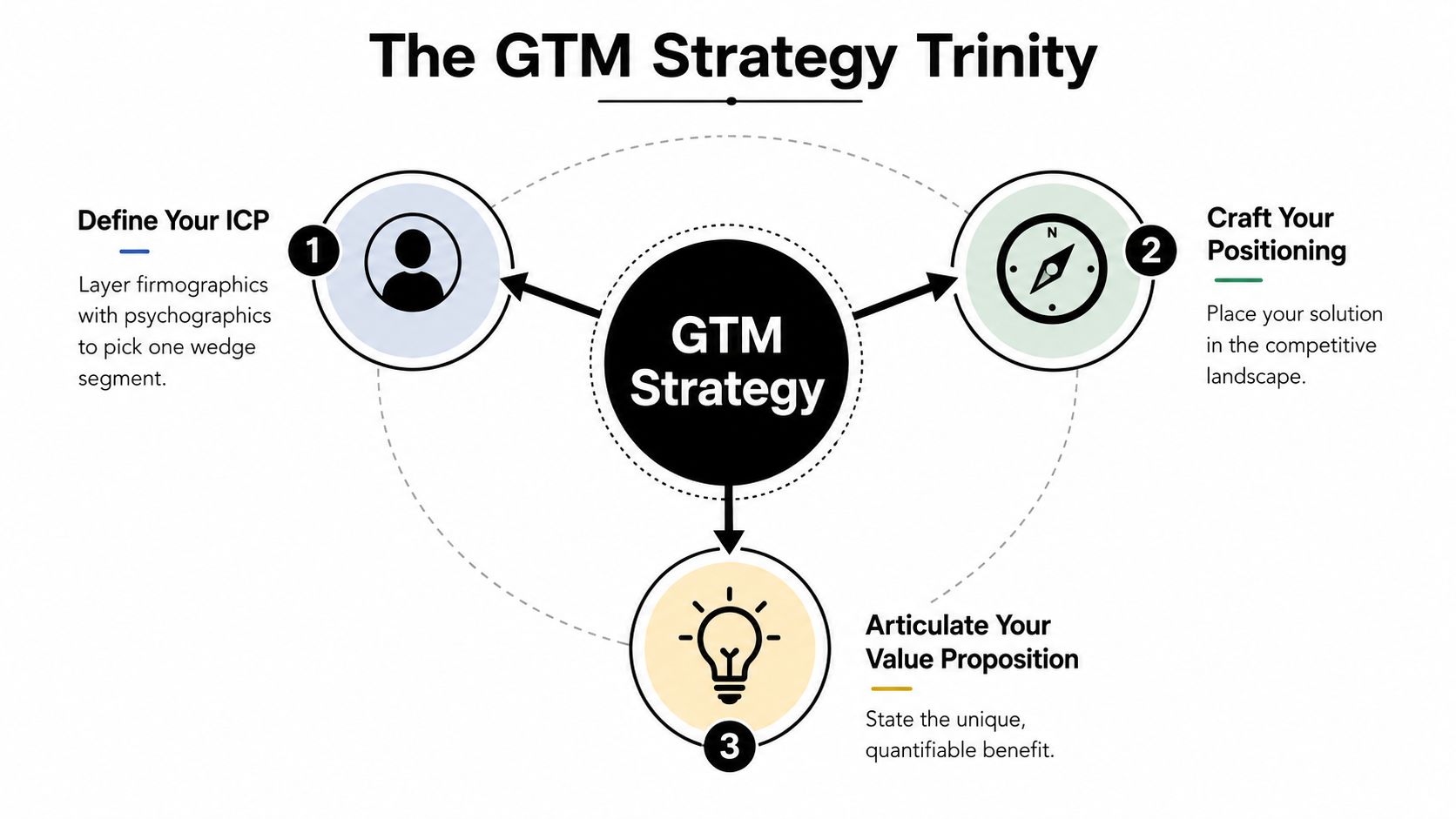
These three pieces belong together because each one answers a different buyer question. ICP tells you who should care. Positioning tells you how you fit in the market. Value proposition tells the buyer what changes after they choose you.
Start with one wedge, not a market map
A lot of founders start with a broad category and work backward. That's how you end up writing for “operations leaders,” “growth teams,” or “modern businesses” and then wondering why nobody feels spoken to. A stronger approach is to choose one wedge segment first, then layer in firmographics and behavioral signals.
For example, a developer tools startup might start with platform engineering leads at Series B SaaS companies. That's narrow enough to guide messaging, but still large enough to test. The personification exercise matters here. Write one paragraph that says what this person owns, what they're measured on, what breaks their week, and what would make them forward your email to a colleague.
Use that paragraph to sanity-check the rest of your launch. If a new hire couldn't tell who the buyer is after reading it once, it's too vague.
A tight ICP doesn't shrink the opportunity, it reduces the number of wrong conversations your team has to have.
Turn the ICP into positioning
Positioning is where teams get sloppy. They either copy a competitor or describe the product so broadly that it sounds interchangeable. A practical format is alternative-to, who-for, and what-changes.
For the same developer tools example, the positioning could look like this. Alternative-to, manual internal tooling and generic observability workarounds. Who-for, platform engineering leads in Series B SaaS companies who need consistent delivery workflows without hiring more headcount. What-changes, the team gets faster internal release handling with less coordination overhead.
That framework forces you to answer three buyer questions. Why now should be obvious from the pain. Why you should be visible in the mechanism or category fit. Why this matters should connect to operational outcomes the buyer already cares about.
The best positioning statements don't try to impress everyone. They create relief for the right buyer.
Translate positioning into a value proposition
The value proposition is where the message becomes usable. Use a simple structure, headline, proof point, and primary CTA. The headline should carry the promise. The proof point should support it with one clear reason to believe. The CTA should point to a single revenue action, not a vague “learn more” path.
For the developer tools startup, the headline might promise faster internal delivery coordination. The proof point could be a specific workflow simplification, if you have one. The CTA should send the buyer to the next commercial step, such as a demo request or pilot signup, depending on motion.
Here's the discipline. Don't ask whether the message sounds clever. Ask whether a buyer could forward it to their boss without rewriting it.
A 30-minute solo exercise before you pitch anyone internally
If the team isn't aligned yet, do this alone first.
- Write the ICP paragraph. Keep it to one paragraph, and make it specific enough that a new hire could recognize the buyer.
- Draft the alternative-to statement. If the alternative sounds as compelling as your product, you haven't positioned sharply enough.
- Write one CTA. Pick the single action that would matter most for revenue.
- Read it out loud. If you trip over jargon or feel tempted to explain every word, it needs tightening.
If you want help building authority around a new product before you socialize the message internally, the playbook on how to build authority for a new product is a useful companion.
Choosing PLG, Sales-Led, or a Hybrid Motion
The motion choice should follow the buyer and the economics, not the trend cycle. Too many founders pick product-led growth because it sounds modern, or sales-led because it feels safer, then discover the motion doesn't match how customers want to buy. The right answer starts with how much friction the buyer can tolerate and how quickly they need value.
What actually makes product-led growth work
PLG only works when the product can create value fast. If onboarding is heavy, setup drags, or the aha moment takes too long, self-serve turns into self-abandonment. It also needs enough top-of-funnel investment to feed the loop, because free discovery alone won't sustain it.
PLG also has economic limits. If the ACV can't support low-touch acquisition, you'll spend too much teaching customers before revenue shows up. That's why some products that look ideal for PLG on the surface end up needing assisted conversion after all.
When sales-led is the better default
Sales-led motion fits when buying is more complex. High ACV, multiple stakeholders, deep integrations, or regulatory pressure usually mean the customer wants a human to help de-risk the decision. In those cases, the sales process isn't a tax, it's part of the product experience.
Founders often misread the market. They assume sales is only for enterprise, but what really matters is whether the buying committee needs context, persuasion, and orchestration. If the buyer can't self-diagnose the value quickly, sales is doing necessary work.
Why hybrid is the motion most early teams end up using
Most early startups don't run a pure motion. They run a hybrid motion, even if they don't name it that way. A common pattern is a self-serve entry tier for individual users, then sales-assisted expansion for mid-market and enterprise accounts once usage signals justify the handoff.
The best hybrid setups share usage data across the self-serve and sales paths. That way, the rep doesn't show up cold, and the product team can see where conversion stalls. The mistake is making those motions feel like separate businesses.
Here's a simple decision table.
| GTM Motion Decision Framework | |||
|---|---|---|---|
| Criterion | Product-Led | Sales-Led | Hybrid |
| Buyer complexity | Best when the buyer can evaluate quickly | Better when multiple stakeholders need support | Best when entry is simple but expansion needs help |
| Time-to-value | Needs a fast aha moment | Can handle longer evaluation cycles | Can start fast, then deepen with sales |
| Economics | Works when low-touch acquisition is sustainable | Works when deal size supports human effort | Works when self-serve creates pipeline for sales |
| Instrumentation needed | Activation, trial-to-paid, product usage | Lead quality, close rate, cycle stage | Usage signals, handoff rules, expansion triggers |
One founder I worked with started in pure self-serve, then realized larger accounts kept asking for procurement help and rollout support. The team kept the entry tier, added a sales overlay, and stopped forcing enterprise buyers through a consumer-like path.
Another company did the opposite. It started with founder-led sales, then simplified onboarding and pricing so smaller teams could adopt without a call. Same product, different motion over time.
Name the motion clearly before launch. Then instrument the one or two mechanics that prove whether it's working, because the wrong motion will make a good product look weak.
How HackerContent Can Help
For cybersecurity startups, a go to market strategy often falls apart because the content sounds generic or the launch cadence is too thin to earn trust. That's where a specialist partner can help, especially if your team needs technically correct writing, social distribution, SEO, and launch assets in one workflow. One option is HackerContent's cybersecurity marketing strategy resource, which sits alongside its broader work in technical content, social media, SEO, video, and go-to-market planning for security vendors.
HackerContent is a fit when the problem isn't just “we need more content.” It's when the team needs security-aware messaging, search visibility for niche queries, and a launch plan that doesn't collapse after day one. Their model includes monthly retainers and bespoke projects priced in USD, which makes sense for teams that want an external production engine instead of stitching freelancers together.
The main trade-off is specialization versus generality. General agencies can move fast, but they often miss the technical nuance security buyers expect. A specialist shop is more useful when credibility, accuracy, and repeatable distribution matter more than broad brand styling.
Pricing, Channels, and Your Launch Timeline
Pricing isn't a math exercise, it's part of positioning. If the price doesn't match the job the buyer is trying to get done, the market reads confusion. The best GTM teams treat price, packaging, and channel sequence as one system, because customers don't separate them.
Price around value, then package for movement
Start with the value metric that best maps to ROI. If the buyer gets more value from usage, seats, workloads, or volume, build pricing around that logic instead of copying a competitor's menu. Then shape three tiers so the first tier is easy to say yes to, the middle tier is where most customers should land, and the top tier removes the constraints that matter to bigger accounts.
A simple tier structure helps if you're early and still learning. Don't overload the menu with every possible feature. Make the upgrade path visible through usage limits, support level, or governance features that align with real buyer growth.
| Pricing Tier Blueprint for an Early-Stage SaaS Launch | |||||
|---|---|---|---|---|---|
| Tier | Target Buyer | Value Metric | Price Range | Usage Limit | Upgrade Trigger |
| Starter | Small team or individual user | Core usage unit | Keep entry accessible | Light usage, basic features | Hitting limits or needing team controls |
| Growth | Core ICP account | Expanded usage and collaboration | Middle tier anchor | Higher volume and shared workflows | More seats, more volume, or stronger reporting need |
| Scale | Larger account or complex buyer | Governance, support, and control | Premium tier | Highest limits, admin features, or advanced support | Procurement, rollout complexity, or multi-team adoption |
Pick channels in the order your buyer will actually touch them
Channel choice should come from motion and ICP. For a narrow B2B wedge, outbound and targeted content usually come before broad paid scale. For self-serve, search, lifecycle email, and product education may matter more than a heavy sales motion.
Use this filter. If the buyer searches before they buy, content and SEO deserve early attention. If the buyer needs proof from peers, partnerships and community will matter more. If the buyer needs a guided sale, outbound and enablement can't be an afterthought.
Build the launch timeline backward from the buyer journey
A launch isn't one day, it's a sequence. The pre-launch work should lock the positioning doc, sales enablement assets, lifecycle emails, analyst brief, social kit, and on-page SEO before the public push. That's the minimum if you want the launch to create durable discovery instead of a short spike.
A useful distribution note for founders is that platforms with persistent project pages and SEO-focused launch assets can extend visibility beyond the launch window. One example is Aura++’s distribution strategy guide for indie founders, which is relevant if you're thinking about how a launch page can keep earning attention after the first wave.
If a launch plan only works on launch day, it isn't really a distribution plan.
A practical timeline looks like this:
- T-30 to T-21: finalize positioning, confirm the pricing page, and write sales rebuttals.
- T-20 to T-14: brief support, prep lifecycle email sequences, and validate the demo flow.
- T-13 to T-7: publish SEO pages, line up social posts, and lock launch assets.
- T-6 to T-1: dry-run the handoffs, test signup-to-activation, and confirm who answers inbound.
- T+1 to T+30: monitor conversion, review feedback, and adjust the offer where friction shows up.
The point isn't to be ceremonial. The point is to make sure every team knows what happens before the market sees your launch and what gets measured after.
KPIs to Track in the First 30, 60, and 90 Days
Vanity metrics can make a bad launch feel busy. Signups, impressions, and raw traffic are useful only if they connect to activation and revenue. The metrics that matter are the ones that tell you whether buyers are moving through the motion you picked.
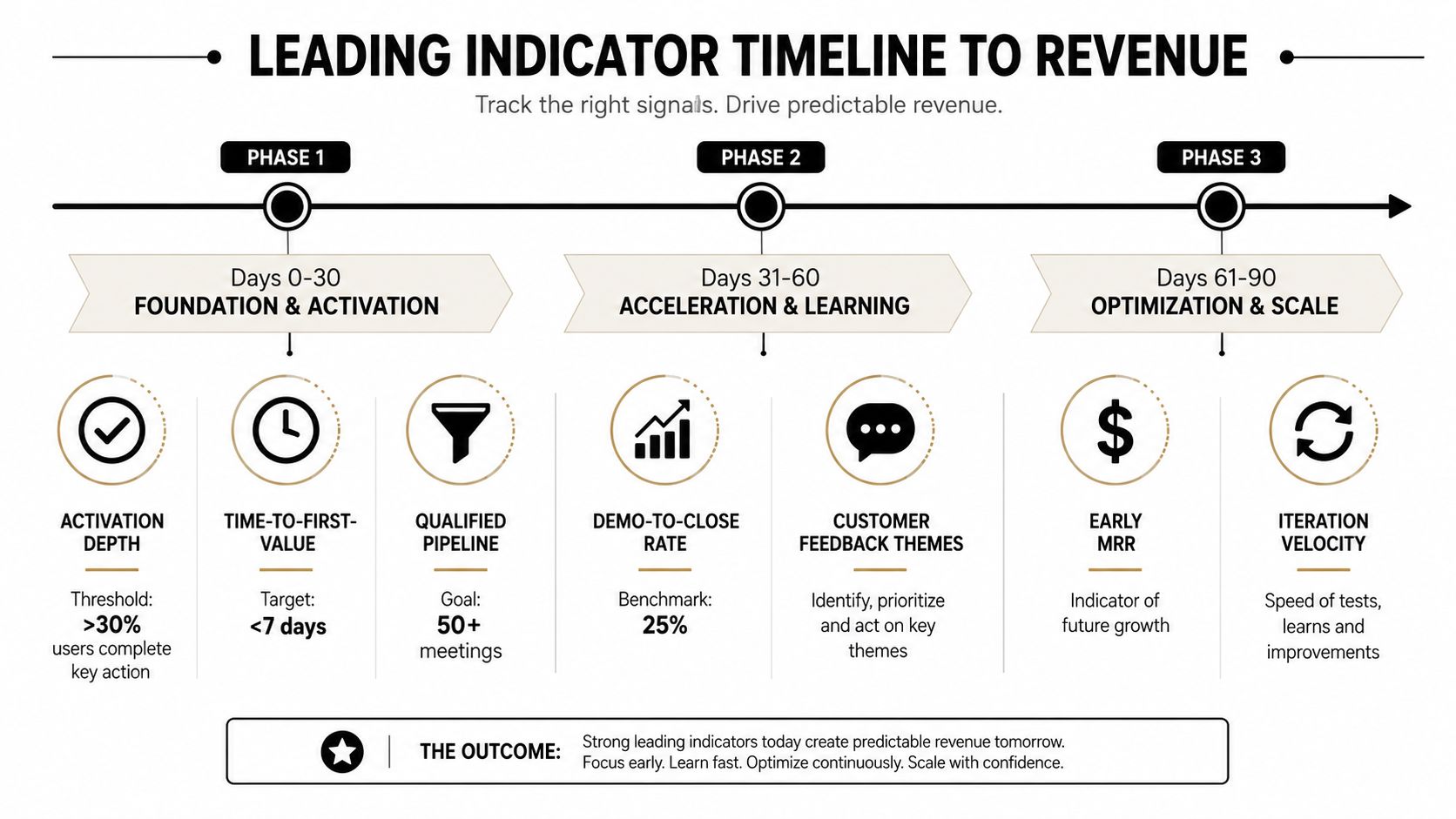
Days 0 to 30 focus on signal, not celebration
In the first month, watch activation depth, time-to-first-value, and qualified pipeline created. If users are signing up but not completing the key action, the issue is usually onboarding or message mismatch. If the sales motion is active but meetings aren't turning into qualified pipeline, the issue is usually qualification or positioning.
For PLG, the early question is whether users hit the first meaningful outcome quickly. For sales-led launches, the question is whether the team is creating the right conversations, not just more of them. For hybrid teams, both paths have to show some movement, or the handoff model is wrong.
Days 31 to 60 expose channel quality
By the second month, the signal should move from “did we launch” to “what's converting.” Track funnel conversion by channel, sales velocity for sales-assisted deals, and how quickly the team learns from objections. Weak channels stop hiding behind initial attention.
It also helps to audit whether each channel is pulling its weight. Some channels generate volume but not fit. Others create fewer leads but far better conversion. You want the latter if the economics hold.
Days 61 to 90 tell you whether the motion is repeatable
By month three, focus on whether the launch has become a system. Look at early retention behavior, expansion signs, and channel ROI. If the same motion keeps producing usable pipeline or activated users, you've got the start of a repeatable engine.
The mistake at this stage is over-crediting the launch spike. A strong opening can hide weak economics for weeks. By day 90, that camouflage is gone.
Track the metric that predicts the next stage, not the one that flatters the last stage.
Common GTM Pitfalls and How to Avoid Them
The easiest way to kill a launch is to make several small mistakes at once. Broad targeting, copied messaging, fuzzy pricing, and weak feedback loops each create friction on their own. Together, they turn a real product into a hard sell.
Diagnose the symptom before you rewrite the plan
If the market is too broad, the symptom is usually a lot of activity and very little resonance. The fix is to shrink to the core ICP wedge until the message feels uncomfortably specific. If positioning looks suspiciously like a competitor's homepage, the fix is to define your own stance and the alternative you're replacing.
If pricing is an afterthought, the symptom is buyer hesitation at the end of the funnel. The fix is to anchor price to the value proposition from day one, not after the launch copy is written. If you're ignoring customer feedback, the symptom is that the same objections keep showing up in sales calls and support tickets.
Don't wait for the product to be perfect
Some teams delay launch because they want the product “ready.” That usually means they're avoiding the work of making trade-offs visible. Others launch with no positioning doc and no handoff rules, then act surprised when the market interprets the product differently than the team intended.
The better trigger is customer evidence. If you can see enough buyer interest to validate the wedge, and the team knows how to respond to the first wave, it's time to ship. If not, tighten the offer before you throw budget at it.
When a launch platform makes sense
A launch platform is worth using when you need more than a one-day spike. If you want a persistent project page, structured distribution, or backlink value that survives the launch window, it can be a useful part of the plan instead of a vanity add-on. The important test is whether the platform extends discoverability, not whether it flatters the launch team.
The practical takeaway is simple. Two weeks before launch, confirm the ICP, rewrite the positioning, lock pricing, test activation, and decide whether your distribution plan matches the motion. If it doesn't, change the plan now, not after the market tells you.
Your 90-Day Go to Market Roadmap and FAQ
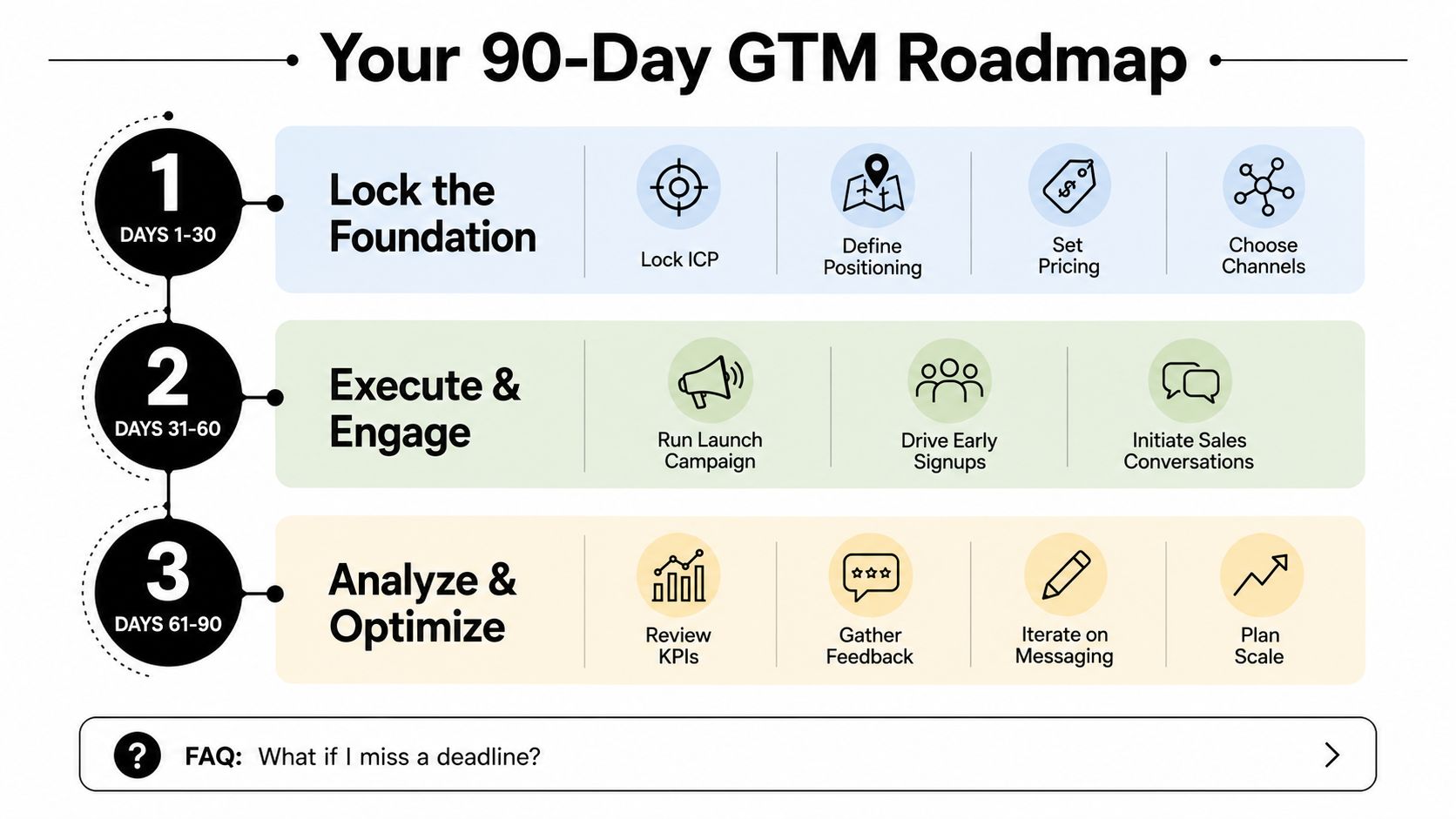
Days 1 to 30 are for locking the foundation. Finalize the ICP, positioning, pricing, and channel picks, then pressure-test the handoffs internally. Days 31 to 60 are for execution, inbound response, and early sales conversations. Days 61 to 90 are for tightening the message, reviewing the KPIs, and deciding which motion deserves more investment.
FAQ
When does a hybrid motion make sense? When you have a self-serve entry point but larger buyers need help to buy, roll out, or expand. That's the moment to connect usage data to sales.
How do I know pricing is wrong? Buyers hesitate at the end, discounting becomes common, or the tier structure doesn't match the value they're getting. That's usually a packaging problem, not a copy problem.
What should I ship to extend launch reach? Ship a strong launch page, a clear positioning summary, a social kit, and a publishable story that can be indexed and shared. If you use a launch platform, make sure it creates a durable page and not just a temporary burst.
How do I recover from a slow first 30 days? Stop promoting the whole product and isolate the friction. Recheck ICP, sharpen the message, and fix the first-value path before you spend more on distribution.
If you're about to launch, use this playbook as your working checklist, not inspiration. Lock the wedge, name the motion, and build the handoffs before the market does it for you.