Your launch went well. Traffic arrived, users signed up, and a few customers sent enthusiastic messages privately. Three months later, your website still has no useful testimonials because nobody built a process for asking, verifying, approving, and publishing them.
That gap is expensive. A competitor with a weaker product can look more trustworthy only because they consistently collect customer evidence and place it where buyers make decisions. The fix isn't another one-off email blast. You need a review operating system with eligibility rules, event-based timing, compliance controls, channel-specific copy, and a publishing workflow that turns genuine feedback into durable search assets.
Table of Contents
- Why Most Review Programs Quietly Fail
- Designing a Staged Review Workflow That Survives Audits
- Compliance and Incentive Design Without Buying Praise
- How Bragly Can Help
- Channel-by-Channel Scripts That Get Replies
- Turning Approved Reviews into SEO and AI-Citation Assets
- Metrics and Dashboards That Prove the Program Works
- Your 30-Day Rollout Plan and Final FAQ
Why Most Review Programs Quietly Fail
A founder usually notices the problem after the launch campaign has ended. The product page is live, paid traffic is running, and sales calls keep producing the same objection: “Do you have examples from customers like me?” The team remembers several happy users, but those comments are scattered across Slack, email, social posts, and support tickets. None has a clear permission record, customer context, or reusable format.
That isn't a customer satisfaction problem alone. It's a systems problem.
A review program fails when the business treats feedback as a reward for a successful launch instead of a normal operating step. Nobody defines who should receive a request. Nobody decides whether the right moment is after delivery, activation, onboarding, or a measurable outcome. Nobody records who was asked, who replied, what was published, or why someone was excluded.
Practical rule: If a team can't explain exactly when a customer enters the review workflow, the workflow doesn't exist.
The stakes extend beyond social proof. Reviews reveal the words customers use to describe outcomes, objections, features, and friction. Those phrases can improve product pages, sales enablement, support documentation, and search content. A project that earns attention but leaves no structured customer evidence behind loses much of its long-term value. For a launch-focused business, a page such as this real-time social proof project illustrates the kind of focused page where a clear product story and customer evidence can work together.
The four operating decisions
A durable program has four connected parts:
- Workflow design: Define eligible customers, trigger events, timing, reminders, and audit records.
- Compliance: Ask broadly, preserve criticism, disclose incentives, and never condition a reward on positive sentiment.
- Channel execution: Match the request to the customer's context instead of sending an identical message everywhere.
- SEO conversion: Turn approved feedback into indexable pages, internal links, structured content, and product insights.
The first decision deserves the most attention because every later outcome depends on the sample you create. If you ask only customers you expect to praise you, the resulting page may look polished while misrepresenting the experience. A credible program invites eligible customers consistently, accepts mixed feedback, and uses criticism to improve the product.
Designing a Staged Review Workflow That Survives Audits
Start with a one-page workflow. You don't need a complex platform to run it, but you do need explicit rules that another team member could follow without guessing.
Filter the audience before writing the message
Create an eligibility record for every customer or account. Include purchase date, delivery or activation date, product category, customer segment, support status, and the event that proves the customer has had a meaningful opportunity to evaluate the product.
Exclude customers whose experience isn't ready for public review. That includes refunded, cancelled, fraudulent, or unresolved orders. Don't use satisfaction signals to exclude people. A customer can have an unresolved complaint and still belong in your feedback system, but that person shouldn't receive a casual public testimonial request before the issue is addressed.
Test wording and select timing deliberately
Pilot the questionnaire with a small group that resembles your target audience. Ask whether the wording is clear, whether the questions apply to their experience, and whether the form feels proportionate. Balanced prompts work better than questions that push customers toward praise.
Timing should follow the experience being evaluated. Ask about a service interaction soon after it ends. Delay product-performance questions until the customer has used the product long enough to judge it. A review-timing study found that a next-day prompt produced fewer reviews than sending no prompt, while delayed prompts around day 9 or day 14 outperformed the control group. See the published review-timing research for the study details.
Use two touches:
- Initial request: Send a personalized message with one direct review link and a neutral question about the customer's experience.
- Reminder: Contact only nonresponders, and make the reminder easy to ignore without pressure.
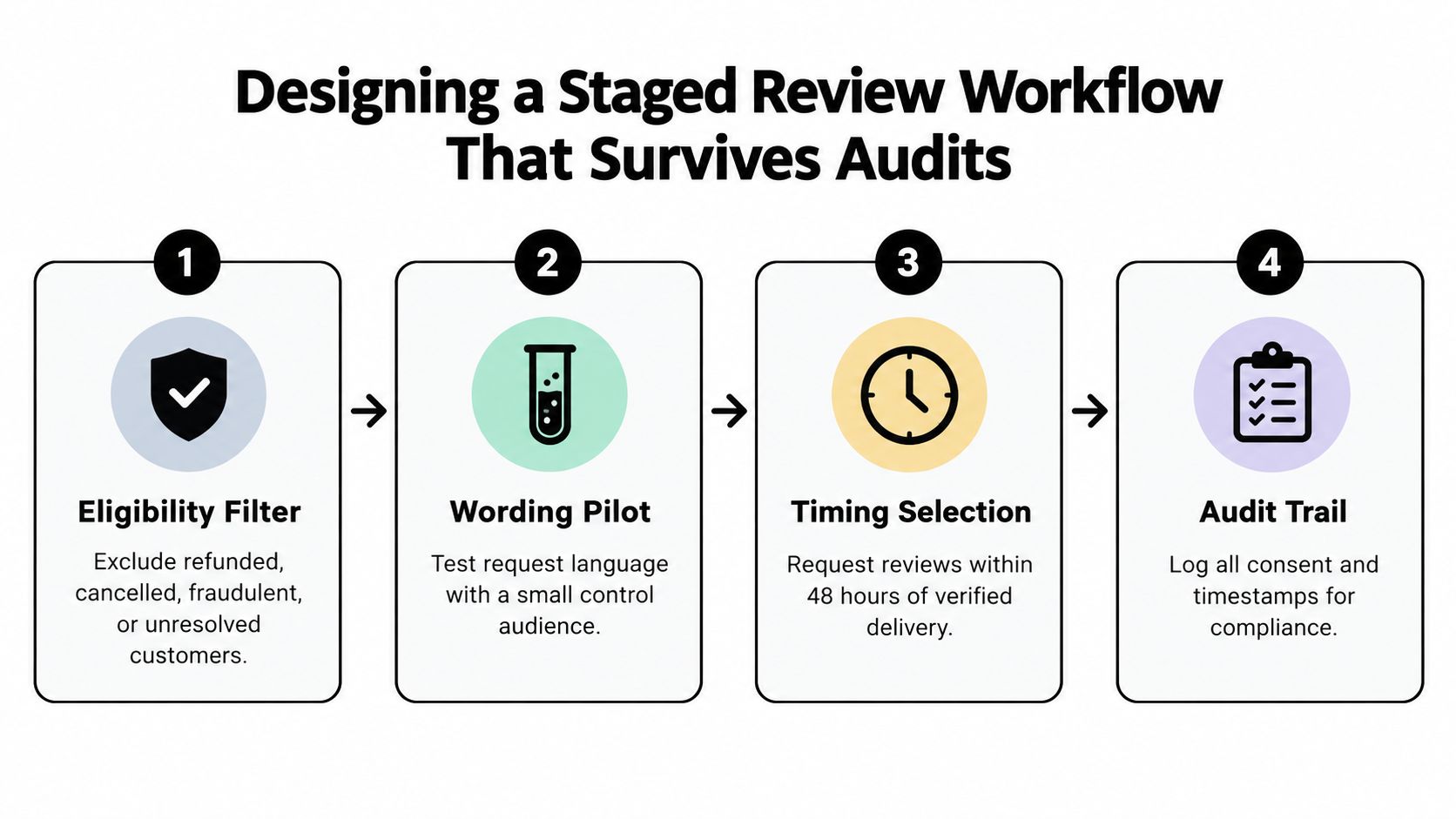
Record the complete trail
Track delivered, opened, clicked, started, completed, published, and invalid-review counts. Calculate completion rate as completed reviews divided by delivered requests, then compare cohorts rather than relying on one blended figure. A cohort might be defined by product category, acquisition channel, customer type, or timing window.
A CRM trigger can add eligible customers to the workflow when an order is delivered or a launch milestone is completed. An in-product survey SDK can trigger a prompt after activation. A lightweight form builder can handle the first version. The tool matters less than the event record and the rules around it.
Put these fields in a Notion database or spreadsheet this week:
- Customer and account identifier
- Eligibility decision and reason
- Trigger event
- Request date and channel
- Link clicked and response status
- Review destination
- Consent and publication permission
- Rating, themes, and support follow-up
- Response date and owner
Compliance and Incentive Design Without Buying Praise
The most dangerous review strategy is the one that produces impressive numbers while hiding how those numbers were created. A business doesn't need to ban every incentive. It needs to stop confusing participation with praise.
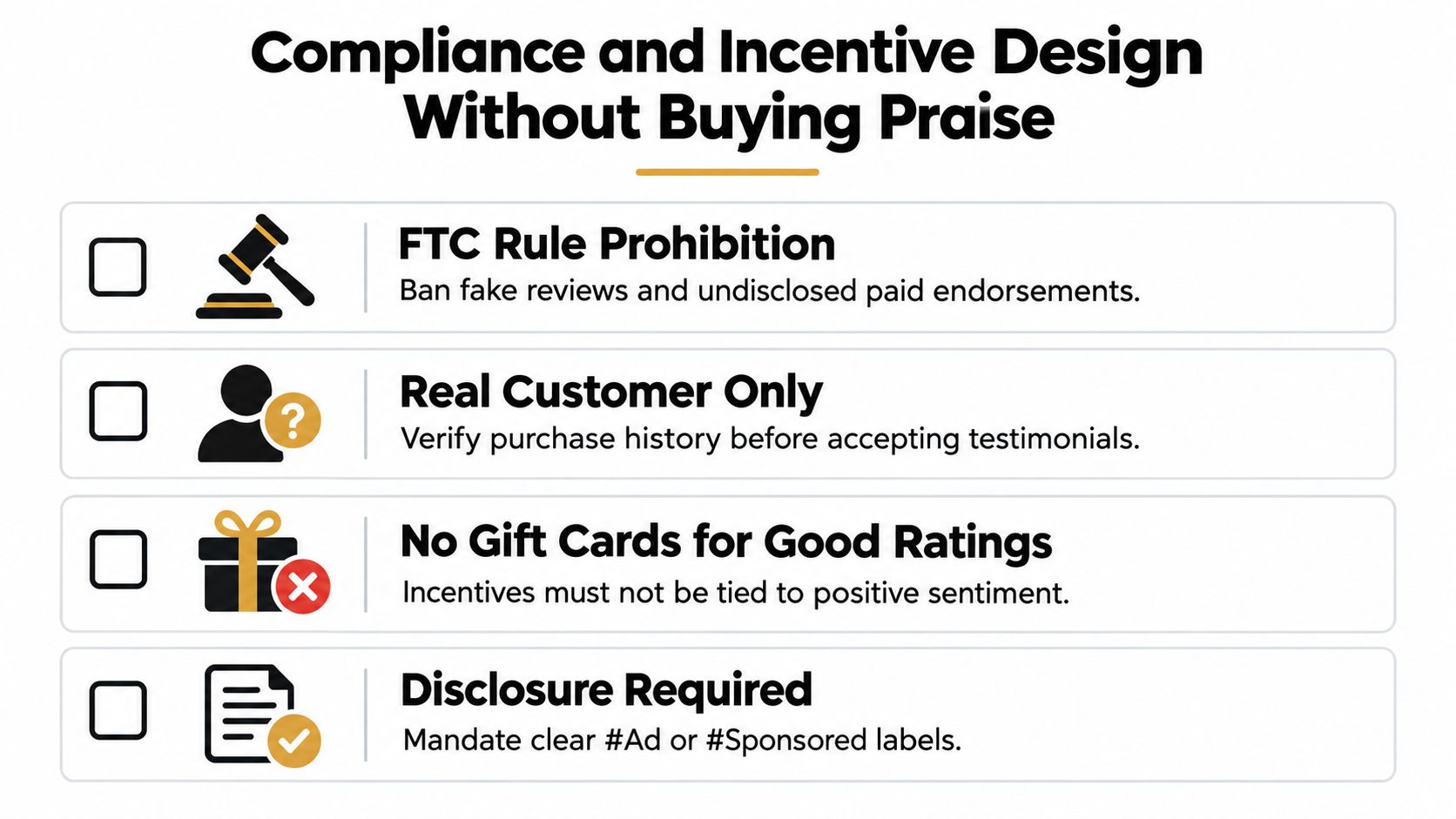
The FTC's Consumer Reviews and Testimonials Rule took effect on October 21, 2024. It prohibits fake or fabricated reviews, reviews from people without relevant experience, and compensation or incentives conditioned on a particular sentiment, such as a five-star rating. The rule doesn't categorically prohibit a neutral incentive for an honest review, but the business should disclose the incentive because it can affect how readers assess credibility. The FTC's questions and answers about the rule provide the governing detail.
The FTC also advises businesses not to request reviews only from people they believe will leave positive feedback, and it warns against suppressing or discouraging negative reviews. That makes review gating a poor operating choice, even before reputational damage enters the picture.
Build a neutral exchange
Use this checklist before launching an incentive:
- Invite every eligible customer: Don't select recipients based on predicted sentiment.
- Ask about experience: Request an honest account of what happened, not a target rating.
- Disclose the reward: State the incentive in the request and wherever the review is displayed.
- Preserve criticism: Keep negative and mixed responses in the private feedback system, even if you don't publish every submission.
- Maintain records: Store eligibility rules, request history, consent, and publication decisions.
- Separate feedback from promotion: Let customers submit private feedback without requiring public publication.
- Reject synthetic praise: Never turn an AI summary into a customer quote or present AI-generated text as a customer's words.
Verification is now a product decision
The European Commission reported in March 2025 that 45% of consumers had encountered online scams, while fake reviews and misleading advertising remained persistent concerns. Read the European Commission's statement on online scams and consumer protection for the reported context.
That environment changes what “verified” should mean. Explain whether verification means a completed purchase, an activated account, a confirmed company domain, or another documented relationship. Don't expose unnecessary personal information. Ask permission before publishing a reviewer's name, photograph, company, or exact quotation, and offer an anonymous option.
The defensible objective isn't the largest possible review count. It's a balanced, traceable collection that a customer, regulator, platform, or future buyer can understand. A flashy volume campaign that rewards praise or filters complaints creates evidence against you. A neutral workflow creates evidence for you.
How Bragly Can Help
Once reviews exist across several channels, the operational problem changes. You need to find them, keep displays current, organize them by use case, and publish approved feedback without asking a developer to rebuild every page.
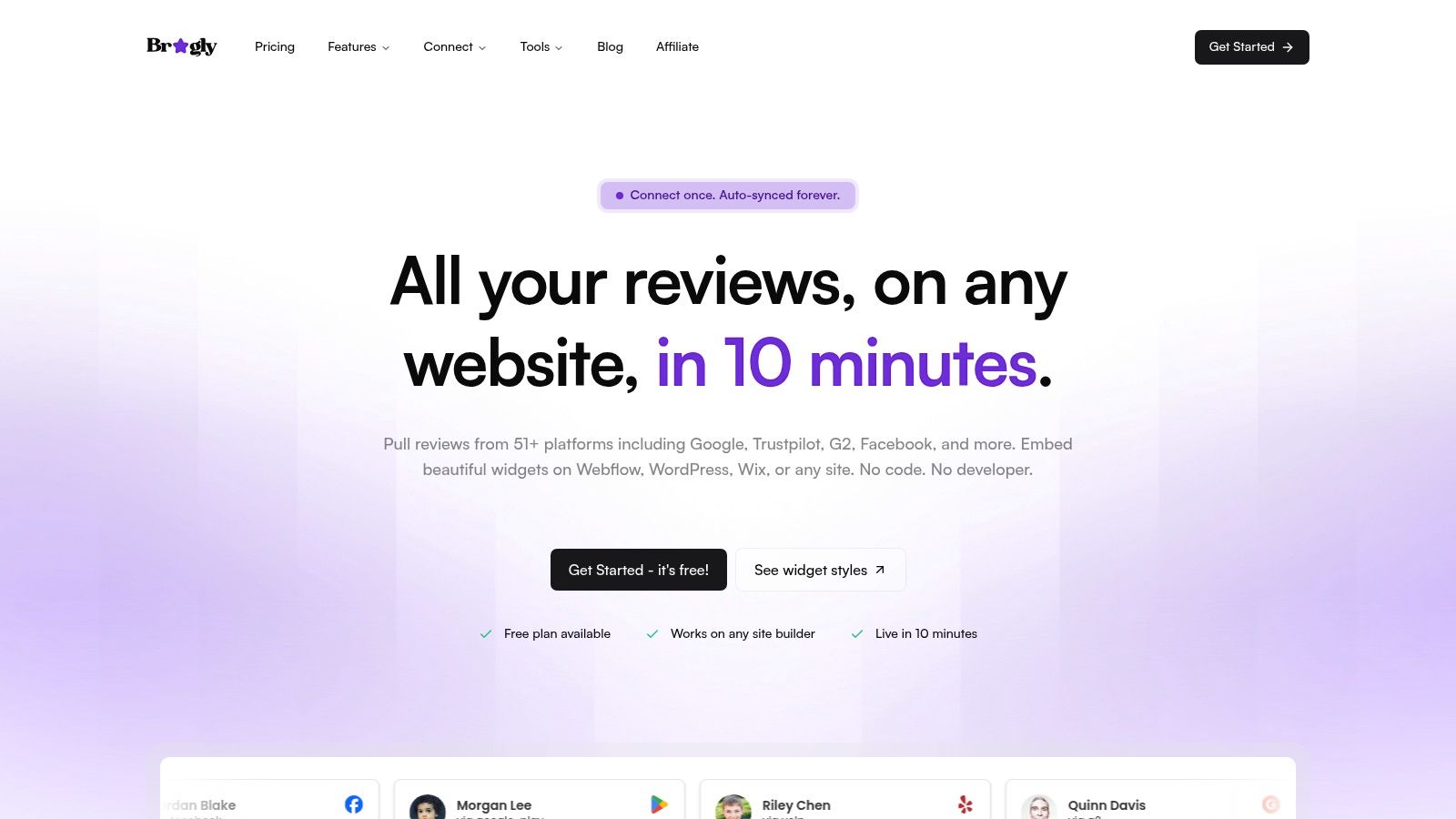
Collect customer reviews with Bragly can fit that middle layer. Bragly aggregates reviews from 50+ sources, including Google, Trustpilot, G2, Facebook, Yelp, Product Hunt, TripAdvisor, Capterra, the App Store, Google Play, Shopify, Airbnb, Glassdoor, and Zillow. It also supports first-party collection forms, so a team can combine external reviews with feedback captured directly from its own workflow.
Where it earns its place
The platform's no-code widgets work with Webflow, WordPress, Wix, and custom sites through copy-and-paste embeds. Carousel, grid, slider, mosaic, ribbon, badge, and video-highlight layouts let a team place evidence according to page purpose instead of forcing every testimonial into one component.
Auto-sync reduces manual updating when a connected source changes. Tags and organization tools help separate reviews by product, customer type, feature, or campaign. Webhooks can connect review events to other systems, while manual addition supports older text reviews that still have valid permission.
Bragly also offers AI-based review analysis and basic analytics. Use those features to identify recurring themes and candidate excerpts, not to manufacture customer language. A summary can guide your content team, but the published quote should remain faithful to the reviewer's actual words and consent.
When it's the right choice
Bragly makes sense when testimonials are spread across many platforms, site updates are manual, and the team needs consistent displays across several pages. Its listed plans include a free tier, Pro at $14 per month with a trial, and Business at $67 per month. Treat those prices and plan limits as current product information to verify before purchase, since offerings can change.
It isn't a substitute for eligibility rules, consent records, or balanced outreach. Use it after designing the collection process, when the challenge is managing and activating legitimate evidence at scale.
Channel-by-Channel Scripts That Get Replies
The best request is specific to the moment that proves the customer has experienced the product. Keep the public destination simple, but make the private prompt useful enough to produce detail.
In-product prompt
Trigger this after a meaningful outcome, such as a completed setup, published page, successful export, or resolved workflow.
Copy:
You've completed [outcome]. What worked well, and what should we improve? Share an honest review here: [review link]. You can submit feedback privately or give us permission to publish it.
Avoid: Showing the prompt immediately after signup, before the customer has reached an outcome.
Tweak: Test the prompt after the outcome event against a prompt shown after a generic session. Compare completed reviews by cohort.
Post-purchase or post-launch email
Use a subject line that describes the request plainly. Give the customer one action, not a menu of review sites.
Subject: How did [product or launch] work for you?
Copy:
Hi [name], you've now had time to use [product]. Would you share an honest review about your experience? It takes a moment: [review link]. You can mention what you used, what changed, and anything that needs improvement. Thanks, [sender]
Avoid: A long brand story, several links, or language such as “Please leave us five stars.”
Tweak: Shorten the body to three sentences and compare completion by delivery, activation, or launch cohort.
Launch page call to action
A launch page should make publication permission explicit. Don't imply that every submitted comment will appear publicly.
Copy:
Used [product] in a real project? Tell us what happened. Submit an honest review, choose whether we may publish it, and add your name or company only if you're comfortable.
Avoid: Copying a social comment onto the page without confirming the reviewer's identity and publication permission.
Tweak: Add a structured field asking what the customer used, what outcome they reached, and who the product is for. Those answers create better page content than a blank text box.
Personal outreach for a high-value customer
Personal outreach can produce depth, but it mustn't become selective solicitation for praise. Contact customers because their experience is relevant, not because you already know their rating.
Copy:
Hi [name], I'm collecting honest feedback from customers who used [product] for [use case]. Would you be open to sharing what worked, what didn't, and whether we may publish your comments? There's no required rating, and private feedback is welcome too: [review link]
Avoid: Asking a customer to approve a prewritten testimonial that exaggerates the result.
Tweak: Offer a short call or voice-note option, then transcribe only with permission and send the text back for approval.
When a customer responds negatively, acknowledge the experience without arguing. Ask whether they'd prefer to discuss it privately, and invite public publication only if they volunteer. A negative review isn't a lead-generation failure. It can identify a broken onboarding step, unclear promise, or support gap that positive comments won't reveal.
Turning Approved Reviews into SEO and AI-Citation Assets
A review becomes a growth asset when a buyer can find it, understand its context, and connect it to the product decision they're making. Leaving every quote in a hidden carousel wastes the language customers already supplied.
Start with a dedicated review page for each important product or use case. Keep the page indexable, link it from relevant product and feature pages, and use headings that reflect the customer's language. If customers repeatedly mention onboarding, reporting, or integrations, those themes can become category hubs that organize approved quotes around real buying questions.
Create useful page architecture
A practical structure looks like this:
- Review hub: Introduce the product, explain how reviews are collected, and link to use-case pages.
- Use-case page: Group approved feedback from a defined customer segment or job to be done.
- Feature page: Place short, relevant excerpts beside the feature they describe.
- Customer story: Expand one approved review into a fuller account, with attribution and consent.
- Internal links: Connect each quote to the product, feature, documentation, or comparison page it supports.
Use structured data carefully and only where the visible page content supports it. Don't add markup for reviews that visitors can't see, and don't imply that every review represents the market. The objective is clarity for humans and machines, not a shortcut to inflated search presentation.
Preserve the evidence chain
For every published review, store the original submission, the approved edit, the customer's permission, attribution choice, date, product context, and source URL where applicable. If you shorten a quote, keep the meaning intact and mark substantial edits clearly.
A launch platform such as Aura++ can use the same principle when a product page combines launch outcomes, category placement, badges, and customer language. A permanent page becomes more valuable when it links to supporting feature pages, receives approved feedback after the launch, and remains useful after the initial announcement. For founders working on AI visibility, the guide to getting a startup cited in AI search answers offers a related framework for making company information easier to interpret.
Don't treat AI agents as a separate audience that needs special praise. They need clear entities, consistent descriptions, visible evidence, attribution, and accessible pages. A reviewer's exact wording can support discoverability, but only if you have permission to publish it and the surrounding page explains who said it, what they used, and why the comment applies.
Metrics and Dashboards That Prove the Program Works
A higher review count does not prove a healthier program. The team may be reaching only enthusiastic customers, asking before customers have used the product, or publishing feedback without a dependable consent record. Measure the operating signals behind each review, not just the star average.
| Metric | What it measures | Healthy signal |
|---|---|---|
| Completion rate by cohort | How many delivered requests become completed reviews in each segment | Comparable performance across relevant cohorts, with weak groups visible |
| Average response time | How quickly the business acknowledges public feedback | Positive and negative reviews receive timely attention |
| Sentiment themes | Recurring praise, friction, objections, and feature requests | Themes inform product and content decisions |
| Positive and negative review mix | Whether published feedback reflects a credible range of experiences | Balanced evidence, not an artificially perfect profile |
| Review-page referral traffic | Whether published pages attract engaged visitors | Relevant visitors reach product and feature pages |
| AI-answer visibility | Whether clear, attributed product evidence appears in AI responses | Increasing presence for relevant customer questions |
Review the dashboard weekly. A spreadsheet is enough at first. Add the request date, channel, cohort, delivery status, completion status, publication decision, rating, themes, response date, and referral destination. For a concrete example of turning raw feedback into measurable signals, see the customer feedback insights platform.
Check for strong opens but weak completions in a channel, repeated onboarding complaints within a cohort, or review pages that attract traffic without sending visitors to product pages. These patterns show where the workflow needs attention. They also separate a sampling problem from a product problem.
Do not optimize for a perfect sentiment line. If every published review is positive, inspect eligibility rules, request timing, and publication decisions before celebrating. A balanced set of responses gives product teams clearer direction and gives buyers stronger reasons to trust the page.
Customer feedback should change the roadmap. When several customers describe the same setup difficulty, assign an owner and record the resulting product change. When customers use a feature in an unexpected way, update its positioning and page structure. Marketing gains credible material from reviews, while product improvements determine whether future feedback becomes stronger.
Your 30-Day Rollout Plan and Final FAQ
Week one, define eligibility, write neutral scripts, choose the review destination, and create the consent fields. Week two, launch the workflow in one channel after a meaningful customer event. Week three, add a reminder for nonresponders, respond to every public review, and tag recurring themes. Week four, publish an indexable review page and review the dashboard with product and marketing owners.
How often should you ask repeat customers? Ask after a new meaningful outcome, not after every transaction. Keep a record of previous requests so customers aren't repeatedly pressured.
Should negative reviews receive public or private replies? Acknowledge the public review briefly, then offer a private support path. Don't demand that the customer move the conversation or remove the review.
What should you do after a sudden negative spike? Pause promotional reuse of the affected claim, check the cohort and trigger event, investigate the common issue, and respond consistently. Don't delete criticism just because several customers reported the same problem.
Can reviewers remain anonymous? Yes, if the destination allows it. Explain what verification means, publish only the details the customer approved, and never expose personal information unnecessarily.
A defensible review program compounds over time. It creates trustworthy evidence, sharper product decisions, stronger landing pages, and a record your team can stand behind. Start this week by defining eligibility, writing one neutral request, and sending it after a real customer outcome. If you want to extend that evidence into a durable launch page, submit your product to Aura++ and build customer proof into the page instead of leaving it buried in private messages.