The most popular advice about local SEO tools is also the least useful: choose one all-in-one platform and let it handle everything. Local search doesn't work that neatly. Map visibility, listing accuracy, reviews, on-page relevance, local content, AI discovery, and reporting are different jobs, and a tool that's excellent at one may be mediocre at another.
The right stack depends on how many locations you manage, who owns execution, how much reporting clients or executives need, and how much operational complexity your team can absorb. The comparison below is designed around those jobs rather than a long feature checklist.
Each platform is evaluated for geographic accuracy, execution depth, automation, transparency, scalability, and integration potential. Some tools measure map visibility. Others distribute business data, manage reputation, or turn recurring work into approval-based workflows. Treating them as interchangeable usually creates overlapping subscriptions and uncovered gaps.
Aura++ can serve as a complementary launch and visibility layer, not a replacement for local SEO execution. Its permanent project pages, structured launch assets, category placement, internal linking, social distribution, and optional backlink packages can support broader discoverability for products and services. Your selected local SEO platform still needs to manage location records, Google Business Profile work, reviews, and map performance.
Table of Contents
- 1. Synup
- 2. BrightLocal
- 3. Whitespark
- 4. Semrush Local
- 5. Yext Listings
- 6. Uberall
- 7. Synup
- 8. Local Falcon
- 9. Localo
- 10. PlePer Local SEO Tools
- 11. Birdeye
- Top 11 Local SEO Tools Comparison
- Build the Stack That Matches Your Operating Model
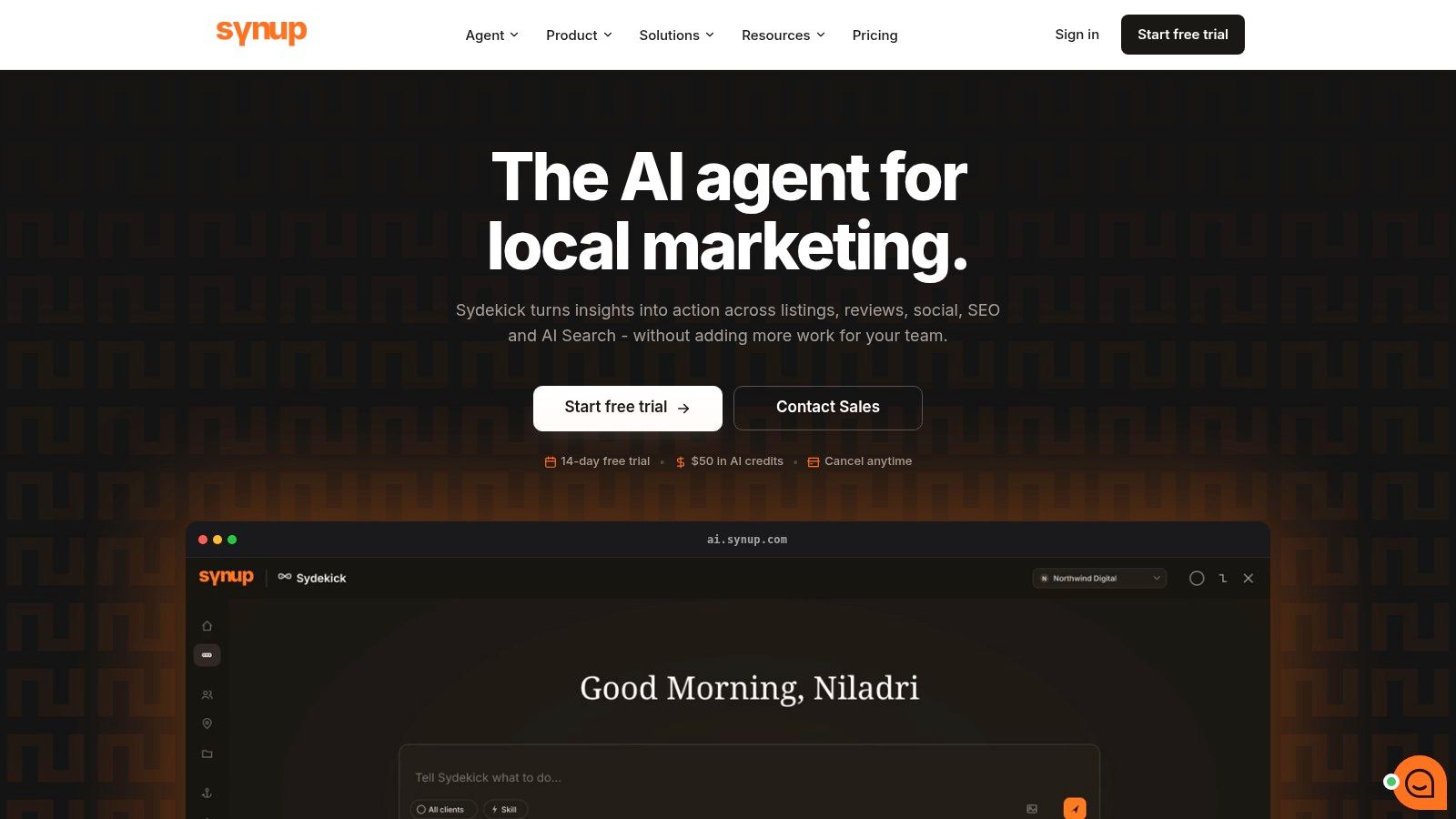
1. Synup
Synup is the strongest choice in this roundup when the local SEO problem is operational rather than purely analytical. It combines listings, reputation, social publishing, local pages, rank visibility, reporting, and an AI agent called Sydekick in one local marketing platform. That makes it relevant to agencies, franchises, software providers, multi-location brands, and small businesses that need repeatable execution across accounts.
The listings workflow is broad. Synup syncs business data across Google Business Profile, Apple Business Connect, Bing, Facebook, and more than 100 publishers, while audits and corrections help teams identify inaccurate or overwritten information. The platform also centralizes reviews, drafts responses for approval, supports review-request campaigns, and schedules location-level social posts with distinct brand voices.
Where Synup earns its place
Sydekick is the differentiator. It can use chat, memory, skills, playbooks, inference, approvals, and an audit trail to move from research to proposed content and publication under defined guardrails. That matters when a team isn't short of ideas, but is short of time to apply the same standards across every location.
The platform also includes a locator and location landing pages on a custom domain, local-pack tracking, visibility insights, and Answer Engine Optimization workflows that assess presence in ChatGPT, Gemini, and Perplexity. Agencies get a multi-client command center, white-label portals, scoped permissions, scheduled branded reporting, APIs, first-party MCP support, and model connector options.
Practical rule: Automation is useful only when every proposed change remains reviewable. Synup's audit trail and approval workflow make that distinction important for regulated brands and agencies protecting client accounts.
Synup isn't automatically the best fit for a single location that only needs occasional citation cleanup. Its value rises when repetitive tasks, multiple brands, location-specific voice, and client reporting create real workload. Pricing is structured around location count and agent throughput, so buyers should model usage and approvals before committing. For teams that need an execution layer rather than another dashboard, Synup's local SEO platform is worth serious consideration.
2. BrightLocal
BrightLocal fits the measurement-heavy local SEO workflow. It brings together local audits, Google Business Profile audits, citation monitoring, review management, Google Posts scheduling, rank tracking, and the Local Search Grid, which displays visibility across a geographic area rather than reducing performance to one average ranking.
That geo-grid view is especially useful when a business ranks well near its address but disappears in surrounding neighborhoods. A practitioner can scan the target service and location, identify weak areas, compare competitors, then connect those gaps to GBP improvements, landing-page work, review processes, or local authority building. It gives clients and non-SEO stakeholders something more concrete than a single ranking line.
BrightLocal's Citation Builder is a practical advantage for teams that don't want a permanent citation service commitment. You can use the platform for ongoing monitoring and purchase citation work when a project needs it. The trade-off is that the core platform has moved to price-on-request, which makes early budget comparison less straightforward, while its listing-sync network is narrower than dedicated listings platforms.
Use BrightLocal as the reporting and local measurement desk, then assign implementation elsewhere if necessary. An agency might pair its grid reports with a separate listings network, a content workflow, and a reputation platform. For products or services that also need a persistent discovery asset, LocalKeys on Aura++ can sit outside the local operations stack and support broader search visibility.
BrightLocal is a good fit for agencies and in-house marketers who need clear local reporting, flexible citation work, and strong geographic diagnostics. It's less compelling when rapid publisher distribution is the main buying requirement.
3. Whitespark
Whitespark is built for practitioners who want to assemble a local SEO stack module by module. Its toolkit centers on citation discovery, local rank tracking, ranking grids, bulk Google Business Profile management, and reputation workflows, rather than forcing every buyer into one broad suite.
The Local Citation Finder helps uncover relevant citation opportunities and monitor existing coverage. Its Local Rank Tracker and Local Ranking Grids handle the measurement side, while Local Platform supports bulk GBP data management. Reputation Builder adds review generation and management for teams that need a repeatable customer feedback process.
The modular design is its main strength. A solo consultant can buy the citation or rank-tracking capability needed for a project, while a multi-location team can add modules as its operating model grows. Whitespark also has mature citation resources and educational material, which is valuable when the problem is deciding which directories matter, not just pushing data to every available publisher.
The cost of modularity
The same structure creates friction. If you need several workflows, separate subscriptions can become harder to administer and compare than a unified platform. Reporting may also be split across modules, so an agency should decide in advance where the client-facing performance narrative will live.
Whitespark works particularly well when a knowledgeable practitioner owns the strategy and wants control over the toolset. It isn't the obvious choice for a small business seeking one guided dashboard with automated next steps. Use it when à-la-carte flexibility and citation expertise matter more than consolidation.
Visit Whitespark to assess its modules against the exact jobs your team needs. A lean setup might use its citation research and rank tracking, while review management, social publishing, and broader listings distribution come from complementary platforms.
4. Semrush Local
Semrush Local makes the most sense when local SEO sits inside a broader Semrush workflow. Teams already using Site Audit, keyword research, competitor analysis, and content tools can add local listings management, AI-assisted Google Business Profile workflows, review processes, and Map Rank Tracker without creating another central SEO environment.
The practical benefit is continuity. Keyword research can inform local service pages, site audits can expose technical issues affecting location pages, and local map tracking can sit beside wider organic visibility work. AI-assisted GBP optimization, post generation, and auto-replies can reduce routine drafting, but human review remains necessary for business-specific accuracy and brand tone.
Where the add-on becomes expensive
Semrush Local isn't the cheapest answer if the only requirement is a geo-grid or basic citation management. Advanced capabilities sit behind higher tiers, and the wider Semrush ecosystem can be more platform than a small operator needs. Buyers should price the full workflow, not just the local add-on, and verify which location, tracking, review, and automation allowances apply to the selected tier.
This is a strong choice for an SEO team that wants one research-to-execution environment. It's less suitable for a business owner who wants a narrow, guided GBP tool or an enterprise brand that needs deep publisher governance and location-level controls.
The Semrush Local pricing page is the right starting point for comparing the available tiers. Use Semrush Local when its integration with broader SEO work removes duplication. Don't buy it solely because it carries a familiar SEO brand.
5. Yext Listings
Yext Listings is a listings governance platform for organizations where business data must remain controlled across a large publisher ecosystem. Its direct integrations and APIs connect with more than 200 publishers and AI assistants, making it particularly relevant to enterprise brands, regulated organizations, and businesses operating across regions.
The platform focuses on the data layer. Listings Verifier identifies errors, duplicates, and overwrites, while structured data supports how information appears across Google, Apple, Yelp, and AI surfaces. Analytics can be segmented by publisher, location, and role, and role-based controls help centralize ownership without giving every local operator unrestricted access.
That governance is the reason to choose Yext, not just the size of its publisher network. A national brand may need a controlled source of truth, auditability, escalation paths, and rapid updates when hours, services, or location details change. Those requirements are different from a local business that needs to correct one profile and monitor reviews.
What smaller teams should question
Yext pricing is quote-based and typically higher than SMB-focused platforms. The platform can also be excessive for an organization managing only a few listings. Before requesting a proposal, document the number of locations, markets, publishers, integrations, approval roles, and reporting requirements. Otherwise, it's difficult to separate essential governance from attractive but unused capability.
For a broader discovery campaign alongside location data management, Magic Listing by InsightAgent on Aura++ can provide a separate structured project asset. It shouldn't be treated as a substitute for Yext's publisher controls.
Explore Yext Listings if your core problem is enterprise-scale data accuracy and governance. If your team mainly needs rankings, reviews, or local content execution, another tool may deliver more practical value.
6. Uberall
Uberall approaches local SEO as a location performance problem, not just a listings problem. Its platform unifies listings accuracy, reviews, local social publishing, audits, health scoring, and analytics across directory, voice, and AI surfaces.
That broader model suits brands with many locations and multiple teams involved in local marketing. A central team can establish standards, local operators can contribute approved content, and leadership can review performance across the network. Reviews and local social activity sit close to listings data, which helps teams connect discoverability with trust and customer choice.
Uberall is particularly useful when the organization needs a managed operating system for local presence. Health scores and audits can identify inconsistent data, while reputation and social workflows support the engagement layer after a customer finds a location. Its enterprise packaging and governance options also make it relevant for brands that need permissions, oversight, and structured reporting.
The trade-off is operational weight
Pricing is request-only, and annual contracts are common. Feature depth can exceed what a very small team needs, especially if one person manages a limited number of profiles and can work directly in Google Business Profile and review channels.
Buyers should ask for a workflow demonstration using real location roles. Can headquarters approve changes? Can local teams publish within guardrails? Can reports show location-level issues without overwhelming operators? Those questions reveal more than a generic feature comparison.
Uberall belongs on an enterprise shortlist when the goal is end-to-end local performance management across a substantial location network. It isn't the natural first purchase for a single-location business seeking simple ranking guidance.
7. Synup
Synup's local SEO platform is better evaluated as a workflow system than as another listings database. Its strongest fit is an agency or multi-location team that needs to turn recurring local marketing tasks into repeatable processes, with people retaining control over approvals and exceptions.
The practical use case is coordinating work across accounts. Teams can map a task from research to draft, review, and execution, then assign access by client, location, or role. That approach helps when several operators contribute to local updates and an agency needs a consistent record of what was proposed, approved, and published.
Use it to reduce recurring work
Synup can support listings, reviews, social activity, and local SEO tasks within one operating workflow. Agencies may also use client-facing reporting and branded delivery to reduce the number of separate dashboards they maintain. The value comes from repeated execution across accounts, not from adding another place to inspect rankings.
A small business with one location may find that scope difficult to justify. Direct work in Google Business Profile, review channels, and social platforms can be simpler when the task volume is low. Pricing is not presented through a simple public price card, so buyers should confirm the total cost, included limits, and onboarding requirements before committing.
Start with a process map. Separate tasks that can run automatically from those requiring client approval, then ask for a demonstration of location segmentation, publishing controls, audit history, and reporting. Confirm how exceptions are handled when a listing, review, or social post needs manual attention.
Synup belongs in an agency stack when it replaces scattered recurring work with a controlled workflow. Pair it with a dedicated rank tracker or citation audit tool if the team needs measurement beyond execution.
8. Local Falcon
Local Falcon is a focused geo-grid rank tracker. It scans Google and Apple visibility across a selected geographic area, producing visual maps that show where a business appears, where competitors lead, and where coverage breaks down.
Its scan sizes range from 3×3 to 21×21, allowing a team to inspect a tight neighborhood or a wider service area. Campaign scheduling, trend reports, AI Visibility Tracking, Falcon AI analysis, API access, Looker Studio, Zapier, n8n, and white-label exports make it useful for agencies that need repeatable evidence rather than occasional manual checks.
A grid can change the conversation with a client. Instead of saying that a location ranks well, you can identify whether visibility holds beyond the immediate storefront, compare target keywords, and monitor whether a specific optimization corresponds with geographic improvement. The tool measures the map surface. It doesn't perform the listings, review, or content work required to change that surface.
Measurement isn't execution. A better grid report doesn't fix a category mismatch, missing service, weak review process, or inaccurate listing.
Local Falcon uses credits, so heavy scanning across many keywords, locations, and schedules requires planning. Agencies should decide which queries deserve recurring scans and which can be checked during audits. Over-scanning creates cost and noise without necessarily improving decisions.
Use Local Falcon as the visibility measurement layer in a lean stack. Its Geo AI Visibility Console on Aura++ can complement broader product or service discovery, but it won't replace local profile optimization. Choose Local Falcon when geographic diagnosis is the missing capability, not when you need an all-in-one platform.
9. Localo
Localo is a GBP-first tool for businesses and agencies that want clear, prioritized guidance. Its workflow centers on Position Map tracking, keyword visibility, weekly tasks, AI-generated posts, review replies, citation audits, and reporting.
The guided task model is useful for teams that know local visibility matters but don't know what to do next. Rather than presenting a large dashboard of unresolved signals, Localo can turn common optimization work into an ordered operating routine. A business owner can work through profile improvements, publishing, reviews, and citation fixes without needing to become a specialist in every local SEO sub-discipline.
Its Position Map helps connect actions to geographic visibility. AI-generated Google and Facebook posts, reply automation, recurring citation audits, team access, and white-label reporting extend the workflow for agencies managing several profiles.
The important boundary
Localo is strongest in a Google-centric operating model. Its listings distribution is lighter than dedicated listing networks, so teams that need broad publisher synchronization may need another platform. It also isn't designed to replace a full content, authority, or enterprise governance program.
That makes Localo a practical fit for an SMB that wants guided execution without enterprise complexity. An agency can use it for hands-on GBP work while keeping citation distribution, deeper geo-grid analysis, or client reporting in separate specialist tools.
Localo is worth considering when adoption is the main barrier. A smaller feature set can be an advantage if it helps the person responsible for local marketing complete the right tasks consistently.
10. PlePer Local SEO Tools
PlePer is a practitioner-oriented collection of GBP research and monitoring tools. It covers category exploration, review-link generation, duplicate searches, listing changes, reviews, Q&A monitoring, basic rank tracking, a Chrome extension, and scraping or API endpoints for GBP data.
The appeal is narrow usefulness. A local SEO specialist can check categories, investigate duplicates, generate a review link, or monitor changes without opening a large enterprise platform. The Chrome extension and lightweight utilities are particularly convenient during audits, prospecting, and quick account reviews.
PlePer works best as a gap-filler. Pair it with BrightLocal, Whitespark, Local Falcon, or a listings platform when you need a fast diagnostic tool alongside deeper rank tracking, distribution, or reporting. It can also help a small business complete routine GBP work without paying for capabilities it won't use.
Don't confuse utility with platform coverage
PlePer isn't a full listings distribution system or a complete review management suite. Reporting and automation are lighter than dedicated platforms, and teams managing many locations may outgrow its standalone workflow.
Use PlePer Local SEO Tools when a specific GBP task is slowing the team down. It's a sensible low-complexity complement, not a universal replacement for a local marketing stack.
11. Birdeye
Birdeye combines reputation management, customer messaging, listings, and local marketing analytics. Its main workflows include review acquisition and response, messaging, social activity, listings, audits, and reporting across locations.
That combination suits healthcare, home services, and multi-location retail, where customer feedback and response speed affect local growth. Reviews AI, Listings AI, Social AI, and messaging workflows bring tasks together that might otherwise be split across review sites, inboxes, listings tools, and social platforms.
The platform also provides integrations and governance for multi-location teams. Central operators can set processes and brand standards, while local teams work with assigned access. Birdeye therefore fits organizations that want local SEO connected to customer experience, rather than managed as a separate marketing channel.
When it isn't the right first tool
Quote-based pricing can make Birdeye a premium option for smaller operations. Its learning curve may also exceed what a business needs for basic review monitoring or listing maintenance.
Before buying, identify the main problem: review generation, customer messaging, listings accuracy, or map measurement. Birdeye is strongest when several of those needs belong together. A small business with one narrow task may get better value from a specialist tool.
Birdeye deserves consideration from brands that need deep reputation workflows plus multi-location controls. Teams that mainly want a visible map grid or a guided GBP checklist will likely find a focused platform easier to operate. Agencies should also assess whether its governance and customer experience features justify quote-based pricing across their client mix.
Top 11 Local SEO Tools Comparison
| Product | Core features | Target 👥 | Standout ✨ / 🏆 | Rating ★ | Price / Value 💰 |
|---|---|---|---|---|---|
| Synup | Listings sync (100+), reviews, AI agent (Sydekick), APIs, white‑label | Agencies & multi‑location brands 👥 | ✨ Agent automation + white‑label; 🏆 audit trail | ★★★★☆ | 💰 Quote-based; best ROI at scale |
| BrightLocal | Local rank tracker, GBP audits, geo‑grid, pay‑as‑you‑go Citation Builder | SMBs & agencies needing reporting 👥 | ✨ Clear geo‑grid visuals; pay‑as‑you‑go citations | ★★★★☆ | 💰 Affordable; some plans PRR |
| Whitespark | Citation Finder, rank tracking, Local Platform, Reputation Builder | Practitioners & small agencies 👥 | ✨ Modular, transparent pricing; mature citation DB | ★★★★☆ | 💰 Buy modules as needed |
| Semrush Local | AI GBP optimization, listing distribution, map rank tracker, reviews | SEO teams using Semrush 👥 | ✨ Tight Semrush integration + AI workflows | ★★★★☆ | 💰 Per‑location tiers; mid‑to‑high |
| Yext Listings | Direct 200+ publisher integrations, verifier, structured data, governance | Enterprise & regulated brands 👥 | 🏆 Market leader in direct publisher sync & controls | ★★★★☆ | 💰 Quote/enterprise, premium |
| Uberall | Listings, reviews, local social, audits, enterprise analytics | Brands with 10s–1000s locations 👥 | ✨ End‑to‑end local performance & analytics | ★★★★☆ | 💰 Request pricing; annual contracts |
| Local Falcon | Geo‑grid rank tracking (3×3→21×21), AI visibility, API & exports | Agencies proving neighborhood visibility 👥 | ✨ Best geo‑grid visualizations; cost‑effective for volume | ★★★★☆ | 💰 Credits‑based; cost‑efficient |
| Localo | Position Map, AI posts/replies, citation audits, prioritized tasks | SMBs & hands‑on agencies 👥 | ✨ Guided "do this next" workflows for non‑experts | ★★★☆☆ | 💰 Good price‑to‑capability |
| PlePer Local SEO Tools | GBP helpers, duplicate finder, monitors, Chrome extension | Solo practitioners & budget users 👥 | ✨ Extremely affordable practitioner toolkit | ★★★☆☆ | 💰 Low‑cost; great gap‑filler |
| Birdeye | Reviews AI, listings AI, messaging, local analytics | Healthcare, home services, multi‑location teams 👥 | 🏆 Deep review & messaging workflows at scale | ★★★★☆ | 💰 Quote-based; premium for small scale |
Build the Stack That Matches Your Operating Model
Local SEO tools perform different operational jobs, so the right stack depends on the work your team repeats and the gap blocking progress. A small business, an agency, and a multi-location brand can review the same features and reach different, reasonable decisions. Some tools measure map visibility; others distribute business data, manage reputation, or convert recurring work into approval-based workflows. Treating them as interchangeable usually creates overlapping subscriptions and uncovered gaps.
For a small business, begin with a lean guided workflow. Establish accurate core listings, claim and complete the Google Business Profile, monitor map visibility, publish useful local updates, and create a repeatable review-request process. Localo can guide GBP tasks, PlePer can cover practical research gaps, and Local Falcon can show geographic variation that a single ranking view may hide. If listings distribution is the immediate need, select one focused platform rather than several overlapping dashboards.
An agency needs modular tools and clear client communication. BrightLocal works well as a reporting and audit desk, Whitespark suits teams that want à-la-carte citation and rank tools, and Local Falcon provides visual geo-grid evidence. Synup becomes more useful when an agency manages recurring listings, review, social, approval, and reporting work across multiple accounts. Semrush Local may reduce overlap when the team already operates inside the wider Semrush environment.
Enterprise brands should start with governance. Yext Listings and Uberall suit organizations that need controlled business data, publisher coverage, permissions, audit trails, and location-level analytics. Birdeye fits teams where reputation, messaging, and customer experience drive the program. Synup can support brands and agencies seeking agent-assisted execution, white-label workflows, APIs, and approval controls. The platform should make ownership visible and changes easy to audit.
Use the fewest tools that close the gaps
Before subscribing, assign one owner to each local SEO job:
- Core listing accuracy: Select the source of truth and identify who approves changes.
- Map visibility measurement: Choose one geo-grid or map tracker, then set a deliberate scan cadence.
- GBP and local content: Define who writes, reviews, publishes, and verifies location-specific details.
- Reputation: Build a review-request, escalation, and response process instead of relying only on drafted replies.
- Reporting: Connect visibility data to calls, leads, bookings, store actions, or another business priority.
Avoid purchasing two listing-distribution tools unless a documented publisher or governance gap justifies the overlap. Set scan and reporting schedules around decisions, not maximum frequency. Review important changes manually, especially categories, hours, addresses, services, review replies, and AI-generated copy.
Aura++ can provide an optional discovery layer for products or services that need visibility beyond local listings. Its permanent SEO- and GEO-optimized pages, launch stories, graphics, category hubs, internal links, social distribution, and Premium-tier dofollow backlink options can extend awareness while local SEO tools handle location-specific optimization. Keep it beside the operational stack, rather than treating it as a GBP or listings-management platform.
Choose the smallest combination that closes your measurement and execution gaps. Establish accurate data first, measure visibility by geography, improve the profile and local content, build a consistent review process, then report against business outcomes. Add automation only where the team can govern it, and add another platform only when it removes a documented bottleneck.
Audit the current local search workflow this week. Identify one owner for listings, one method for measuring map visibility, one review process, and one reporting destination. Test the smallest stack that can execute those jobs consistently before adding advanced automation or broader discovery campaigns.