The popular advice is that an outsourced SDR team is just a cheaper version of an in-house sales development function. That framing is wrong. The actual purchase is speed, operating leverage, and a feedback system, and the real risk is letting an external team scale bad targeting, questionable data, or brand-damaging messaging before anyone notices.
A vendor can produce healthy activity reports while your pipeline deteriorates unnoticed. Meetings get booked, calendars fill, and opportunity creation stays flat. Founders who judge the program by meetings alone usually discover the problem after the contract has already become expensive to unwind.
The right question isn't, “How many meetings will they book?” Ask instead: Can this team learn our ICP, protect our brand, respond while intent is fresh, and improve its targeting based on what happens after the meeting?
Table of Contents
- Why Founders Outsource SDR and Where It Goes Wrong
- What an Outsourced SDR Team Does
- Pricing, Cost Models, and the Real Comparison
- Build, Buy, or Run a Hybrid SDR Model
- How LatHire and HireSDRs.com Can Help
- Vendor Evaluation Checklist and Sample SLAs
- Onboarding Playbook for the First 30 to 60 Days
- AI, Data Privacy, and Governance Risks
- KPIs, Benchmarks, and Your 90-Day Decision Gate
Why Founders Outsource SDR and Where It Goes Wrong
Outsourced SDR teams are usually sold as cheaper substitutes for an in-house function. That is the wrong buying frame. Founders buy speed, scalable capacity, and a feedback system. The core risk is simpler. An external team can scale bad targeting, weak data, and off-brand messaging faster than your internal team would have.
That is why the first month often looks better than the fourth.
In the opening stretch, a vendor builds lists, launches sequences, and fills calendars. The dashboard stays green. Activity climbs. The founder gets prospecting off their plate and can return to product, hiring, and customers. It feels like relief, and relief is easy to mistake for traction.
Then the gap shows up. Meetings happen, but opportunities do not. Some prospects were never in your ICP. Some had curiosity, not intent. Some accepted only to stop the follow-up. The vendor can still show strong output because the contract rewards booked meetings, while your business needs qualified pipeline and closed-loop learning from what happens after the handoff.
That pattern is common enough to treat as a default risk, not a surprise. A SaaStr community survey summarized by ClearDesk found that 7% of more than 1,200 respondents said outsourced SDRs had “really worked,” while 26% said they had “sort of worked.” Read plainly, outsourced SDR can work, but only with tight governance. Vendor choice matters. Client discipline matters more.
The economic problem is bigger than salary
Too many founders compare a vendor fee with an SDR base salary and stop there. That misses the rest of the system. Management time, tools, recruiting, onboarding, training, admin support, replacement coverage, and ramp all sit outside the salary line, but they are still part of the cost.
One industry cost comparison from Martal puts the annual fully loaded cost of an internal SDR at approximately $232,000, compared with roughly $138,000 for a managed outsourced team. The same research cites another comparison showing typical fully loaded internal costs at $9,800 to $14,200 per month, versus an outsourced retainer averaging about $5,000 per month. That implies a direct program reduction of approximately 40% to 65%, depending on geography, seniority, scope, guarantees, and comp structure.
Those savings are useful. They are not enough on their own. The better reason to outsource is that a specialist can run recruiting, coaching, sequencing tools, list building, QA, reporting, and replacement coverage as one operating unit. You get a working outbound motion faster, without hiring every supporting role around it.
The hidden failure is the missing feedback loop
Outsourcing helps with turnover and ramp disruption. It does not fix bad governance. If your ICP is vague, your data source is sloppy, your AI personalization is superficial, or your AEs never mark what happened after the meeting, the vendor is flying blind.
Operating rule: If your vendor knows which meetings were booked but not which became accepted opportunities, it isn't learning your sales motion. It's counting activity.
Run the program like revenue operations, not calendar arbitrage. Define qualification before launch. Set rules for data provenance and message approval. Review replies, calls, and no-show patterns weekly. Evaluate cohorts at 30/60/90-day intervals, not just aggregate meetings booked. If the vendor cannot learn from downstream outcomes, replace them before they train your market to ignore you.
What an Outsourced SDR Team Does
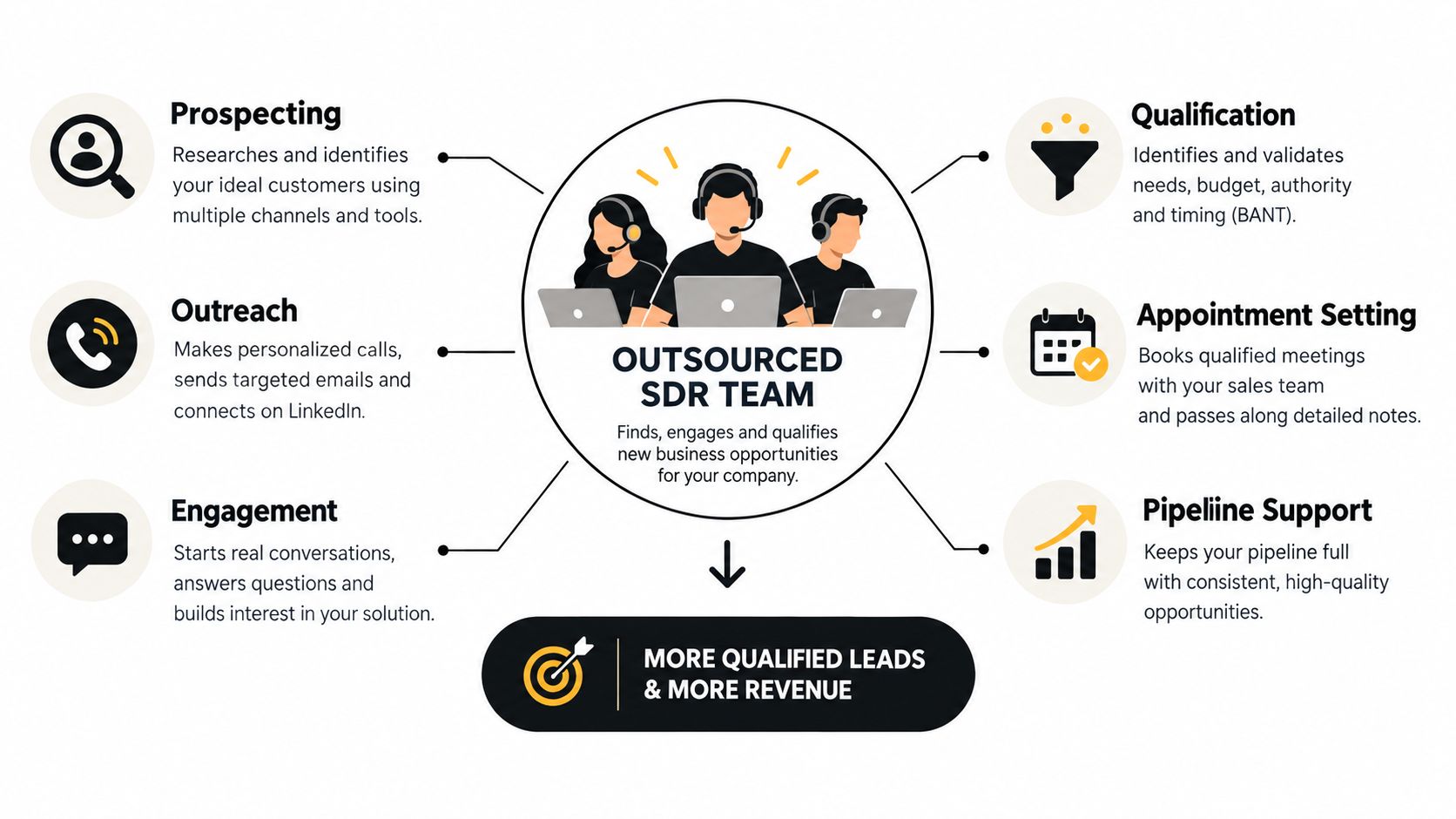
An outsourced SDR team runs the top of your outbound funnel. The vendor researches accounts, finds contacts, builds outreach, handles replies, qualifies interest, and puts meetings on the calendar for your founders or AEs. Your team still owns discovery depth, proposals, negotiation, and close.
Write that line of responsibility into the agreement from day one. Vendors can create access and surface demand, but they cannot rescue a weak follow-up process or explain a value proposition your market still does not understand.
What the service usually includes
Good providers run a clear operating sequence, and each step should feed the next with clean data and fast feedback:
- Define the target. The team turns your ideal customer profile into account filters, personas, buying signals, exclusions, and disqualification rules.
- Build and maintain lists. Researchers source contacts, enrich records, verify fit, and remove people who should never enter the sequence.
- Create the message. Copy and talk tracks are built around the prospect's problem, context, trigger, and role in the buying process.
- Run outreach. SDRs execute the cadence, monitor replies, answer basic questions, and route positive intent to sales.
- Qualify the conversation. The team checks the agreed criteria before putting time on an AE's calendar.
- Report and improve. The provider tracks activity, responses, accepted meetings, opportunities, and sales feedback.
That last step matters more than vendors admit.
The output is not a pile of booked calls. You are buying target-account lists, multichannel sequences, CRM records, meeting outcomes, and recurring pipeline reviews. You are also buying governance. Which signals triggered outreach, where the contact data came from, how AI personalization was approved, what reply patterns changed the sequence, and whether accepted opportunities looked anything like the ICP you agreed on.
If a vendor can report meetings booked but cannot trace what became an accepted opportunity, it is measuring volume and missing the learning loop that improves pipeline quality.
Agencies, BDR-as-a-Service, and managed teams
The labels blur together, so judge the operating model. A lead generation agency may run campaigns and hand over contacts or appointments. A BDR-as-a-Service provider usually gives you named reps, management, training, and a longer-running sales development program. A managed outsourced SDR team should give you a defined pod, an accountable manager, documented workflows, and shared reporting tied to downstream sales outcomes.
For a launch platform such as Aura++, a stronger motion would use live signals instead of a static list. The team might prioritize founders after a pricing-page visit, SaaS teams after a launch submission, or companies engaging with SEO and distribution content. Enrichment can then segment by company profile, launch timing, market, and stated growth need.
Channel mix is secondary. Message, qualification, data provenance, and 30/60/90-day cohort learning are what separate a useful SDR partner from an expensive calendar-filling service.
Pricing, Cost Models, and the Real Comparison
Outsourced SDR pricing usually falls into three structures. The cheapest-looking option can create the highest downstream cost if it rewards meetings that your sales team can't use.
| Model | Typical Cost Basis | Cash Flow | Risk Shift | Best Fit |
|---|---|---|---|---|
| Per-SDR retainer | Fixed monthly fee for named or allocated capacity | Predictable | More execution risk stays with the client | Teams that want control and a durable operating pod |
| Per-meeting fee | Payment for booked or accepted meetings | Variable | More quality risk shifts to the buyer unless qualification is strict | Short tests with tightly defined qualification |
| Hybrid performance tiers | Base retainer plus outcome-related component | Moderately predictable | Risk is shared, but definitions matter | Teams with clean CRM data and mature measurement |
Compare loaded economics, not seats
Benchmark estimates place productive internal SDR cost at approximately $9,800 to $14,200 per representative per month, compared with roughly $3,000 to $8,000 for outsourced equivalents, according to SalesHive's outsourced sales team overview. The same source cites startup comparisons indicating total sales-cost savings of about 30% to 45% when recruiting, management, technology, and overhead are included.
Those figures don't tell you whether a vendor is profitable for your business. Calculate:
- Cost per accepted meeting, not cost per booked meeting.
- Cost per sales-qualified opportunity, using your own qualification definition.
- Pipeline created per dollar, with a stated attribution window.
- Cost of no-shows, rejected meetings, and stalled opportunities.
- Internal coordination cost, including AE and founder time.
A vendor that charges less per meeting but sends poor-fit prospects can be more expensive than an accountable retainer.
The line items founders forget
Your model should include onboarding, list development, data licenses, CRM integration, vendor management, compliance review, replacement coverage, meeting-show rate, opportunity acceptance, and downstream win rate. It should also account for the cost of waiting while an internal hire ramps and the opportunity cost of leaving a market untouched.
For example, suppose you compare a two-representative internal pod with an outsourced pod. A 40% reduction in direct program cost may look attractive, but the reduction only matters if the outsourced pod creates comparable or better accepted opportunities. Put the difference into a pipeline model, then subtract the value of low-quality meetings and the internal time required to manage the vendor.
Use the same ICP, qualification rules, attribution window, and sales follow-up standard for both cohorts. Don't compare a vendor's booked meetings with an internal team's closed revenue. That isn't a comparison. It's an accounting error.
You can also use virtual assistant services for supporting sales operations when list cleanup, CRM administration, or research is the bottleneck rather than live selling.
Build, Buy, or Run a Hybrid SDR Model
The right SDR model depends on five variables: ICP clarity, management capacity, sales complexity, cash constraints, and urgency. Map those accurately, then pick the default that fits your operating reality.
| Situation | Best default | Why |
|---|---|---|
| ICP and messaging are unproven | Founder-led learning plus limited outsourcing | Direct buyer feedback matters more than scale at this stage |
| Pipeline is urgent and AEs have capacity | Outsourced | You can stand up outbound faster than a full hiring cycle |
| Product requires deep technical discovery | In-house | Product fluency, continuity, and judgment matter more than speed |
| Several segments need different motions | Hybrid | Internal reps can own strategic accounts while an external pod tests volume |
| Management bandwidth is limited | Outsourced with named leadership | The provider should bring coaching, QA, and a clear operating cadence |
| Outbound playbook is proven | In-house or hybrid | Internal hiring compounds faster once the system already works |
Use outsourcing for speed, market testing, or temporary coverage. Use in-house when call quality, product depth, and account continuity determine whether the opportunity is real. Use hybrid when you need both: internal control over the accounts that matter most, external capacity for repeatable segments, channel experiments, or fast coverage in a new market.
The mistake is treating outsourced SDR like a cheaper copy of an internal team. The critical choice is governance. Who approves messaging. Who owns data provenance. Who catches bad enrichment, weak personalization, and off-ICP targeting before they pollute the pipeline. If you cannot answer those questions, the model is wrong even if meetings appear on the calendar.
Outsourcing is defensible when you know what you want to learn and can enforce the feedback loop. That means clear ICP rules, approved claims, call reviews, CRM discipline, and cohort evaluation at 30, 60, and 90 days. Judge the vendor on accepted opportunities, conversion quality, and how quickly they improve against feedback, not just meeting volume.
Do not outsource confusion. If the founder has not personally closed enough deals to recognize real pain, common objections, and the buying process, an external team will scale noise. The vendor can run outreach. It cannot supply positioning clarity or decide which buyer signal actually matters.
Choose in-house when the SDR must handle technical discovery, work through layered buying committees, or protect strategic account context over time. Choose hybrid when your top accounts need internal ownership but the rest of the market can be worked through a tighter, better-governed external motion.
A hybrid model fails when each team runs a different system. Keep one CRM, one qualification standard, one set of account exclusions, one source of truth for contact data, and one outcome taxonomy. Otherwise you are not comparing models. You are managing two disconnected sales motions and guessing which one works.
How LatHire and HireSDRs.com Can Help
Not every founder wants a fully managed agency. Some want the control of a direct hire without running a full cross-border recruiting process themselves. Two routes fit that middle ground, depending on whether you need one dedicated rep or a team.
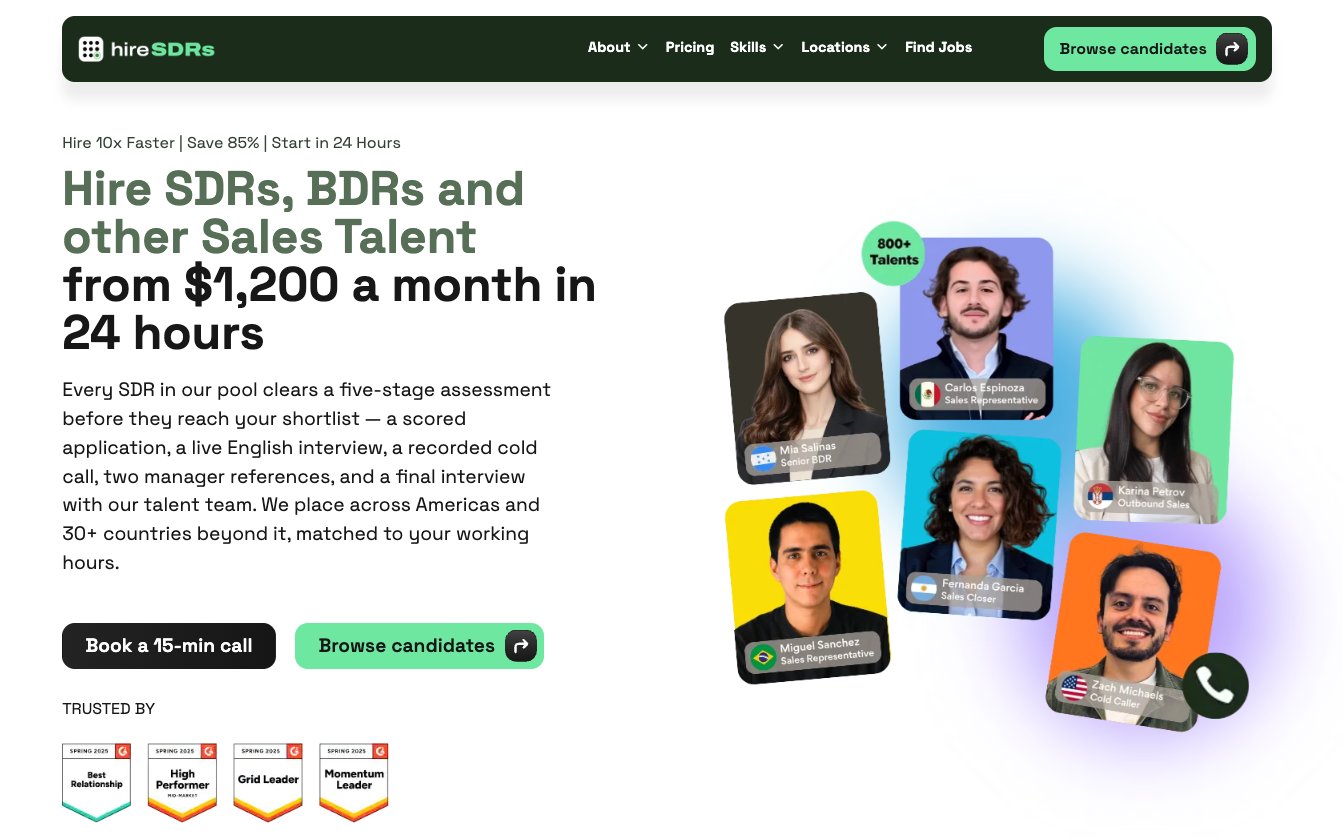
HireSDRs is a talent marketplace dedicated to sales development. It’s built for companies standing up an SDR team rather than a single seat, which makes it relevant when you’ve already validated your outbound motion and need several reps working one ICP, one qualification standard, and one CRM. Because you hire the reps directly rather than buying a campaign, you keep ownership of messaging, data provenance, and the feedback loop this guide keeps returning to, while avoiding the time cost of sourcing and screening a whole pod yourself.
LatHire connects US and Canadian companies with pre-vetted Latin American professionals across sales, marketing, technology, and operations. Its platform combines AI assessments, skills evaluations, human-led background checks, candidate matching, and support for HR, international payroll, benefits, and legal compliance. You can bring an existing job description, generate one with AI, review candidate profiles, and select people with stated availability in your time zone. For founders comparing a managed provider with direct hiring, LatHire’s best place to hire SDRs resource is a useful starting point for evaluating talent availability, engagement structure, and operational fit. It also suits teams that need supporting roles around the SDR function, such as list research, CRM administration, or sales operations.
The trade-off with either route is responsibility. You still need to define the ICP, train the representatives, approve claims, manage CRM hygiene, and create feedback loops. Direct hiring reduces recruitment and cross-border administration, but it doesn’t replace sales leadership. It’s the better route when you want dedicated people inside your process, especially for a repeatable motion that needs more brand immersion than an agency can provide.
Vendor Evaluation Checklist and Sample SLAs
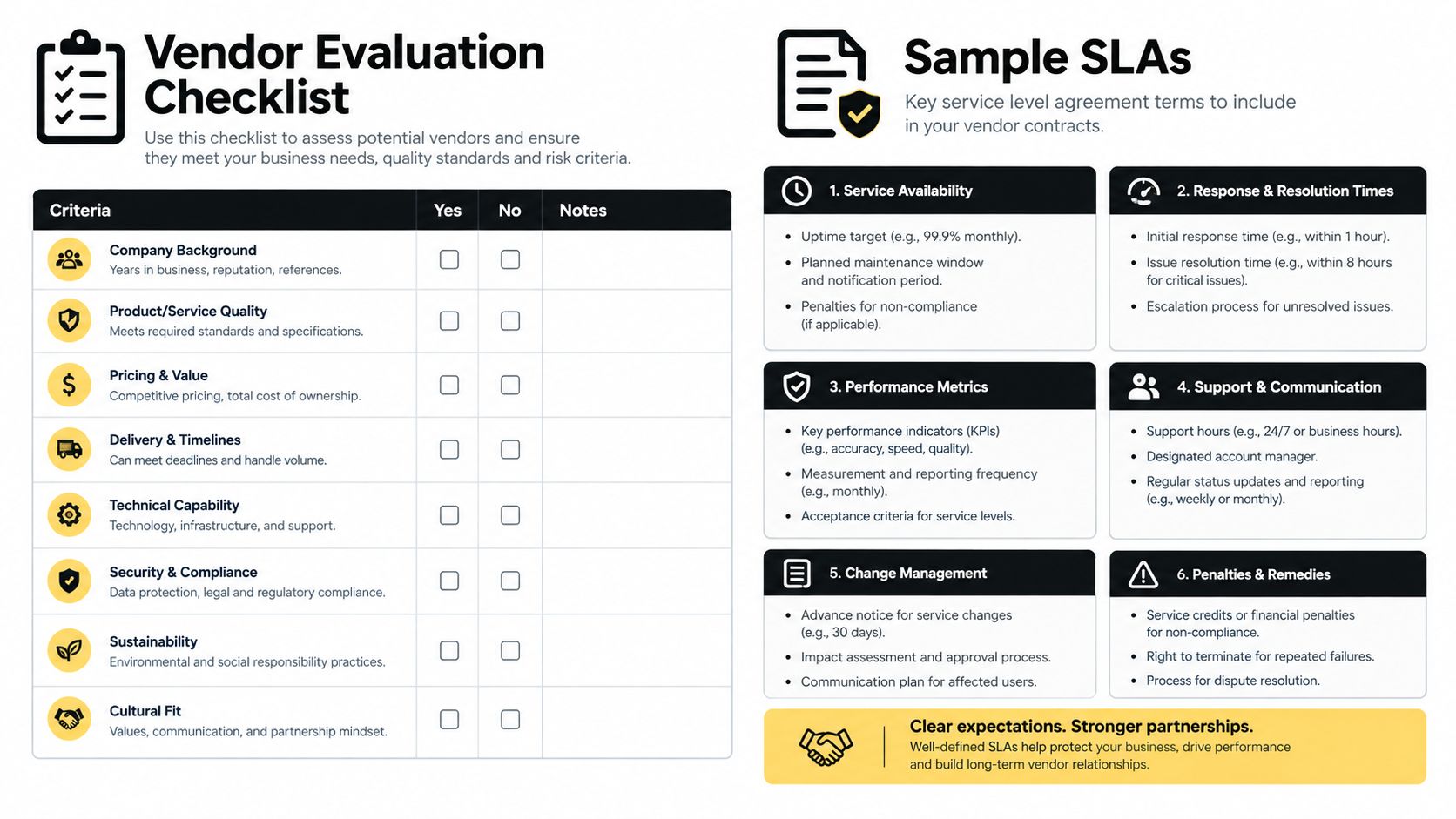
A polished sales deck proves almost nothing. Ask the vendor to show you the system that produces its results, including the people assigned, the data sources, the qualification rules, the QA process, and what happens when performance falls short.
Demand evidence before promises
Use a diligence checklist that forces specificity:
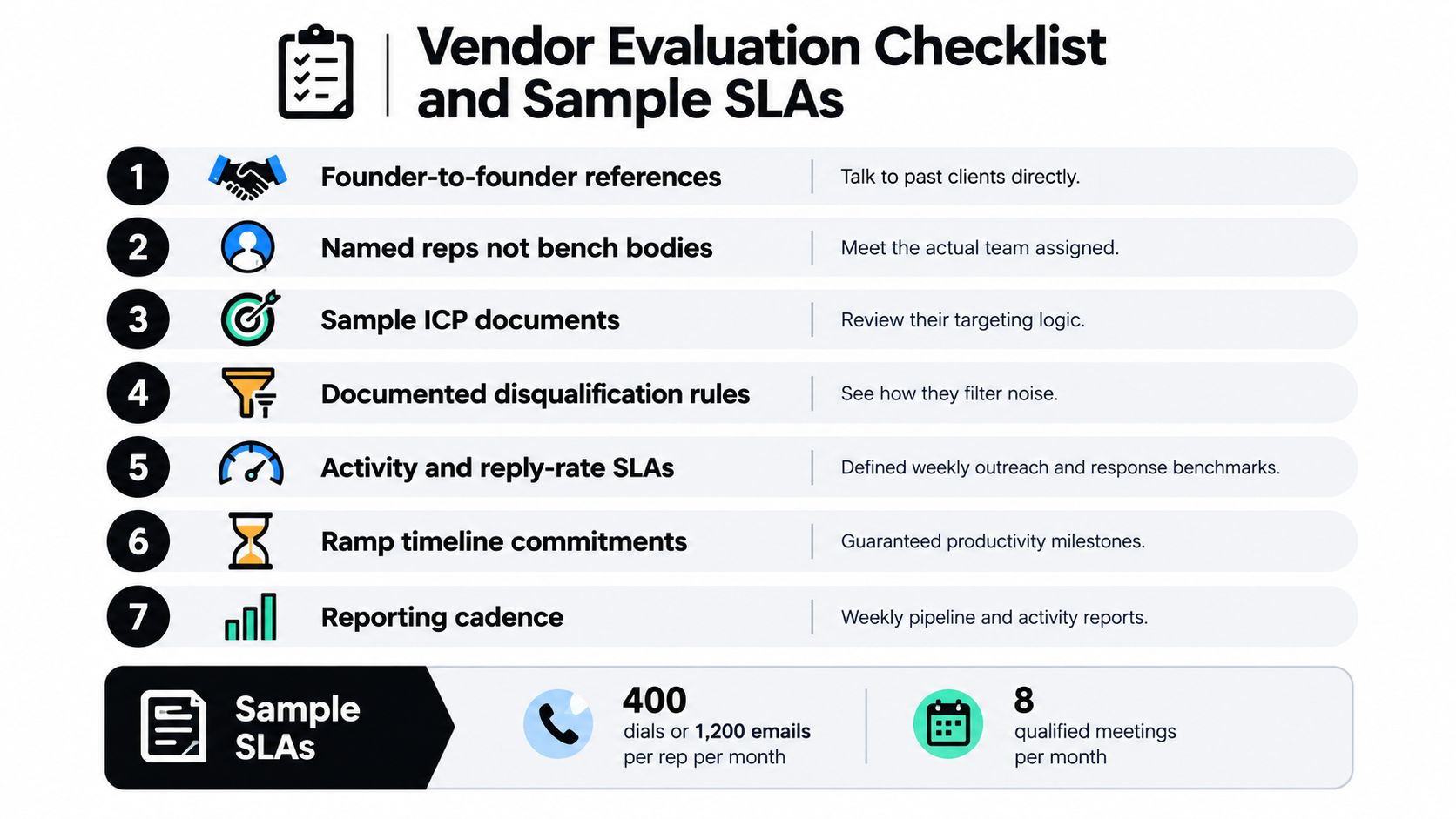
- Founder-to-founder references: Speak directly with past clients, including one that ended the engagement.
- Named representatives: Meet the people who'll work on your account, not only the sales executive.
- ICP documentation: Review an anonymized target-account brief and ask how exclusions are handled.
- Cadence examples: Inspect messages, call guides, follow-up logic, and reply-handling rules.
- Data provenance: Ask where records come from, how they're verified, and how suppression lists are maintained.
- QA process: Request examples of call reviews, message approval, and rejected-meeting handling.
- Replacement policy: Confirm who replaces a rep, how handoff works, and whether continuity is protected.
Score each provider across ICP expertise, data quality, security, reporting transparency, management depth, price predictability, and brand fit. Don't let a low fee compensate for a weak governance score. A cheap vendor with poor data can create an expensive cleanup project.
Build the SLA around outcomes
An early-stage SLA might define staffed-hour response time, CRM logging, weekly reporting, message approval, meeting qualification, and a remediation process for rejected appointments. A more mature agreement should also cover data-source documentation, consent obligations, suppression handling, AI use, claims approval, incident escalation, and account ownership.
Keep activity metrics in the agreement, but don't mistake them for performance. Dials and emails tell you whether the vendor worked the process. Accepted meetings and opportunity creation tell you whether the process deserves more investment.
Contract principle: Never guarantee volume without defining fit. A meeting only counts when the prospect meets the agreed profile, attends, and accepts the next sales step.
Run a four-week pre-scale ramp:
- Week one: Agree on ICP, personas, triggers, exclusions, qualification, and disqualification.
- Week two: Approve data sources, first lists, copy, sequences, CRM fields, and routing.
- Week three: Review shadowed calls, test replies, inspect records, and correct weak assumptions.
- Week four: Increase activity only after quality checks pass.
If you need a separate recruiting workflow for technical or sales operations roles, document the same ownership boundaries in your tech recruiting agency process. The principle is consistent: define the handoff before the work begins.
Onboarding Playbook for the First 30 to 60 Days
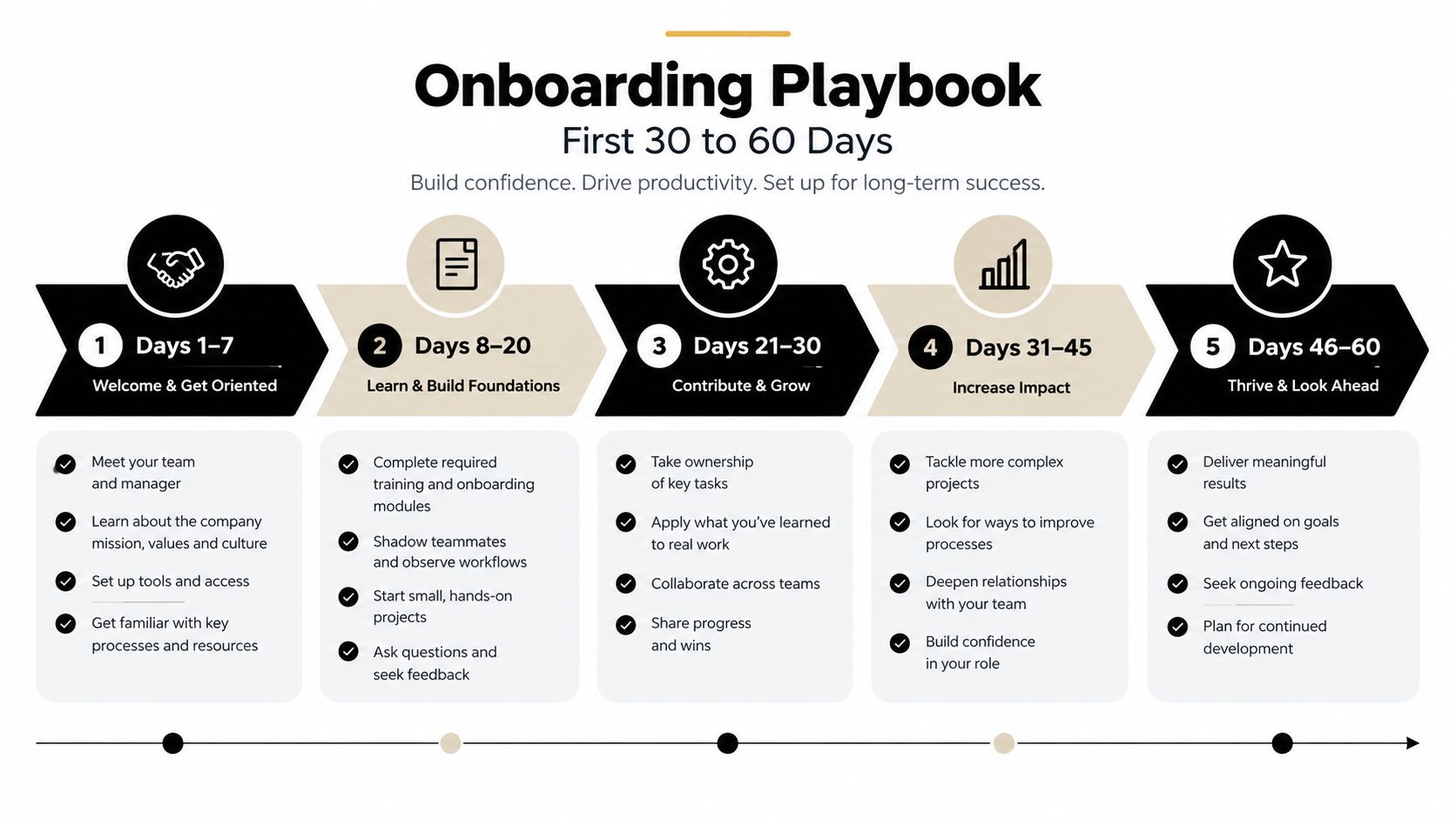
Most vendors want to start sending quickly. Resist that pressure. The first month should produce a reliable operating system, not a large meeting count.
Week one creates the boundaries
The founder or sales leader should lead an ICP and disqualification workshop. Share closed-won and closed-lost context, objections, competitors, pricing logic, customer language, and examples of bad-fit accounts.
The exit criteria are simple: the vendor can explain who to target, who not to target, what problem to lead with, and what evidence qualifies a meeting. If those answers differ between the provider and your AE team, don't launch.
Week two creates one source of truth
Connect the CRM, calendar, routing rules, activity fields, reply ownership, suppression lists, and reporting views. Decide whether the vendor works in your instance or a connected workspace, then make sure every outcome flows back into the same opportunity record.
Many programs lose weeks here. A prospect replies to an email, but nobody owns the response. A meeting is held, but the outcome field stays blank. A contact opts out, but the suppression list isn't shared. Fix those handoffs before adding volume.
Week three tests the human workflow
Have the provider run supervised outreach. Review messages, calls, replies, qualification notes, and calendar handoffs. Test negative scenarios, including an opt-out, an angry reply, an inaccurate prospect detail, and a request for a product claim the SDR can't substantiate.
During staffed hours, target high-intent inbound leads within five minutes. The Teamgate lead-response study reports that qualification likelihood can fall by up to 80% after the five-minute window compared with faster contact. Treat this as a directional operating benchmark, not a guaranteed revenue lift, because the cited research measured contact and qualification behavior rather than closed-won revenue.
Week four opens the controlled program
Scale only after the vendor passes quality review. Set a staffed-hours service target for high-intent leads, define fallback coverage outside those hours, and apply the same urgency to outbound triggers such as a pricing-page visit, launch submission, or high-intent download.
By days 30 to 60, review cohort quality rather than raw activity. Which segments reply? Which messages produce accepted meetings? Which meetings advance? Which contacts complain or opt out? Use those answers to expand the motion, narrow it, or stop it.
Founders building a broader remote operating model can also use this guide to hiring a first SaaS freelancer to clarify ownership before adding external capacity.
AI, Data Privacy, and Governance Risks
AI makes personalization faster. It also makes mistakes faster.
A generated first line can invent a company detail, misread a prospect's role, or make a claim your legal team never approved. A provider may use enrichment tools you haven't reviewed, combine records from unclear sources, or process your customer data through an AI system whose training practices are not documented.
The governance question isn't whether the vendor uses AI. It's whether you can explain what AI does, what a human reviews, who owns the decision, and how an incident gets contained.
Put responsibility in four boxes
| Risk area | Operational owner | Contractual control |
|---|---|---|
| Targeting and data provenance | Provider maintains sources, verification, and suppression | Client approves permitted sources and audit rights |
| Message and claims accuracy | Provider drafts, trained reviewers check | Client approves prohibited claims and escalation rules |
| Consent and opt-outs | Provider captures and honors signals | Contract assigns regional compliance duties and records |
| AI processing | Provider discloses tools and data flows | Contract restricts training use, retention, and subprocessors |
A 2025 Demandbase B2B buyer report says legal and compliance teams are involved from the beginning, particularly because of data-privacy regulations. That should change vendor selection. Compliance can't remain a procurement footnote while the sales team operates across regions and tools.
Require practical controls
Your agreement should answer these questions in plain language:
- Where did the contact record come from?
- How does the provider document lawful use and suppression?
- What happens when a prospect opts out?
- Can customer data be used to train a vendor's AI system?
- Which claims require written approval?
- Who receives a complaint or regulator inquiry?
- How quickly must the provider report a mis-send or data incident?
- Can you audit subprocessors and delete retained data?
Create an incident runbook. Pause the affected sequence, preserve the relevant record, identify the audience, notify the accountable owner, correct the message, honor all suppression requests, and document the resolution. Don't let a vendor decide privately whether a brand incident is serious enough to mention.
Governance principle: Outsourcing execution doesn't outsource exposure. Your brand still appears in the prospect's inbox, and your company still owns the commercial consequences.
Review the program by cohort at least quarterly. Compare segments, messages, data sources, and AI-assisted versus human-edited workflows. Renew when quality and pipeline improve together. Expand only when the vendor can explain why performance improved. End the contract when it hides data provenance, ignores suppression, repeats rejected messaging, or optimizes volume after quality has deteriorated.
KPIs, Benchmarks, and Your 90-Day Decision Gate
A useful outsourced SDR scorecard separates what the vendor controls from what the client controls. This prevents the standard blame cycle where the provider cites activity and the sales team cites weak opportunities without agreeing on the handoff.
Use four metric groups
Vendor-controlled activity includes outreach execution, list production, response handling, CRM completeness, and service-level adherence.
Vendor-influenced outcomes include contact rate, qualified-meeting rate, meeting-show rate, and the quality of qualification notes.
Client-controlled inputs include message approval speed, AE follow-up, calendar availability, pricing, product readiness, and whether sales accepts the agreed leads.
Shared economics include cost per accepted meeting, cost per sales-qualified opportunity, pipeline created per dollar, sales-cycle movement, and revenue attribution.
Track the groups separately, then inspect the cohort path from first touch to opportunity. A booked meeting with no attendance is not equivalent to a held meeting. A held meeting that sales rejects isn't equivalent to an accepted opportunity. Pipeline is the point where the vendor's work meets the client's ability to sell.
Set decision gates before launch
- Day 30: Confirm data quality, message accuracy, routing, compliance, and qualification discipline. Don't scale on meeting volume.
- Day 60: Compare cohorts by segment, persona, reply quality, show rate, and sales acceptance. Cut weak segments and revise the message.
- Day 90: Decide whether the program creates credible opportunity flow at an acceptable cost. Renew, narrow, or end based on pipeline evidence.
- Day 180: Review whether learning has compounded, whether the vendor still has fresh territory, and whether the operating model should become hybrid or internal.
One industry guide reports that companies maintaining SDR investment for six months or more can see 150% to 200% improvement versus initial 90-day performance as learning compounds, as summarized by QuotaEngine's outsourced SDR services guide. Treat that as a directional industry claim, not a promise. Early cancellation can interrupt learning, but patience doesn't rescue a vendor with bad data or weak qualification.
Renew when accepted opportunities and pipeline quality improve, the vendor shares evidence, and your AEs can absorb the flow. Expand when a segment has repeatable economics and the provider can preserve governance at greater volume. End the contract when activity remains high but opportunity creation stays weak, the vendor refuses transparent data, or your team can't provide the feedback required for improvement.
If you're building a launch-driven growth motion, use Aura++ to turn product launches into durable, structured visibility through permanent project pages, SEO-focused assets, social distribution, and repeatable relaunch opportunities. Review the available plans at Aura++, then bring the resulting intent signals into your SDR scorecard rather than treating launch traffic as a vanity metric.