You're three weeks from launch, and the inbox is already louder than the product. Customer interviews are overdue, the landing page still has placeholder copy in two spots, and a Stripe webhook is failing quietly while you keep jumping between Slack, Figma, and your calendar.
That's the moment most founders realize they don't need “help” in the abstract. They need another pair of hands that can be wired into the launch system fast, without dragging them into more management overhead. Virtual assistant services are no longer a side hustle fix for email cleanup. In a 2025 to 2035 market report, the category is projected to move from USD 5.3 billion in 2025 to USD 43.4 billion by 2035, with India forecast to grow at 24.6% CAGR over that period, a sign that remote support has become a serious operating layer, not a novelty (industry report).
The mistake is obvious too. Founders hire the wrong kind of VA, keep the scope vague, and end up with more coordination work than before. Treat this as an operating decision, not a rescue move.
Table of Contents
- Why Founders Are Renting Extra Pairs of Hands
- What Virtual Assistant Services Actually Are
- The Four Service Models Compared
- Startup Tasks You Can Delegate in Week One
- How Virtustant Can Help
- Pricing and Contract Models Explained
- Hiring and Onboarding Checklist
- Wiring a VA Into a Product Launch Workflow
- Measuring ROI and Building Follow-Up Cadence
Why Founders Are Renting Extra Pairs of Hands
A founder in week three of pre-launch doesn't need motivation. They need relief from drag. The problems are always the same. The calendar keeps fragmenting, the inbox becomes a queue of unresolved decisions, and every small admin task steals attention from the one thing only the founder can do, which is shape the product and the launch story.
The pressure is time, not just workload
A launch date creates hard scarcity. There's no extra week hidden in the schedule, and every hour spent on travel booking, CRM cleanup, or support triage has to come out of product, positioning, or distribution. That's why renting extra hands is a deliberate operating choice, not a fallback when things get messy.
The second pressure is context switching. A founder who moves from product work to scheduling, then into inbox triage, then back to launch copy, pays a cognitive tax each time. That tax isn't visible on a spreadsheet, but it shows up as slower decisions and sloppier execution.
Practical rule: if a task doesn't benefit from founder judgment, it probably belongs in a VA workflow.
The third pressure is asymmetry. A focused founder can create outsized value in positioning, sales, hiring, and product judgment. A competent assistant can protect that focus by absorbing repetitive work, but the wrong hire compounds everything. If the handoff is weak, you don't buy time, you buy coordination debt.
That's why this topic matters now. The core question isn't whether you should delegate. It's whether you can build a support layer that preserves speed while you're still small.
What Virtual Assistant Services Actually Are
Virtual assistant services are remote, contract-based support for administrative, operational, or specialized work. The person is not a W-2 employee, and the relationship is built around output, not headcount. Think of it less like hiring a machinist and more like renting a specialized workstation. You're paying for capacity and execution, not bench depth.
Human execution and software assistance are not the same thing
The human side is straightforward. A person works inside your tools, handles tasks, follows SOPs, and escalates what needs judgment. That's where calendar control, customer support triage, inbox sorting, research, and content ops usually live.
The AI side is different. Scheduling bots, transcription tools, and LLM-based agents can automate slices of the workflow, but they still need guardrails. A founder should think of AI as a tool inside a VA system, not a substitute for one. The best setup in 2026 is often a hybrid, where a human operator supervises automation, checks outputs, and handles edge cases.
The hard part is the gray zone. Many teams now use AI-assisted VAs who combine software with human judgment. That model works because enterprise-style work is messy, multilingual, and full of exceptions. TRUEBench, for example, was built from productivity-assistant service patterns and includes 12-language prompts with intra-instance multilingual instructions because real assistant work often mixes languages, task constraints, and context switching (TRUEBench paper).
A good way to judge the category is by the job, not the label.
If the task needs taste, escalation, or judgment, keep a human in the loop. If it's repeatable and rule-based, automate the boring part first.
That's why the next decision is model selection. Freelance, agency, dedicated, and AI-assisted VAs solve different problems. Pick the wrong one and the whole launch stack gets brittle.
The Four Service Models Compared
Not every VA setup works for a founder under launch pressure. The right model depends on how much control you want, how fast you need help, and how much process you're prepared to own. The fastest choice isn't always the cheapest, and the cheapest choice can become expensive if you spend all week supervising it.
The trade-offs founders actually feel
| Model | Typical Cost | Ramp-Up | Best Fit |
|---|---|---|---|
| Freelance VA | Usually the lowest | Fast | Small, clear tasks where you can vet directly |
| Agency VA | Higher than freelance | Fast to moderate | Pre-launch founders who want backup coverage |
| Dedicated VA | Retainer-based and steadier | Slower | Post-PMF teams that need accountability and continuity |
| AI-assisted VA | Lowest marginal cost per task | Requires setup time | Repeatable, high-volume workflows with strict QA |
Freelance is the cheapest and quickest way to start. The downside is obvious, you own the vetting, continuity, and replacement risk. If the freelancer disappears mid-launch, you're the backup plan.
Agency support costs more, but it gives you a bench and a process. For a solo founder pre-launch, that usually beats the chaos of sourcing solo because the agency already knows how to replace a weak fit. The trade-off is control. You'll get less certainty over who shows up day to day.
Dedicated support is the strongest accountability model. You get one named operator and usually a more stable retainer relationship, which works best once the company has recurring operating rhythms. It's slower to onboard, but it usually pays off when the founder needs a long-term extension of the team.
AI-assisted support is the most misunderstood. It looks cheap because the marginal cost is low, but only if the founder designs prompts, guardrails, and QA. If you want that route, your SOPs need to be tight enough that mistakes don't leak into customer-facing work.
If you're pre-launch and under pressure, I'd lean agency. If you're past product-market fit and need continuity, go dedicated. If your work is repetitive and structured, AI-assisted can be a strong layer, especially when it sits on top of a human operator.
Startup Tasks You Can Delegate in Week One
The fastest wins come from tasks that don't require deep product judgment. Don't start by handing off strategy or anything that lives in your head. Start with work that has obvious inputs, clear outputs, and low emotional risk if it's done imperfectly the first time.
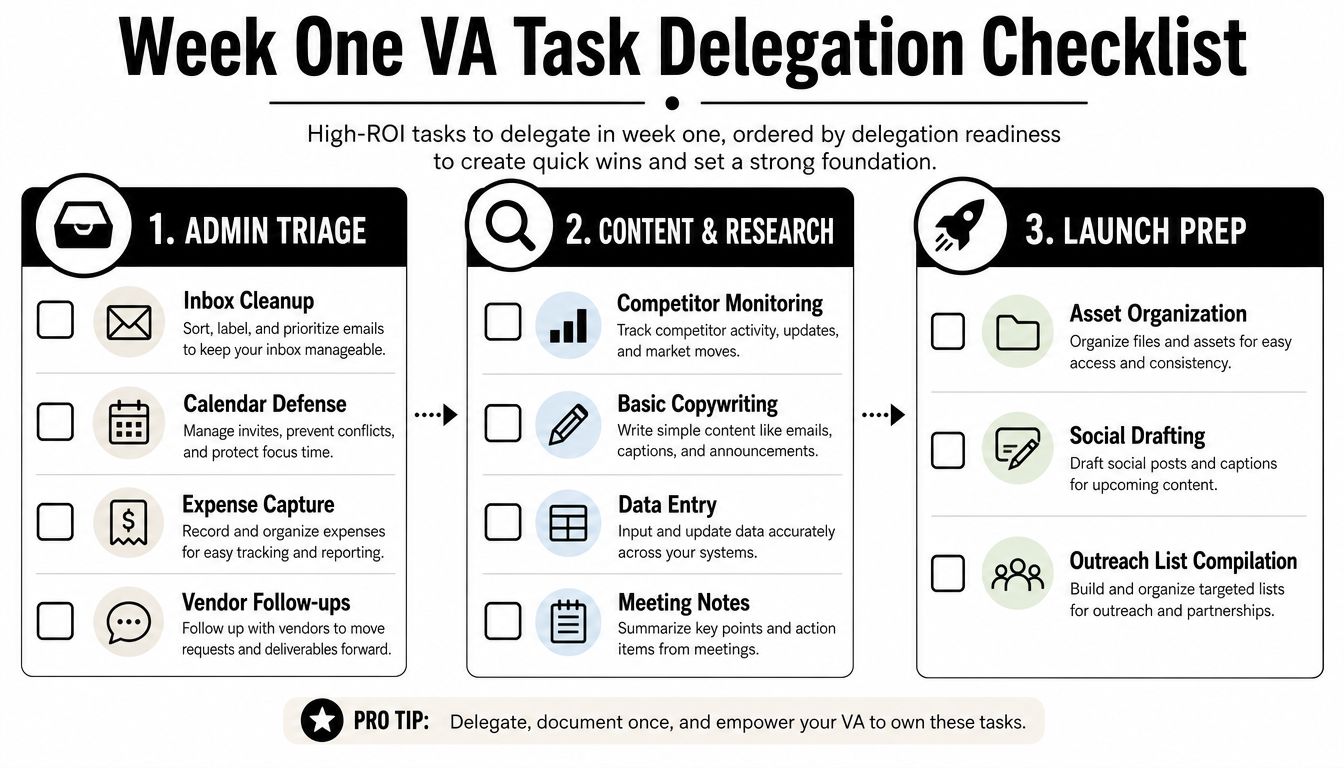
Delegate admin triage first
Inbox cleanup, calendar defense, expense capture, vendor follow-ups, and CRM hygiene are the first jobs to offload. They create immediate relief because they sit close to the founder's attention, but far from the founder's unique judgment. The first week should produce a clean inbox label structure, a defended calendar with hold rules, and a simple weekly admin summary.
Move into support and content operations
Tier-one support work is usually safe to delegate early. Ticket tagging, canned response dispatch, refund routing, and review monitoring across App Store, G2, and Trustpilot are all systematic enough to hand over quickly. For content, use the VA for transcript cleanup, formatting draft posts, newsletter assembly, repurposing long-form into LinkedIn and X threads, and podcast show notes.
Use the launch window for controlled distribution support
Social scheduling is another clean entry point. A VA can build queues in Buffer or Typefully, gather assets from Figma, do hashtag research, and produce a weekly analytics digest. During launch week, they can also handle email verification, beta tester onboarding drips, webinar rehearsal logistics, and pre-event tech checks.
A good first seven days should leave behind artefacts you can inspect, not just “progress.” Ask for a cleaned inbox view, a task log, a scheduled content queue, and a launch prep checklist with open issues clearly flagged. If those four outputs don't exist, the scope is too fuzzy.
For founders building launch content, the work often connects directly to generative AI for advertising, especially when a VA is formatting, repackaging, or queueing assets rather than creating from scratch.
How Virtustant Can Help
Virtustant is a remote staffing agency that connects U.S. companies with vetted professionals across Latin America for full-time remote roles. It handles sourcing, assessment, placement, contracts, payroll, HR, and compliance under a single all-in hourly rate, which matters if you want one vendor to own the admin burden instead of splitting it across four systems.
It's a fit when the founder wants nearshore support with U.S. time-zone overlap and strong English fluency, not just cheap labor. Virtustant says it delivers a curated shortlist within 48 hours, usually 3 to 5 pre-vetted candidates, and uses a four-stage vetting process that includes a live English screen, cognitive assessment, role-specific skills testing, and experience verification. It also offers a lifetime replacement guarantee, which is unusual compared with the tighter replacement windows many founders see elsewhere. If you want to compare the service structure directly, their virtual assistant services page lays out the role categories and operating model.
For founders, the question is whether the workflow needs managed staffing or just task coverage. If you need one person embedded in daily operations, with payroll and compliance handled outside your company, that model makes sense. If you only need a few hours of errand-style support, it's probably too much structure.
The rate-to-output question is simple. If a hire reduces your founder time on repetitive work and keeps your launch moving, the cost is justified. If the person mainly creates review loops, the hire is wrong for the stage.
Pricing and Contract Models Explained
Virtual assistant pricing only makes sense when you tie it to output. Hourly rates tell you very little by themselves. What matters is whether the task you're handing over produces a lower cost per deliverable than doing it yourself.
Think in deliverables, not just hours
An entry-level offshore assistant is usually the lowest-cost route for straightforward admin. A mid-tier multilingual VA costs more because the work can cross customer touchpoints and collaboration layers. Premium U.S. or EU generalists sit higher because you're paying for overlap, communication quality, and often faster judgment. Specialists like bookkeepers or video editors command more because the output is narrower and the risk is greater.
That's where the comparison starts. A founder should estimate the minutes needed per task, translate that into weekly hours, then compare the monthly line item against the founder's own hourly value. If the founder is spending two hours a week on support inbox triage, the question isn't “can I afford a VA,” it's “what does that time cost me in launch momentum.”
Match the billing model to the job
Retainers work best when the scope is stable and recurring. Project-based pricing is better for bounded work, like a launch asset build or a one-time CRM cleanup. Pay-per-task can work for very clean workflows, but it gets messy when tasks change every week. Dedicated full-time support makes sense when volume is steady enough to keep one person busy without constant reprioritization.
Hidden costs show up fast if you don't ask for them upfront. Onboarding time, tool licenses passed through to the client, timezone overlap premiums, and churn risk all affect the actual cost. If a VA leaves mid-launch, the replacement friction is often more expensive than the missing hours.
Contract terms matter more than founders think. Watch for auto-renewal clauses without notice windows, weak IP assignment language, and vague termination terms. If you're handling launch copy, customer data, or proprietary workflows, those gaps are not minor paperwork issues.
For teams experimenting with AI support around legal or compliance-adjacent workflows, this AI legal assistant discussion is useful because it highlights the difference between automated assistance and work that still needs human review.
Plug-in formula: weekly hours needed × blended hourly rate = monthly baseline, then add a 20% buffer for ramp, corrections, and coordination overhead.
| Model | Typical Rate Range | Best For | Key Risk |
|---|---|---|---|
| Offshore generalist | Lower end | Email, scheduling, research | Over-delegating unclear work |
| Multilingual VA | Mid range | Support, coordination, client-facing tasks | Paying for fluency you don't use |
| U.S. or EU generalist | Higher range | Overlap-heavy work | Cost creep |
| Specialist | Highest range | Bookkeeping, editing, technical tasks | Scope mismatch |
Hiring and Onboarding Checklist
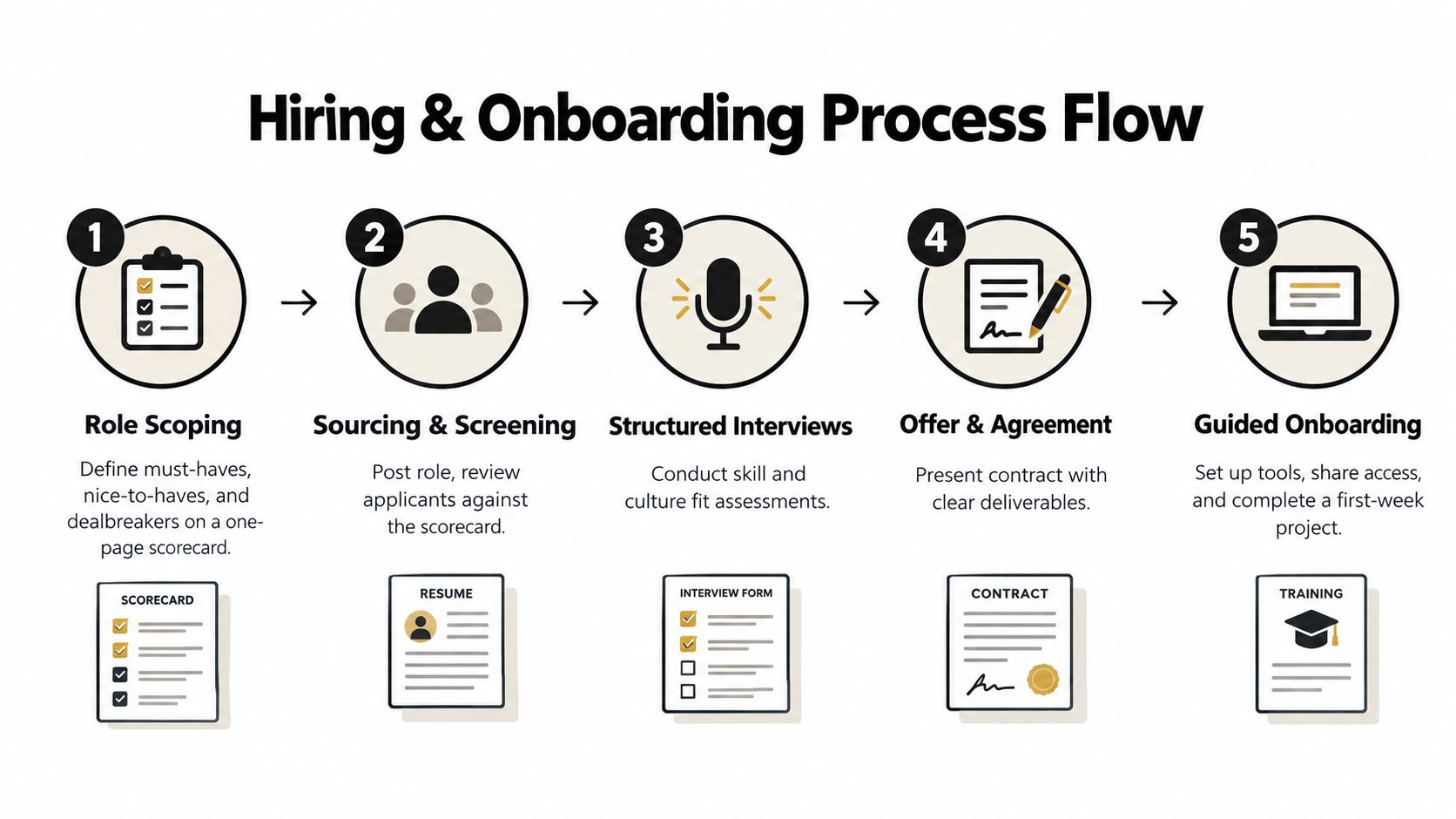
Hiring goes wrong when founders skip the scorecard and start with vibes. If you want a VA who can support a launch, define the job in writing before you invite a single candidate to talk. The deliverable on day one should be a one-page role scorecard with must-haves, nice-to-haves, and dealbreakers, plus timezone overlap, English level, and tool fluency.
Screen for execution, not polish
Sourcing should come from three places: agencies with a real shortlist process, founder communities with direct referrals, and your own network of operators who've already vetted assistants. Once candidates are in, ask for a 20-minute async video, a paid 60-minute trial task, and two recent client references. The trial task should mirror the work they would do, not some abstract test.
Lock down the operating rules early
The contract setup needs four things, NDA, IP assignment, data handling policy, and a tool access list. Don't leave access decisions until after onboarding starts. A VA can't move quickly if they're waiting on permissions or unclear about what they're allowed to touch.
Make onboarding week boring and structured
Use Loom walkthroughs for every workflow, put the SOPs in Notion, and run a 15-minute daily check-in for the first five days. After that, move to a weekly review cadence. The deliverable is not “they understand the business,” it's a shared operating doc showing exactly what was done, what broke, and what needs escalation.
The 30-day evaluation should end with a written continue-or-replace decision. Keep an exit handoff template ready before you need it. The best founders don't hope a bad fit improves, they make the decision fast and move on.
Wiring a VA Into a Product Launch Workflow
Most launch teams waste VA capacity because they hand over random tasks instead of a workflow. If you're running a product launch stack like Aura++, the assistant should sit inside the system, not outside it. Aura++ schedules and publishes daily launches, keeps launch pages live, and packages SEO-focused assets for distribution, so the VA's job is to keep that machine fed with organized inputs and clean follow-through.
Split ownership by judgment, not by volume
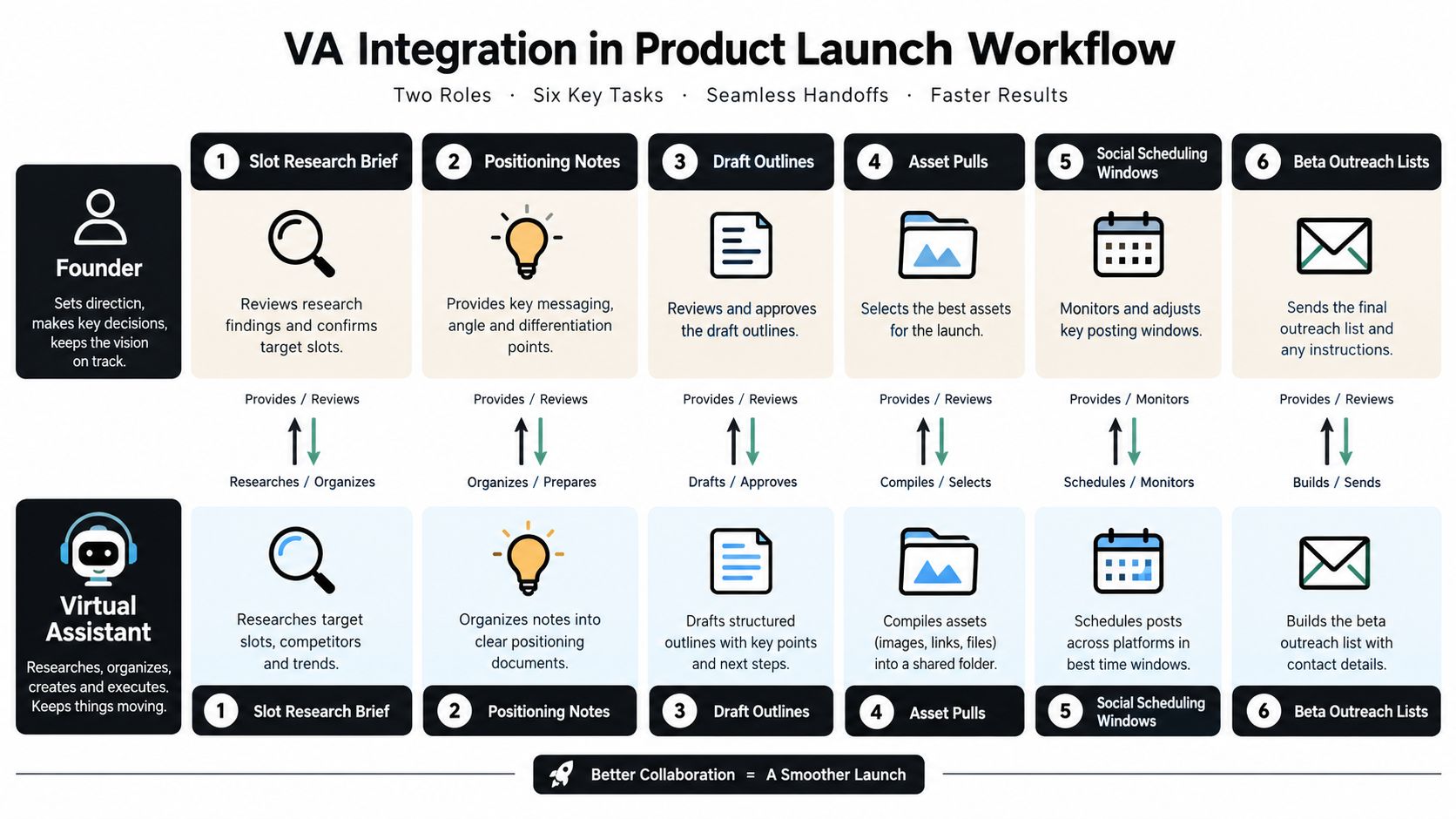
The founder should own positioning calls, final copy approval, pricing decisions, and anything that changes the story. The VA should own asset tagging, schedule queue management, reply triage, beta list assembly, and prep work that keeps the launch moving. If you blur those lines, the launch loses its voice.
A practical handoff looks like this. The VA researches launch slots and compiles the brief. The founder reviews positioning notes and chooses the angle. The VA drafts outlines, pulls assets from the shared folder, and schedules the social queue. The founder approves the final version and sends the beta outreach list.
Build the week-by-week board before launch day
A simple board in Notion or Trello works fine if it's specific.
- Week 1: research launch slots, collect competitor references, gather asset inventory.
- Week 2: draft launch copy, organize screenshots, prepare social variants.
- Week 3: build distribution queue, assemble beta outreach, test links and tracking.
- Launch week: publish assets, monitor replies, flag issues, queue the re-launch plan.
The two biggest failure points are predictable. First, VAs publish without a brand-voice review. Second, they stall because nobody shared the assets in a usable folder. Fix both with a content-ops SOP and a pre-shared asset library before the first task ever lands.
For launch positioning and sequence design, the go-to-market strategy guide is useful context because a VA can only support the launch narrative if the founder has already decided what the narrative is.
Automate scheduling and QA. Keep the launch narrative human. That's the rule.
Measuring ROI and Building Follow-Up Cadence
Ignore vanity metrics like “hours saved” unless they connect to output. A VA is worth keeping only if the work moves something the business cares about. For founders, that usually means support speed, assets shipped, replies handled, leads booked, or launch slots filled.
Build a dashboard that exposes whether the hire works
The simplest dashboard has four metrics. First, tasks completed versus committed, which shows whether the VA is executing the agreed scope. Second, turnaround time by task category, which tells you where the bottleneck lives. Third, error rate or revision rate, which reveals whether the SOP is tight enough. Fourth, a dollar proxy that combines hours freed with the founder's hourly value, plus any direct revenue touched.
| Metric | How to Measure | Target Benchmark |
|---|---|---|
| Tasks completed vs. committed | Count completed items against the weekly plan | Close to plan, with misses explained quickly |
| Turnaround time | Measure from assignment to delivery by task type | Stable or improving |
| Error rate or revision rate | Track rework requests and avoidable mistakes | Low and trending down |
| Dollar proxy | Hours freed × founder hourly value, plus revenue touched | Positive and growing |
The cadence matters as much as the metrics. Run a weekly 20-minute review, a monthly performance retro, and a quarterly scope reset. The weekly review catches drift early. The monthly retro catches scope creep before it becomes permanent. The quarterly reset decides whether the VA should take on more, stay flat, or narrow scope.
Use this script in the monthly retro: “What tasks are still taking my time, what work is creating rework, and what should we stop doing next month?” That question set surfaces scope creep without turning the conversation into a complaint session.
If the dashboard doesn't improve quarter over quarter, the hire isn't working. Cut scope, rewrite SOPs, or replace the role.
A VA should reduce founder drag and keep the launch system moving. When the metrics move, the relationship is healthy. When they don't, the issue usually isn't effort, it's design.
If you're hiring a VA for an upcoming launch, start with one role scorecard, one trial task, and one week of tightly scoped work. If the assistant can clear admin, keep the launch queue moving, and produce clean handoffs without constant correction, expand the scope. If not, replace quickly and keep the launch moving.