Your English demo is ready, the French launch version is not. Marketing wants something polished for next week, product needs the transcript to stay accurate, and a founder somewhere is asking whether a cheap AI voice is “good enough” for a public launch. That's the French audio translation problem, not a language puzzle but a shipping decision under pressure.
French audiences also bring higher expectations than many teams assume. France has a deep dubbing culture shaped by the rise of talking films in the late 1920s and early 1930s, when dubbing and subtitling both became part of mainstream cinema rather than one completely replacing the other (historical overview of French audiovisual translation). That legacy still matters, because people notice when phrasing sounds translated, when lips don't match, or when a synthetic voice flattens the performance.
Table of Contents
- Why French Audio Translation Decisions Matter More Than You Think
- Choosing Between Machine Translation, Human Translation, and Hybrid Workflows
- Building a French Speech-to-Text and Translation Pipeline
- How WhisperAI.com Can Help
- Quality Assurance Practices That Protect French Audio Projects
- Final Delivery Formats, Subtitles, and Realistic Turnaround Expectations
- Putting It All Together with a Practical French Audio Workflow
Why French Audio Translation Decisions Matter More Than You Think
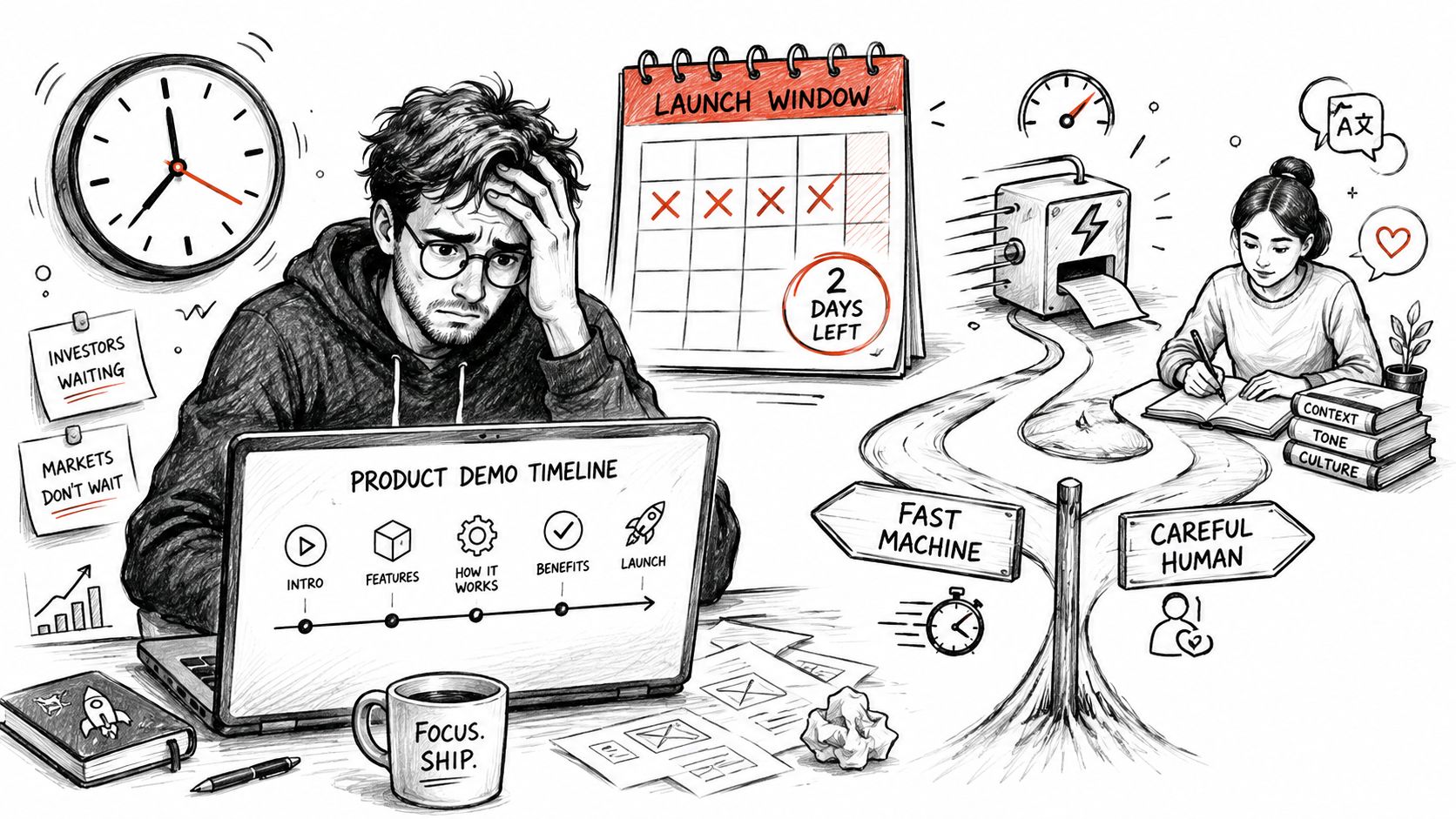
A startup founder typically views French audio translation as a simple fork. Ship a machine-generated version now, or wait for a human team and risk missing the launch window. The actual decision hinges on whether the audio just needs to be understandable, or whether it has to carry brand voice, emotion, and trust.
That difference shows up fast in product demos, onboarding videos, and investor-facing content. A literal translation can preserve meaning and still feel off, because French listeners notice register, pacing, and how a sentence lands when spoken aloud. If the voice sounds rushed or the wording feels imported, the audience hears a project that was treated as a checkbox rather than a local release.
History explains the expectation gap
France developed a different viewing habit from much of Europe. Both dubbed and subtitled films entered mainstream cinemas, so audiences got used to more than one translation mode instead of a single default (historical overview of French audiovisual translation). By the 1930s, dubbing had become standard practice, and later cinema, television, and home video kept that expectation alive. French audio projects still get judged against that background.
The market reflects the same pressure. Industry reporting places the French dubbing market at EUR 420 million in 2023, and describes dubbing as the dominant transfer method in French television and cinema since the 1930s, with television in the 1950s reinforcing that pattern (Gitnux dubbing market statistics for France). The number is not the main point. The point is that polish has been normal for a long time.
Practical rule: if customers, partners, or the public will hear it, treat French audio as a performance problem, not just a translation problem.
Accessibility raised the stakes further. The first national TV program for deaf and hard-of-hearing viewers aired on 27 March 1976, and by February 2010 intralingual Teletext subtitling became a legal obligation for eight major national channels (Gitnux dubbing market statistics for France). French audio work now sits inside a regulated media workflow, not just a creative service line.
For product teams, the takeaway is direct. If French audio supports sales, support, or a public launch, the cheapest path can become the most expensive once rework, audience distrust, and brand damage enter the picture.
Choosing Between Machine Translation, Human Translation, and Hybrid Workflows
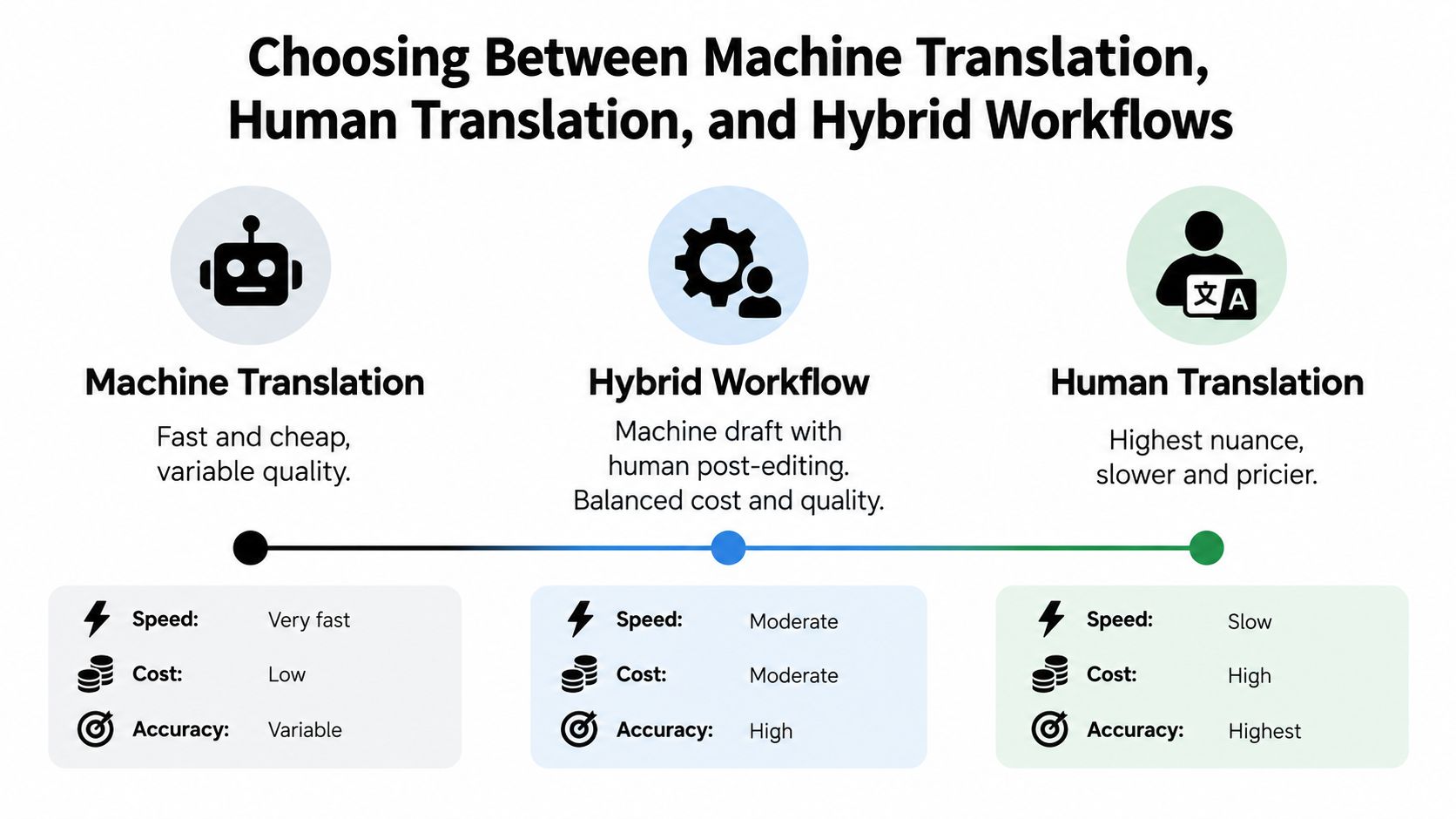
A startup can translate a French demo overnight and still lose a week fixing it before launch. The choice is not merely AI versus humans. It is a decision about stakes, review capacity, and how much control the team needs over the final spoken performance. Internal content, customer-facing material, and brand-critical campaigns require different workflows.
Where machine output works
Machine translation is a practical fit for low-stakes content where speed and scale matter more than polish. Internal training clips, rough meeting notes, support-triage audio, and first-pass subtitles can move through automation efficiently. Someone still needs to accept the limits: idioms, tone shifts, terminology, and brand-specific phrasing may require correction.
Machine output fails in a different way when the French must sound native in public. The problem is often not basic grammar. Awkward pacing, flat intonation, unnatural word choices, and emotionally empty delivery make the recording feel generated, even when the meaning is accurate. A machine-first workflow is safer when a French editor controls the final text before anyone records or synthesizes the voice.
Where human dubbing still wins
Human translation, adaptation, and recording remain the right choice when the script must persuade. Commercials, launch videos, product narratives, nuanced humor, and rhythm-dependent writing need more than literal fidelity. A trained French adapter can reshape lines to fit spoken cadence, preserve emphasis, and make the presenter sound natural rather than translated.
The trade-off is coordination. Script adaptation, voice casting, studio sessions, mixing, and revision cycles slow delivery and increase review work. The result can sound highly natural, but only if the team has time to manage those stages and resolve feedback before release.
The hybrid workflow that fits product teams
The useful middle path is: machine draft, human edit, final voice decision. Automation handles the first translation pass and repetitive coverage. A French editor then corrects tone, terminology, cultural references, sentence length, and pronunciation risks. Human voice talent enters when the material needs presence, emotional range, or close control over delivery.
For a machine-first draft with editorial control, see the XCLocalize AI translator project as a reference implementation. If the launch page and audio companion are published together, Aura++’s structured project pages can keep those assets discoverable while the translation remains under editorial control. The page supports the release workflow, but it does not replace French review.
The right handoff depends on the audience. Internal material can tolerate rough edges. Public product content usually cannot. Customer support audio sits between those cases: clarity comes first, while tone still matters because listeners may already be frustrated.
The best workflow is not the most automated one. It is the workflow that makes bad output easy to catch before customers hear it.
Building a French Speech-to-Text and Translation Pipeline
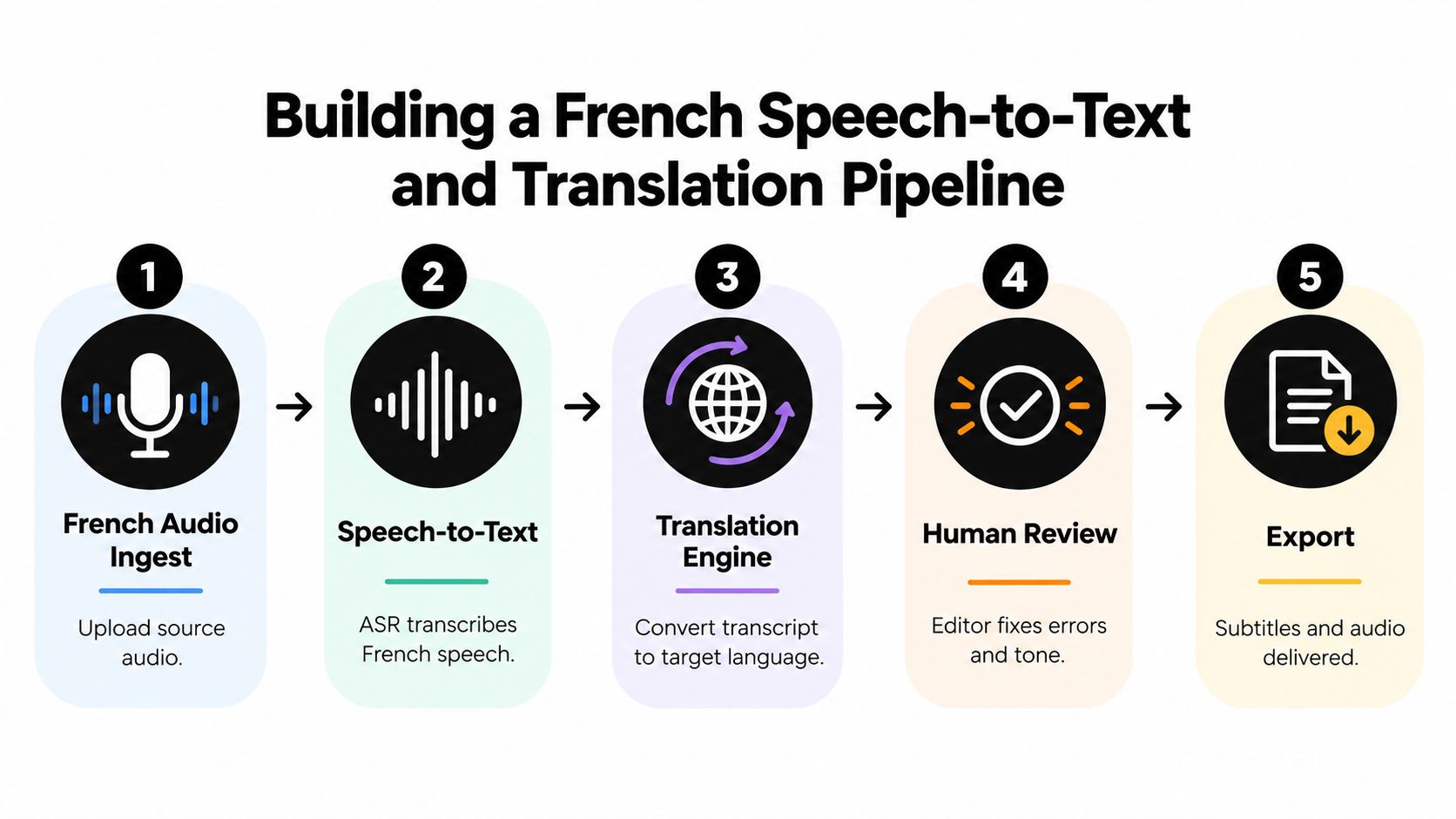
A French audio pipeline works best when each stage stays visible. Start with French ASR, move to machine translation, then add text-to-speech only if the project needs spoken output. That split makes it easier to see whether the failure came from recognition, translation, or synthesis.
Start with the transcript, not the voice
If the French transcript is wrong, the rest of the chain has little to work with. In practice, I measure word error rate at the ASR layer, then review translation quality on the text layer, then check the spoken output on its own. That separation is standard because it keeps recognition errors from getting mixed up with translation or synthesis problems (speech-to-speech benchmark methodology).
Production failures usually show up here first. A team will tune the translation, ship the voice, then discover later that the output sounds flat or the pacing drifts. The benchmark method splits translation quality from audio naturalness, speaker consistency, prosody, isochrony, isometry, and lip sync, which is a better model for real deployments than judging everything as one score (speech-to-speech benchmark methodology).
For a production-grade French ASR layer, see the Soniox speech AI platform as a reference for diarization and language detection.
Use a controlled prompt and terminology layer
For API-driven workflows, keep prompts short and specific.
- Source handling: preserve named entities, product names, and timestamps.
- Tone setting: formal, conversational, support-friendly, or promotional.
- Terminology lock: keep approved brand terms unchanged.
- Output format: subtitle text, plain transcript, or dubbed script.
That structure matters because French translation often breaks on terminology drift, not on basic comprehension. If the source uses one product term consistently, the output should do the same. Otherwise, reviewers spend time normalizing terms instead of improving the script.
Keep humans in the loop where speech quality matters
A hybrid pipeline does not mean manual review at every step. It means placing review checkpoints where the system is most likely to fail. For French, that usually means checking the transcript before translation on noisy audio, then reviewing the adapted script before final voice generation. Once the content becomes spoken output, the risks shift from wording alone to pacing, emotion, and voice fit.
Useful rule: optimize translation quality and speech quality separately. A clean transcript can still produce a wooden dub.
Research on French speech translation shows why that separation matters. LeBenchmark's French speech benchmark covers 2,933 hours across read, broadcast, spontaneous, telephone, and emotional speech, while its speech-translation portion uses smaller French source pairs into English, Portuguese, and Spanish with different training sizes for each direction (LeBenchmark data). The practical lesson is simple. Validate on mixed domains, not only clean reads.
Tooling options for this stage are covered in the WhisperAI.com section below.
A good pipeline does not hide errors. It surfaces them early enough that a human can fix the right layer instead of reworking the whole project.
How WhisperAI.com Can Help
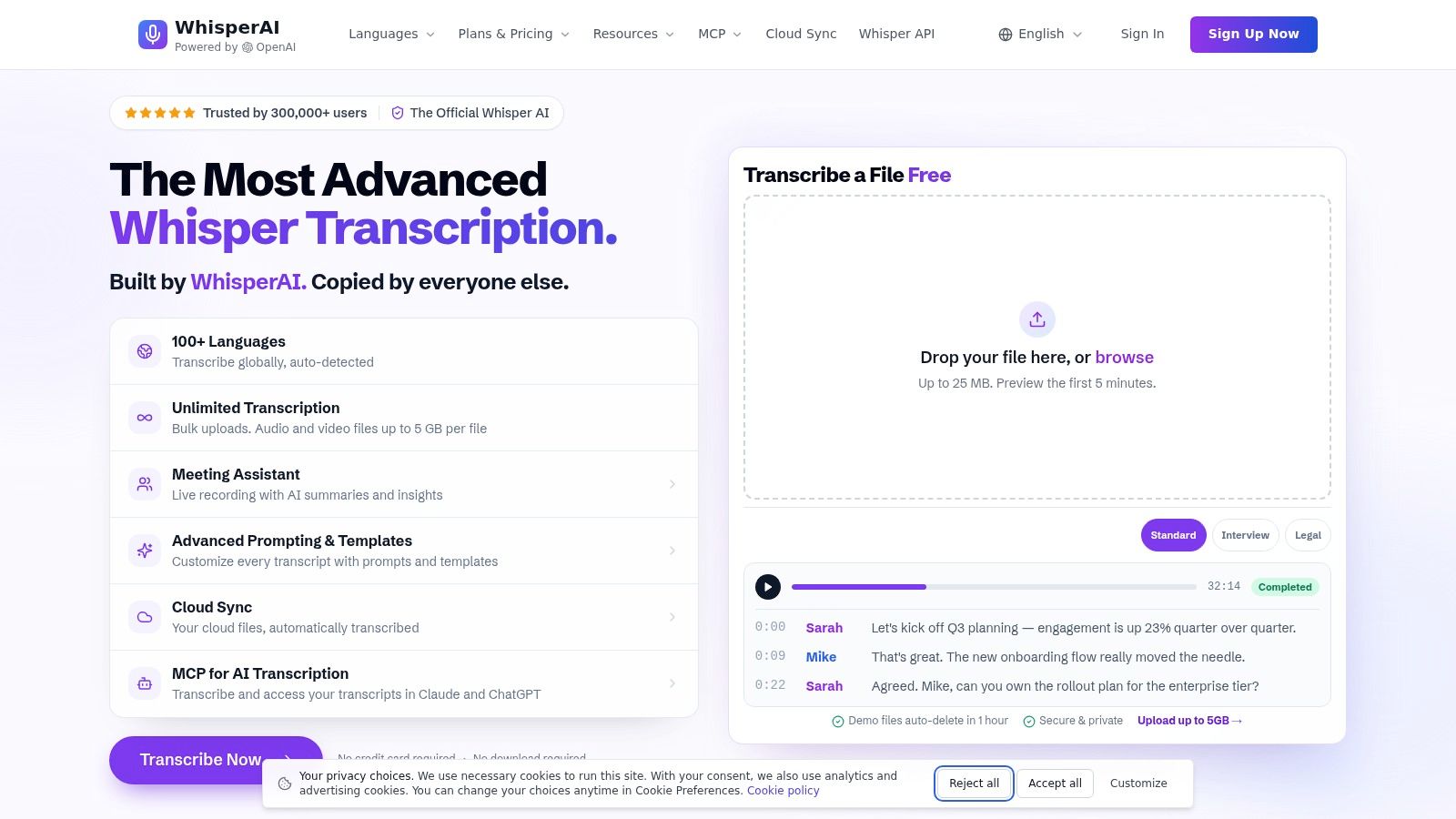
WhisperAI.com is useful when the work starts as audio, not text. It handles uploaded audio and video, live recording, multilingual transcription, translation, speaker labeling, and exports for subtitles and documents. That makes it a fit for teams that need one workflow for meetings, interviews, support calls, webinars, or launch recordings.
For French audio translation, the strongest benefit is workflow consolidation. Instead of using one tool for transcription, another for translation, and a third for subtitle export, you can keep the transcript, the translated text, and the timed delivery assets aligned in one editor. That matters when a French project has multiple speakers or needs accurate subtitles that still sync to the source file.
The decision point is simple. Use it when speed, traceability, and structured outputs matter more than studio-grade dubbing. Use something more editorial when the final voice performance is part of the brand promise. For anyone comparing practical localization tools, the platform page on WhisperAI.com shows how it handles real files, live sessions, and export formats without pushing the user through a manual transcription workflow.
Quality Assurance Practices That Protect French Audio Projects
French QA fails in predictable ways, so the review process has to be systematic, not ad hoc. The first check is whether the transcript and translation were built on the right kind of French. Read speech, broadcast speech, spontaneous speech, telephone speech, and emotional speech do not behave the same way, and a model trained on one can stumble on another.
Build separate checks for each layer
A reliable QA pass should inspect the transcript, the translation, and the voice output separately. On the transcript side, listen for dropped names, clipped function words, and misread numbers. On the translation side, read the French aloud and check whether the cadence matches natural speech. On the generated audio side, listen for pacing, awkward pauses, and a voice that sounds detached from the message.
That split matters because the failure modes are different. Recent unified speech-to-speech evaluation treats French as one of several languages and measures multiple dimensions separately, since translation quality and speech quality do not always move together (speech-to-speech benchmark methodology). If you only inspect the text, synthesis artifacts can slip through and make the final asset feel robotic.
Use the right benchmark mindset
French ASR accuracy should be tested against messy audio, not only clean read corpora. A recognizer can look solid on polished input and still struggle with spontaneous speech or telephone audio, which is how a pipeline passes internal tests and breaks in production. A practical benchmark set should include at least one broadcast-like source and one conversational source.
Synthetic data needs the same discipline. As the LeBenchmark speech-translation experiments report, gains reversed once the synthetic set exceeded 100,000 utterances (LeBenchmark speech translation data). The point is not the exact threshold. It is that more synthetic data can start to reinforce bad patterns instead of cleaning them up.
Run listener tests before delivery
A French listener test should ask three questions. Does the terminology sound right, does the tone fit the use case, and does the voice feel natural at normal listening speed? Those checks catch most release-breaking issues faster than a generic “does this sound okay” review.
Practical checkpoint: if a French reviewer laughs at a line that was meant to sound serious, the script is not ready.
Short feedback loops matter more than large review meetings. Save the approved terminology, record recurring ASR errors, and reuse correction patterns across future projects. That makes each French project cheaper to clean up than the one before it.
Final Delivery Formats, Subtitles, and Realistic Turnaround Expectations
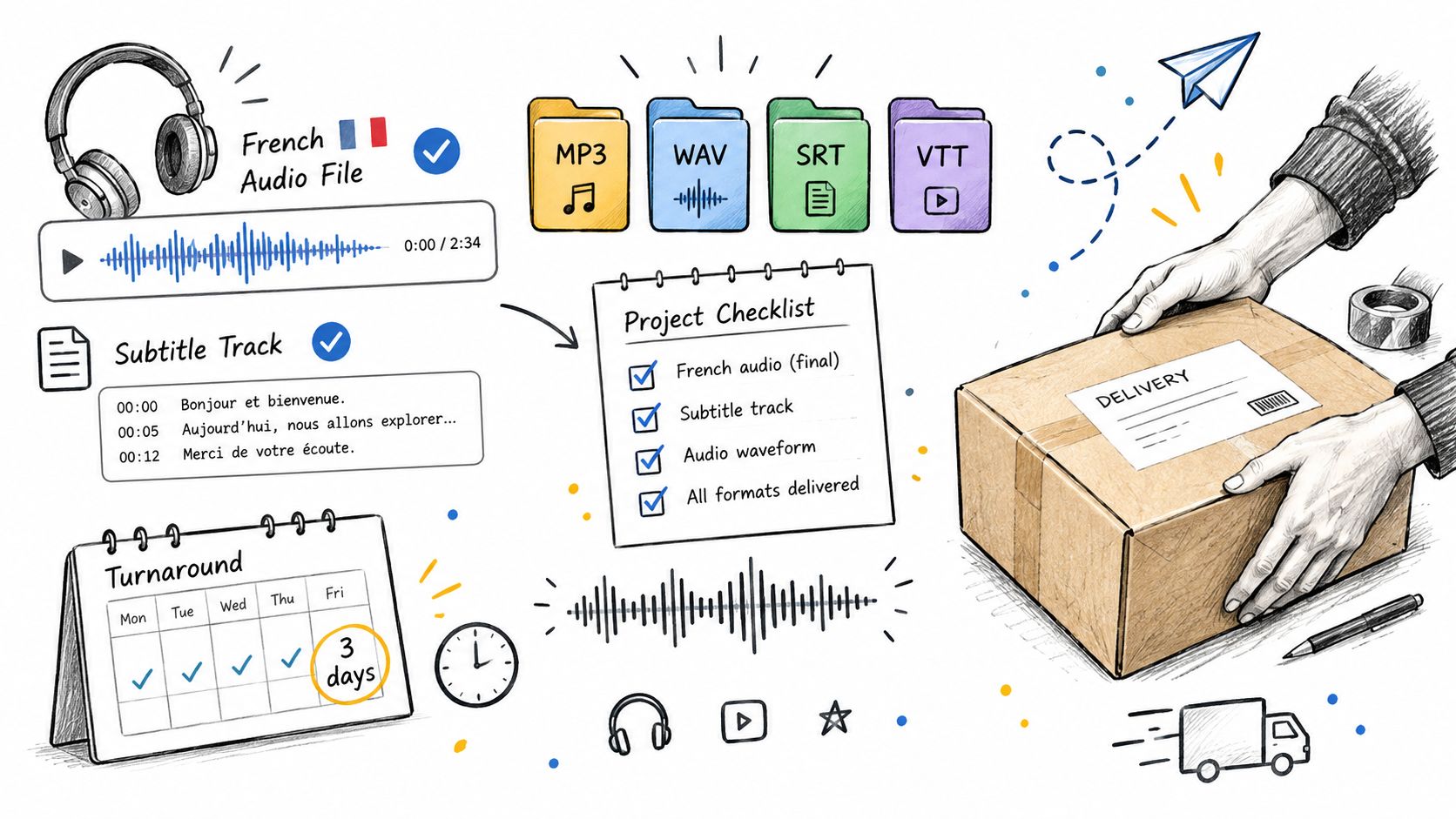
The last mile is where otherwise solid French audio projects get damaged. A project can sound right in review and still fail if the export format is wrong, the subtitles drift, or the delivery package doesn't match the platform. That's why format decisions should be made before recording or translation starts, not after.
Match the deliverable to the channel
If the content is going to YouTube or another video platform, SRT subtitles are usually the most portable output. If the project is a training asset or internal reference, TXT or DOCX may be enough. If it's part of a formal content package, PDF can help preserve review comments and approvals.
For longer productions, the question is whether to ship a mixed master or deliver separate stems. Mixed masters are easier for simple publishing. Stems give editors more control when they need to rebalance speech, music, or effects later. That's a production choice, not a translation choice, but it affects how usable the French asset will be downstream.
Agree on revision rules before the work starts
Revision cycles get expensive when nobody knows what counts as a correction. A terminology fix is not the same as a tone rewrite, and a subtitle timing adjustment is not the same as a full re-record. If those categories aren't defined early, the project turns into invisible scope creep.
That's also where tools with structured workflows help. A platform such as SubtitlesFast on Aura++ can be useful when the output needs clean subtitle packaging and project continuity rather than one-off file handling. The value is less about hype and more about keeping the delivery artifacts organized.
Check the final package before release
A quick pre-delivery checklist should cover:
- Audio levels: consistent enough that the French version doesn't sound quieter than the source.
- Subtitle sync: lines appear and disappear at a natural pace.
- Terminology consistency: product names and key phrases match the approved glossary.
- Platform fit: file type and length match the destination system.
Automated pipelines can return fast, but full editorial dubbing still takes longer because people are making judgment calls on adaptation, casting, and mix quality. That's not a weakness. It's the price of sounding intentional.
Putting It All Together with a Practical French Audio Workflow
A sane French audio workflow starts with the question nobody likes to ask upfront, who needs to trust this content? Internal training materials can usually live with light automation and a quick human review. Customer-facing support assets need stronger terminology control and subtitle accuracy. Brand launches need the full hybrid treatment, and sometimes a fully human dub.
The cleanest way to manage that is to rank the project by risk before you touch the audio. If the content is low-stakes, automate aggressively and check for obvious errors. If the content is public, keep the machine draft but let a French editor approve the wording. If the voice itself carries the message, spend the extra time on performance.
That's the gap between AI dubbing hype and actual editorial quality. Audiences still respond to natural phrasing, believable timing, and a voice that fits the message. The technology is useful, but the judgment call still belongs to the team shipping the content.
Start small. Run one French asset through a hybrid pipeline, compare the machine-only version with the editor-led version, and keep notes on what broke. Then reuse the same glossary, review rules, and export settings on the next project so each release gets more predictable.
If you're planning a French launch, pick one file this week and localize it end to end, transcript, translation, review, and export. Measure what failed, keep the fixes, and build the next version on that evidence. That's how a small startup turns French audio translation from a scramble into a repeatable part of the launch process.