FinCEN received 15,417 Bank Secrecy Act reports from 841 financial institutions tied to more than $688 million in suspicious activity. That's the right place to start if you're asking how to mail a check. The issue isn't postage. The issue is that an unprotected check can be stolen, altered, copied, or signed by someone who never should've touched it. Mail theft-related check fraud is a security problem first, and a mailing problem second.
If you're cutting a check today, treat the envelope like a vulnerability, not a delivery method. Use the right ink, the right envelope, the right USPS handoff, and the right fallback plan if the payment disappears. If the amount matters, pay for proof. If the amount is small, keep it simple but don't get sloppy.
Table of Contents
- The Real Risk in Mailing a Check in 2026
- Preparing the Check and Endorsing It Correctly
- Choosing the Right USPS Service for the Dollar Amount
- How Check Supply Can Help
- Packaging and Drop-Off Habits That Reduce Theft
- What to Do When the Check Never Arrives
- Faster Alternatives Worth Considering First
- Quick Checklist and Common Questions
The Real Risk in Mailing a Check in 2026
The first mistake people often make is thinking the risk is delayed delivery. The primary risk is interception before the check reaches the payee. FinCEN's 2024 analysis tied mail theft-related check fraud to 15,417 BSA reports from 841 financial institutions, with more than $688 million in reported suspicious activity, and that's not a niche problem. It's large enough to change how anyone serious about payments should think about paper checks.
Once a thief gets the check, the fraud usually goes one of three ways. In FinCEN's analysis, 44% of stolen checks were altered and deposited, 26% were used as templates for counterfeit checks, and 20% were fraudulently signed and deposited. Those are the failure modes you're trying to block when you mail a check. The thief doesn't need your full banking profile. They need one envelope and enough time.
What the theft paths actually mean
Practical rule: If a check leaves your desk and you can't prove where it is, you're already exposed.
A stolen check that gets altered is usually the cheapest fraud path for the criminal because the account details already exist. A counterfeit template is worse operationally because it can be reused. A fraudulently signed deposit turns your own check into a weapon against you. In plain terms, the check's value can be extracted without ever forcing the criminal to “cash” it in the old-fashioned sense.
That's why the first defensive move is physical, not digital. Put outgoing mail in a secure mailbox, don't leave it visible, and use more protected delivery methods when the payment is meaningful. The other move is to stop treating the envelope as low stakes. It isn't. A thief doesn't care that you meant the payment to be ordinary.
| Failure Path | Share of Incidents | Typical Dollar Exposure | Primary Defense |
|---|---|---|---|
| Altered and deposited | 44% | Highest when amount and payee fields are changed | Conceal the check, use secure drop-off, and keep the handwriting hard to tamper with |
| Used as a counterfeit template | 26% | High, because the information can be reused | Limit what's visible, avoid exposed outgoing mail, and use trackable mailing for larger payments |
| Fraudulently signed and deposited | 20% | Medium to high, depending on recipient verification | Restrictive endorsement and proof of mailing |
If you want a broader privacy lens on payment handling, the internal policy side matters too, especially when checks contain names, addresses, and account details. See the privacy guidance for sensitive mailing workflows if your team handles more than one-off personal payments.
The takeaway is simple. Mailing a check is a fraud decision. Treat it that way, or you're handing a thief a ready-made payment instrument.
Preparing the Check and Endorsing It Correctly
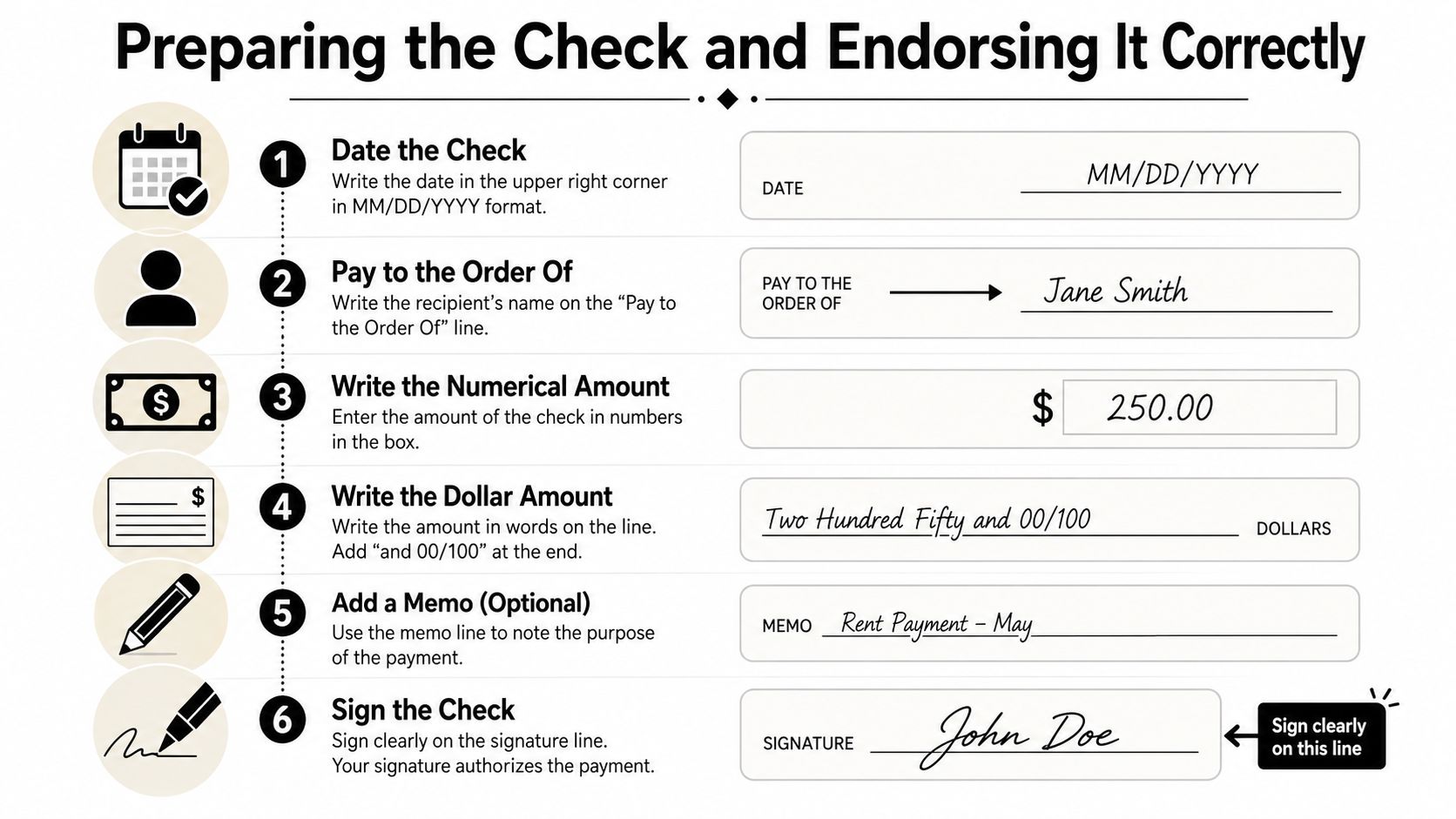
Start with the face of the check and fill it out cleanly. Use the date your bank will accept in a standard MM/DD/YYYY format, write the payee name exactly as intended, and make sure the numerical amount and written amount match. Banks and automated systems look for consistency first, not creativity. If those fields conflict, you've created avoidable friction before the envelope even leaves your desk.
Use blue or black ink, not pencil, not erasable ink, and not a light pen that disappears under poor scanning. Keep stray marks out of the amount box and don't crowd the signature line. A signature that drifts too far off the baseline is sloppy at best and a rejection risk at worst. If you're writing a check from a business account, don't rush it. Messy checks create processing work, and processing work creates delays.
Get the back of the check right
The endorsement block matters because it limits what a thief can do if the check is intercepted. A blank endorsement gives the least protection. A restrictive endorsement is better, because it tells the bank how the item should be handled. If the payee is your own account, write “For deposit only to account of [payee]” on the back and keep it tight. That doesn't make theft impossible, but it narrows the fraud options.
A mobile deposit endorsement is different from a restrictive one, and you should not improvise the language unless you know your bank's requirements. Keep the endorsement neat and in the space the bank expects. If the back is crowded or messy, you're creating an unnecessary dispute point if the check is later altered.
Before sealing the envelope, make a photo copy of the front and back. That's the evidence you'll need if the amount or payee is changed later. It takes seconds and it's the easiest proof you'll ever create.
A clean check is harder to dispute, easier to trace, and less useful to a thief.
A last practical note. Don't overfill the memo line with sensitive detail. Write enough for your own records, then stop. The point is payment identification, not broadcasting the reason for the transfer.
Choosing the Right USPS Service for the Dollar Amount
Many overpay for the wrong thing or underpay for the right thing. If the payment is small, don't waste money on premium mail just to feel better. If the payment is meaningful, don't use plain First Class and hope. The right USPS choice depends on value, urgency, and how much proof you'd want if the check disappears.
The internal pricing guide for direct mail is useful if you're comparing postage and fulfillment options at a broader level. For a check specifically, though, the service choice comes down to chain of custody, not branding. That's why the direct mail pricing reference is only a starting point, not the decision itself.
What to buy and what to skip
| USPS Service | Approx. Cost | Proof of Mailing | Proof of Delivery | Recommended Threshold |
|---|---|---|---|---|
| First Class | Lowest-cost option | No formal chain-of-custody proof | Limited | Under $500 when the recipient is routine and low risk |
| Certified Mail with Return Receipt | Adds paid proof features | Barcode-based evidence using PS Form 3800 | Return Receipt uses PS Form 3811 | $500 to $5,000 when the payment needs proof |
| Registered Mail | Highest-protection USPS option | Strongest custody trail | Stronger handling documentation | Above $5,000 or any check you absolutely can't afford to lose |
Return Receipt without Certified Mail is a vanity add-on. Don't buy it just to feel safer. It doesn't solve the core problem unless you also have the mailing proof that matters. Certified Mail alone proves the item entered the system, but it doesn't guarantee the right person signed for it. If you need more than that, step up properly.
For routine payments, First Class in a plain envelope is fine when the amount is modest and the recipient is trustworthy. For midrange payments, Certified Mail with Return Receipt is the sensible default. For larger checks, use Registered Mail or stop pretending the mail channel is the right tool and use a courier.
The straightforward guideline is clear. If the amount is significant to your business, secure proof. If it isn't, avoid embellishing the envelope with costly add-ons that don't alter the actual risk.
How Check Supply Can Help
If you need to send a physical check but don't want to handle printing, envelopes, stamps, or a post office run, Check Supply is one practical option. It's a mobile and web app that prints and mails physical checks to U.S. addresses, connects to bank accounts through Plaid, and supports personal and business payments like rent, vendor invoices, reimbursements, and tax payments.
It offers mailing tiers that map to speed and tracking, including First-Class (5-day) high-security check for $6.99, Certified Mail (5-day) with USPS tracking for $12.99, Priority Mail (3-day) with tracking for $21.95, and Priority Mail Express (approximately 2-day) with tracking for $49.99. It also includes a Checkbook bundle with 12 business checks for $69.99, which works out to $5.83 each. For teams that need physical checks but hate the manual admin, that's the main appeal.
The service also gives you real-time status, email notifications from printing through USPS handoff, scheduling for arrival windows, recurring payments, and same-business-day processing for submissions before 3 PM EST. If you're comparing options and want a vendor that handles the mechanics, you can review how to mail a check online with Check Supply as one reference point.
The right use case is simple. If you need a mailed check, want tracking or certified options, and don't want to manage the physical workflow yourself, a service like this can save time and reduce handling mistakes. If you're only sending one low-value check and already have a printer and envelopes, don't add complexity you don't need.
Packaging and Drop-Off Habits That Reduce Theft
The envelope is where most check fraud starts, so the handling has to be deliberate. Don't use a transparent or glossy envelope. Use a non-glare window envelope or a plain #10 envelope with the address printed cleanly, and keep the check concealed inside a blank sheet of paper. Fold it so the amount and memo information face inward. You're not trying to make the mail pretty. You're trying to make it useless to anyone who shouldn't see it.
Use blue or black gel ink on the check and for the address if you're handwriting. Gel ink resists washing better than weak ballpoint ink, and it's less forgiving to thieves who try to alter the item. Don't mail cash, gift cards, or a second check in the same envelope. You're adding unnecessary loss exposure to one piece of mail.
Practical rule: Hand the envelope to a postal clerk or use an official collection point during posted pickup hours. Don't drop a meaningful payment into an unlocked residential mailbox and walk away.
The drop-off point matters as much as the stationery. A blue USPS box is fine only when you know pickup hasn't already happened. A post office counter is better because it removes the uncertainty. If you're traveling, use USPS Hold Mail. If you're at home and the outgoing envelope is sitting overnight in a personal mailbox, you're asking for trouble.
A simple checklist keeps this tight:
- Use concealed packaging: Hide the check inside a blank sheet of paper.
- Seal it firmly: Press the flap all the way down.
- Choose a secure handoff: Use a post office counter or official USPS collection point.
- Photograph both sides: Keep evidence before sealing.
- Keep mail moving: Don't leave outgoing checks exposed overnight.
The video below is a good reminder of how thieves exploit weak mailing habits.
If the check still hasn't cleared after a few business days, don't sit on it. Confirm the address, check your copy, and escalate fast if the amount matters. Waiting politely is not a strategy when the mail can be intercepted and altered.
What to Do When the Check Never Arrives
Start with the obvious. Confirm the check number, date, amount, and mailing address against your own records before you accuse the mail system of anything. Then call the recipient and verify the address one more time. A surprising number of “lost” checks are really misaddressed checks, and you don't want to burn time on the wrong problem.
If the item still doesn't show up, escalate based on value. For a modest payment, you can wait a bit longer, but once the amount matters, act like the check is compromised until proven otherwise. A 2025 consumer finance explainer says mailed checks typically take two to five business days, and if the check doesn't arrive, the practical next step is to confirm mailing details and then request a stop payment and reissue or switch to direct deposit.
Escalation by value
- Under $500: Reconfirm the address and consider replacement before paying for a formal stop.
- $500 to $2,500: Issue a stop payment the same day you confirm non-delivery.
- Above $2,500: Consider closing the account and opening a new one if the facts point to theft rather than a simple delay.
That last step sounds aggressive because it is. Stolen checks are commonly altered or washed, not cashed as written. If the amount is large enough to hurt, don't keep a vulnerable account open longer than necessary.
For mailed items that never arrive, USPS can only help if you ask. File a Missing Mail search after the check has had enough time to plausibly arrive. If the payment is meaningful, don't wait around for a perfect timeline. Contact your bank, request a fraud affidavit if needed, and ask for a check tracer or image from the recipient's bank. If theft is credible, report it to postal authorities. Local police make sense only when you have a real theft record, not as the first move.
| Action | When to Use It | What It Gives You |
|---|---|---|
| Wait and verify | First sign of delay | Confirms whether the issue is simple misrouting |
| Stop payment | Once non-delivery is confirmed and the amount matters | Blocks payment if the item resurfaces |
| Reissue | After the original item is treated as compromised | Keeps the business relationship moving |
| Fraud affidavit and tracer | When theft or alteration is likely | Creates a paper trail with the bank |
Faster Alternatives Worth Considering First
Paper checks still exist because some payees insist on them, but they're rarely the best default. If you're sending money inside the U.S., ACH through your bank's bill-pay is the cleanest substitute for a mailed check. It usually settles in one to two business days, and in normal domestic use it beats First Class mail on both speed and operational control. If your accounting platform has an ACH or vendor-payment feature, start there.
Zelle is faster still, usually moving in minutes, but that speed comes with practical limits. It's good for smaller transfers between known parties, not for every business payment. Don't use it for an amount you can't mentally afford to send in a hurry, because the consumer protections and reversal behavior aren't built like a bank check.
Wires are the right tool when the payment is time-sensitive, high-value, or cross-border and the fee is justified. That's the whole argument for wires. They're not for routine vendor spend or recurring rent. Use them when the risk of delay outweighs the cost. Card payments fit different problems, mainly where the payee accepts them and you need the convenience of a card rail.
| Method | Typical Settlement | Sender Cost | Fraud / Reversal Risk | Best Use Case |
|---|---|---|---|---|
| Check | Days by mail plus bank processing | Low to moderate | High if mailed poorly | Rent, legacy payees, proof-sensitive settlement |
| ACH | One to two business days | Often low or no cost | Lower than mailed paper | Routine domestic payments |
| Zelle | Minutes | Usually low | Limited reversal room | Small, trusted transfers |
| Wire | Same day or very fast | Higher fee | Low reversal flexibility | High-value, urgent, or cross-border payments |
| Card | Fast authorization | Merchant fees apply | Depends on dispute rules | Purchases and services that accept cards |
The honest verdict is simple. Paper checks still make sense for landlords who refuse to enroll in electronic systems, for settlement payments where someone wants a canceled instrument, and for cases where you don't have a U.S. bank account. For everything else, use your bank's bill-pay, your accounting platform's ACH feature, or a vendor-payment tool like the one in your finance stack. If you're still reaching for a stamp by habit, you're probably using the wrong rail.
Quick Checklist and Common Questions
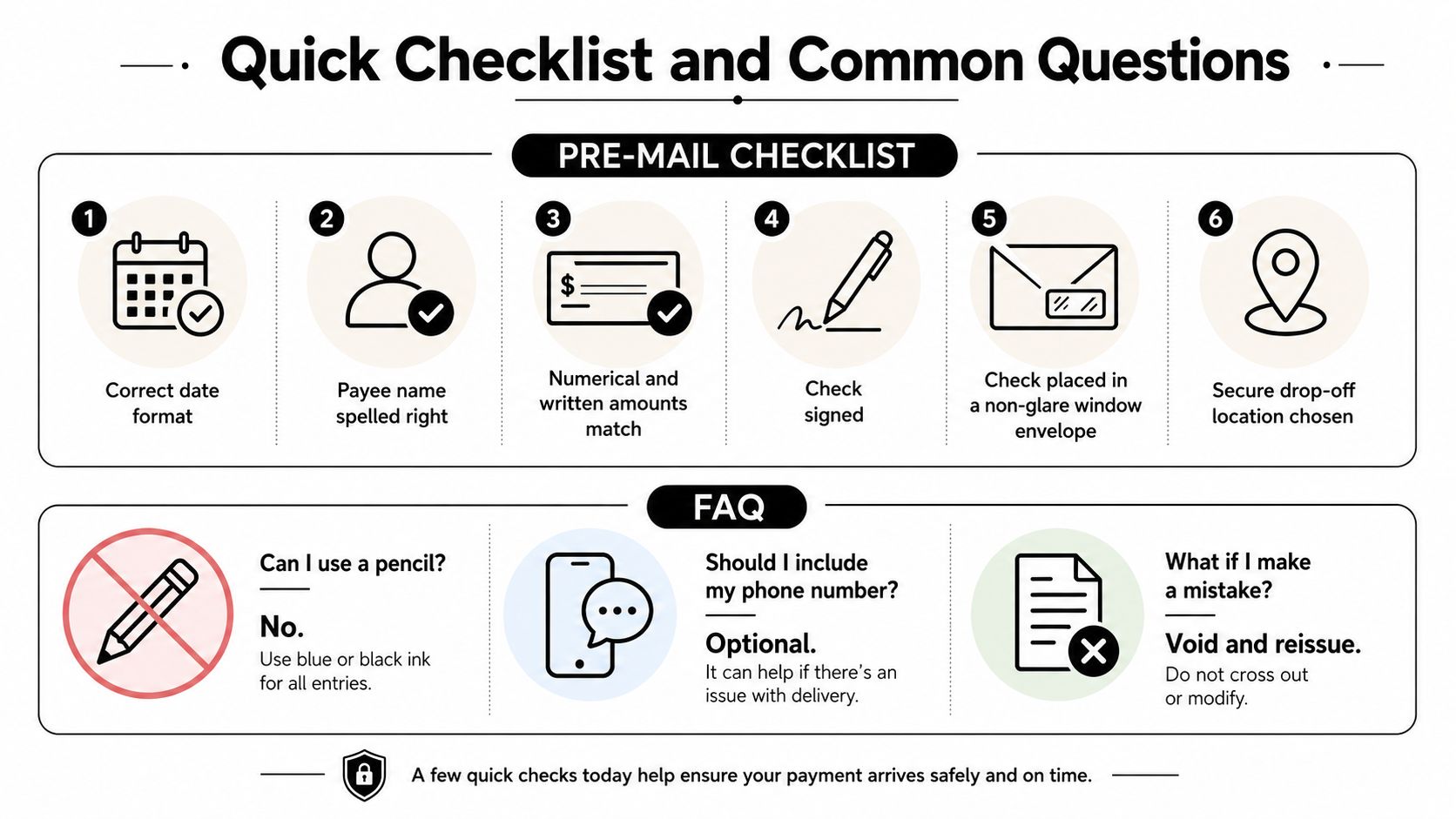
Pre-mail checklist
- Date the check clearly.
- Spell the payee name exactly right.
- Match the written amount and numeric amount.
- Sign the check in blue or black ink.
- Add a restrictive endorsement if needed.
- Photograph the front and back.
- Seal the check in a non-glare envelope.
- Choose a secure drop-off point.
- Use Certified Mail or Registered Mail when the value justifies it.
- Track the delivery if you paid for tracking.
Common questions
How long should a mailed check take to clear?
The mail itself can take a few business days, and the bank's posting time is separate. A sensible planning window is two to five business days for delivery, then whatever your bank and the payee's bank need after that. If the item is late enough to worry you, treat it as a problem, not a delay.
Should I use a stamp or metered mail?
Use whatever gets the item into the safest mailing channel without adding friction. A stamp is fine for ordinary checks. If you need tracking or a proof trail, pay for the USPS service that gives you custody evidence, not a fancier stamp.
Can I mail cash through USPS?
Don't. Cash has none of the traceability, cancellation, or recovery structure you want. If the payment is small and urgent, use an electronic option. If the recipient insists on paper, send a check instead.
What if I make a mistake on the check?
Void it and reissue it. Don't try to fix a messy item with marginal edits. That's how you create a dispute later.
Should I mail checks internationally?
No, not unless you've exhausted other options and understand the bank and postal risks. Cross-border paper payments are the wrong default in almost every case.
If you're sending checks regularly, stop doing it manually. Build a standard process, use a secure payment rail first, and reserve paper for the situations where it makes sense. If you need to send one today, do it cleanly, choose the right USPS service, and keep proof of everything you sent.